


B2B online marketing has transformed from simple website presence to sophisticated, multi-channel strategies that demand precision, personalization, and measurable returns. The landscape in 2026 requires businesses to balance automation with human insight, data-driven decisions with creative execution, and broad reach with targeted precision. Understanding how to navigate this complexity separates companies that generate consistent revenue from those struggling with inconsistent results.
Understanding the B2B Online Marketing Landscape
The fundamental difference between B2B and B2C marketing lies in complexity, stakeholder involvement, and decision timelines. B2B online marketing addresses longer sales cycles, multiple decision makers, and higher transaction values that require sustained engagement across numerous touchpoints.
Recent research shows significant shifts in buyer behavior. Forrester’s B2B predictions indicate that buyers increasingly prefer digital self-serve options, with 74% of B2B buyers conducting more than half their research independently before engaging with sales teams. This shift places enormous pressure on marketing teams to deliver educational, valuable content at every stage of the buyer journey.
The Multi-Channel Reality
Modern B2B buyers don't follow linear paths. They research on LinkedIn, read industry blogs, attend webinars, download whitepapers, and engage with paid content across multiple sessions before making contact. Your b2b online marketing strategy must acknowledge this reality by creating integrated campaigns that work cohesively across channels.
Key channels that matter in 2026:
- LinkedIn for professional targeting and thought leadership
- Google Search for intent-based discovery
- Industry publications and content syndication platforms
- Email marketing for nurturing and relationship building
- YouTube for educational content and product demonstrations
- Webinars and virtual events for deeper engagement
The mistake many businesses make is treating these channels as isolated efforts. Successful b2b online marketing connects these touchpoints into a coherent narrative that guides prospects from awareness to decision.

Content Marketing as Your Foundation
Content Marketing Institute research reveals that 73% of successful B2B organizations have a documented content strategy. Content serves as the engine that powers virtually every other b2b online marketing channel, from organic search to paid advertising to social media engagement.
The challenge isn't creating content. It's creating content that addresses specific pain points, answers technical questions, and builds confidence throughout extended decision processes. Generic blog posts and surface-level advice no longer cut through the noise.
Strategic Content Types That Convert
Different content formats serve different purposes in the B2B journey. Understanding when and how to deploy each type dramatically improves campaign performance.
| Content Type | Primary Purpose | Best Stage | Average Engagement |
|---|---|---|---|
| Blog Posts | SEO, awareness, education | Early awareness | 2-4 minutes |
| Whitepapers | Deep expertise, lead generation | Mid-consideration | 15-25 minutes |
| Case Studies | Proof, validation | Late consideration | 8-12 minutes |
| Webinars | Engagement, qualification | Consideration to decision | 45-60 minutes |
| Video Tutorials | Product education | Decision to retention | 5-15 minutes |
The data tells a clear story. According to NetLine’s B2B content consumption report, whitepapers and research reports continue to generate the highest quality leads, while video content sees the fastest growth in consumption rates.
At Intoact, we've observed that businesses combining educational content with practical tools see significantly higher engagement. Our approach through digital content marketing focuses on creating assets that serve immediate needs while building long-term authority.
Paid Advertising for B2B Growth
Organic reach and content marketing build foundations, but paid advertising accelerates results and targets specific accounts or personas with precision. B2B online marketing in 2026 demands sophisticated paid strategies that go beyond basic demographic targeting.
LinkedIn Advertising Strategy
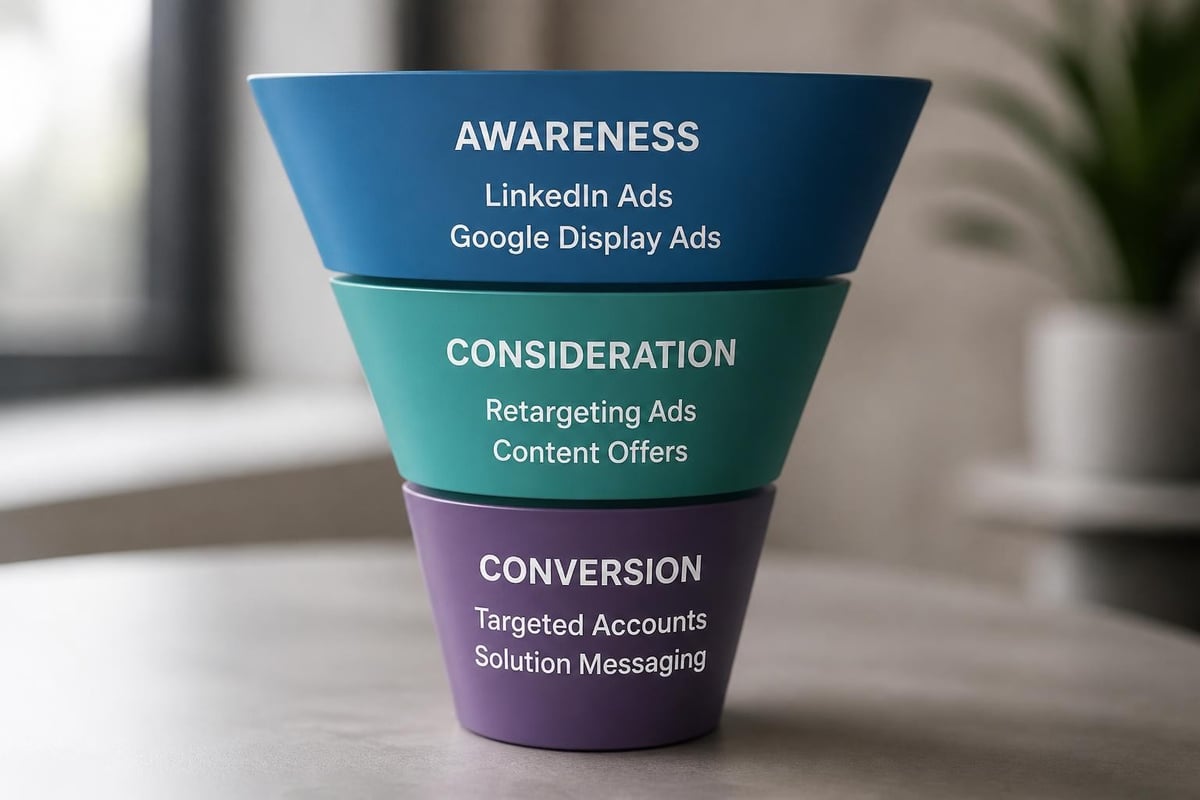
LinkedIn remains the dominant platform for B2B paid advertising, offering unmatched targeting based on job titles, company size, industries, and professional interests. LinkedIn’s B2B Marketing Benchmark shows that campaigns focusing on mid-funnel content see 2.5x higher conversion rates than top-of-funnel awareness plays.
Effective LinkedIn campaign structures:
- Awareness campaigns targeting broad professional audiences with thought leadership content
- Consideration campaigns retargeting engaged users with deeper resources like webinars or guides
- Conversion campaigns targeting qualified accounts with demo offers or consultation requests
- Retention campaigns engaging existing customers with product updates and expansion opportunities
The key to LinkedIn success lies in audience segmentation and creative testing. Generic messaging underperforms dramatically compared to role-specific content that speaks directly to individual pain points.
Google Ads for Intent-Based Capture
While LinkedIn excels at proactive targeting, Google Ads captures active intent. When prospects search for solutions, your b2b online marketing presence must appear with relevant, compelling offers.
Search campaigns require meticulous keyword research focusing on commercial and transactional intent. Broad awareness keywords drain budgets without generating qualified leads. Instead, target specific solution searches, comparison queries, and problem-statement keywords that indicate active buying processes.
For businesses looking to master these platforms, comprehensive training that covers campaign structure, targeting strategy, and optimization techniques becomes essential. Programs like the Meta & TikTok Ads Course provide hands-on experience building, managing, and optimizing paid campaigns with real business applications.

Search Engine Optimization for Sustainable Visibility
SEO remains one of the highest ROI channels for b2b online marketing, delivering compounding returns as authority builds over time. Unlike paid advertising that stops generating results when budgets pause, organic rankings continue driving traffic and leads indefinitely.
Technical excellence, content depth, and authoritative backlinks form the three pillars of effective B2B SEO strategy. Each requires sustained attention and expertise to execute properly.
Technical SEO Foundations
Search engines can't rank what they can't properly crawl and understand. Technical issues like slow loading speeds, mobile responsiveness problems, broken internal links, and poor site architecture undermine even exceptional content.
Critical technical elements:
- Page speed optimization for sub-2-second load times
- Mobile-first responsive design
- Proper XML sitemap structure and submission
- Clean URL hierarchies that reflect content organization
- Schema markup for enhanced search result displays
- Secure HTTPS implementation across all pages
Many businesses overlook these fundamentals, focusing exclusively on content creation while technical debt accumulates. A comprehensive SEO audit identifies these issues before they impact rankings and traffic.
Content Depth and Topical Authority
Google's algorithms increasingly reward comprehensive coverage of topics rather than isolated keyword-optimized pages. Building topical authority means creating interconnected content clusters that thoroughly address subject areas relevant to your B2B audience.
This approach requires strategic planning. Identify core topics central to your business value proposition. Create comprehensive pillar content that covers these topics broadly. Then develop supporting content that addresses specific subtopics, questions, and use cases in depth.
Internal linking between related content pieces signals topical relationships to search engines while helping users discover relevant information. Strategic anchor text that describes linked content improves both user experience and SEO performance.
For businesses serious about long-term visibility, professional SEO services that incorporate traditional optimization, Answer Engine Optimization (AEO), and Generative Engine Optimization (GEO) ensure presence across evolving search landscapes.
Lead Generation and Conversion Optimization
Traffic and visibility mean nothing without conversion mechanisms that capture and qualify leads. Effective b2b online marketing balances audience building with systematic lead generation and nurturing.
Strategic Lead Magnets
Generic newsletter signups generate low-quality contacts with minimal purchase intent. Valuable lead magnets that address specific challenges attract engaged prospects actively seeking solutions.
| Lead Magnet Type | Typical Conversion Rate | Lead Quality | Best Use Case |
|---|---|---|---|
| Whitepapers | 8-15% | High | Technical decision makers |
| Templates/Tools | 15-25% | Medium-High | Practitioners seeking efficiency |
| Webinar Registration | 12-20% | High | Solution evaluation stage |
| Calculator/Assessment | 20-35% | Medium | Early awareness/research |
| Case Studies | 5-10% | Very High | Final decision stage |
Conversion rates vary significantly based on traffic source, audience qualification, and offer relevance. Testing different lead magnets against specific audience segments reveals which formats resonate most effectively.

Nurture Sequences That Build Trust
Most B2B leads aren't ready to purchase immediately. Nurture sequences maintain engagement, build credibility, and provide value while prospects move through buying processes at their own pace.
Effective nurture programs segment contacts based on behaviors, interests, and engagement levels. Someone who downloaded an introductory guide receives different content than someone who attended a product webinar or requested pricing information.
Key nurture sequence elements:
- Immediate value delivery confirming the lead magnet choice
- Educational content addressing common questions and objections
- Social proof through case studies and testimonials
- Product or service education highlighting differentiation
- Clear calls to action for next-step conversations
Automation handles delivery, but personalization drives results. Dynamic content that references specific downloads, behaviors, or company characteristics significantly outperforms generic messaging.
Analytics and Performance Measurement
B2B online marketing without rigorous measurement wastes resources on ineffective tactics while missing optimization opportunities. Establishing clear metrics, tracking systems, and reporting processes enables continuous improvement.
Metrics That Actually Matter
Vanity metrics like page views and social media followers rarely correlate with business outcomes. Focus instead on metrics directly tied to revenue generation and customer acquisition.
Essential B2B marketing metrics:
- Cost per lead (CPL) across channels and campaigns
- Lead-to-opportunity conversion rate showing marketing quality
- Customer acquisition cost (CAC) including all marketing spend
- Marketing-qualified lead (MQL) volume and trends
- Return on ad spend (ROAS) for paid campaigns
- Pipeline contribution showing marketing's revenue impact
- Content engagement metrics predicting conversion likelihood
These metrics require proper tracking implementation. UTM parameters on all campaign URLs, conversion tracking pixels on key pages, and CRM integration that connects marketing activities to sales outcomes provide the data foundation for intelligent decisions.
Attribution and Multi-Touch Analysis
Single-touch attribution models that credit only first or last interactions dramatically misrepresent b2b online marketing effectiveness. B2B buyers interact with multiple touchpoints across extended timeframes before converting.
Multi-touch attribution models distribute credit across the customer journey, revealing which channels and content pieces contribute most significantly to conversions. This understanding guides budget allocation and content strategy far more effectively than last-click models that ignore nurturing touchpoints.
Many businesses struggle with attribution complexity. Working with experts who understand both the technical implementation and strategic interpretation of marketing data accelerates improvement. Performance management services that focus specifically on tracking, analysis, and optimization ensure marketing investments deliver measurable returns.
Account-Based Marketing Integration
Account-based marketing (ABM) represents the evolution of b2b online marketing from broad audience targeting to focused account engagement. Rather than casting wide nets, ABM identifies high-value target accounts and creates personalized campaigns designed specifically for those organizations.
This approach works exceptionally well for businesses with defined ideal customer profiles, high transaction values, and limited total addressable markets. Instead of generating thousands of low-quality leads, ABM generates dozens of highly qualified opportunities.
ABM Campaign Structure
Successful ABM campaigns require coordination between marketing and sales teams, alignment on target account lists, and customized content that addresses specific account characteristics and challenges.
Core ABM components:
- Account identification based on firmographic data, intent signals, and strategic fit
- Stakeholder mapping identifying key decision makers and influencers
- Personalized content addressing specific account pain points and opportunities
- Multi-channel engagement coordinating LinkedIn, email, direct mail, and advertising
- Sales coordination ensuring marketing activities support ongoing sales conversations
Technology platforms enable ABM execution at scale, matching website visitors to target accounts, personalizing content based on company data, and tracking account-level engagement across channels.
The combination of broad b2b online marketing strategies that build awareness and ABM tactics that convert high-value accounts creates powerful revenue generation systems. Neither approach alone maximizes potential, but integrated execution delivers exceptional results.
Emerging Technologies and AI Integration
Artificial intelligence fundamentally changes how businesses approach b2b online marketing, from content creation to campaign optimization to predictive analytics. Understanding how to leverage these tools while maintaining strategic oversight separates leaders from followers.
AI-Powered Content Creation
AI writing tools dramatically accelerate content production, helping teams create first drafts, generate variations, and optimize existing content for different audiences and channels. However, AI-generated content requires human editing, fact-checking, and strategic direction to maintain quality and accuracy.
The most effective approach uses AI for efficiency while preserving human expertise for strategy and refinement. AI helps scale content production to meet the volume demands of modern b2b online marketing without proportionally increasing team size.
For marketers looking to integrate AI effectively into their workflows, understanding both capabilities and limitations proves essential. Practical training that demonstrates real-world applications, common pitfalls, and optimization techniques ensures teams use these tools productively rather than creating low-quality content that damages brand reputation.
Predictive Analytics and Lead Scoring
Machine learning algorithms analyze historical data to predict which leads will most likely convert, which accounts show buying signals, and which content resonates with specific audience segments. These insights enable smarter resource allocation and more effective targeting.
Predictive lead scoring goes beyond traditional demographic and firmographic criteria, incorporating behavioral signals, engagement patterns, and similarity to previous customers. This sophistication improves sales efficiency by focusing efforts on genuinely qualified opportunities.
Implementation requires clean data, sufficient historical volume for model training, and ongoing refinement as markets and buyer behaviors evolve. Many businesses attempt DIY implementation and struggle with data quality issues or model accuracy. Expert guidance accelerates deployment and ensures predictive systems actually improve performance.
Building Internal Capabilities
Whether you execute b2b online marketing in-house, work with agencies, or use hybrid approaches, building internal knowledge and capabilities ensures strategic oversight and continuous improvement. Teams that understand fundamental principles make better decisions, spot opportunities faster, and adapt more effectively to market changes.
Training and Development
Marketing landscapes evolve constantly. Platforms update algorithms, new channels emerge, buyer behaviors shift, and technologies introduce new possibilities. Teams that invest in continuous learning maintain competitive advantages.
Comprehensive training programs that cover digital strategy, channel execution, analytics, and emerging technologies provide foundations for effective marketing organizations. These programs work best when they combine theoretical knowledge with practical application, allowing teams to immediately implement what they learn.
The challenge many businesses face is finding training that addresses both strategic thinking and tactical execution while remaining relevant to specific business contexts. Generic courses teach concepts without practical application, while overly tactical training lacks strategic frameworks.
Successful b2b online marketing requires strategic thinking, tactical excellence, and continuous optimization across multiple channels and touchpoints. The businesses that thrive combine strong foundations in SEO, content marketing, and paid advertising with sophisticated approaches to measurement, attribution, and conversion optimization. Whether you're building internal capabilities, optimizing existing campaigns, or developing comprehensive strategies, expert guidance accelerates results and avoids costly mistakes. Intoact offers specialized training, consulting, and performance management services designed specifically for businesses seeking measurable marketing ROI through digital channels and AI-powered optimization.


