


Choosing the best course of digital marketing requires more than browsing through online reviews or picking the platform with the most followers. The landscape has shifted dramatically in 2026, with AI integration, privacy regulations, and performance measurement reshaping what marketers need to know. Whether you're a business owner looking to understand your marketing spend, a professional pivoting into digital, or a marketer upgrading your skills, the right program should deliver practical, measurable results that translate directly into campaign performance and business growth.
What Makes a Digital Marketing Course Worth Your Investment
The best course of digital marketing balances three critical elements: comprehensive curriculum coverage, hands-on practical application, and recognized credentials that employers or clients actually value. Many programs excel at one or two of these factors but fall short on the third.
Curriculum Depth and Breadth
A complete digital marketing education needs to cover the full ecosystem of channels, platforms, and strategies. This includes:
- Search Engine Optimization (SEO) and Answer Engine Optimization (AEO) for visibility across traditional and AI-powered search
- Paid advertising across Google Ads, Meta platforms, TikTok, and emerging channels
- Content strategy and creation using both traditional methods and AI tools
- Analytics and measurement with GA4, conversion tracking, and attribution modeling
- Social media marketing with platform-specific tactics and community management
- Email marketing and marketing automation workflows
- Strategic planning including customer journey mapping and integrated campaigns
The Fundamentals of Digital Marketing course from Google provides a solid foundation for beginners, though professionals typically need more advanced, hands-on training to manage real campaigns. According to research from the Content Marketing Institute, 73% of B2B marketers say they need more advanced training in content strategy and measurement, not just basic concepts.

Practical Application Over Theory
Theory without practice creates a dangerous gap. The best course of digital marketing should require you to build actual campaigns, analyze real data, and make optimization decisions under constraints similar to what you'll face in the workplace.
Look for programs that include:
- Live campaign projects where you set up and manage real ad accounts
- Analytics exercises using actual GA4 properties and conversion data
- SEO audits performed on live websites with actionable recommendations
- Content creation assignments that incorporate AI tools alongside traditional research
- Performance reporting with stakeholder presentations and ROI justification
Boston University’s Digital Marketing Essentials program exemplifies this practical focus, requiring students to execute campaigns and defend their strategic decisions with data.
Credentials That Open Doors
Certification matters, but the issuing organization and industry recognition determine whether a credential strengthens your resume or collects digital dust. In 2026, employers and clients value certifications that demonstrate platform-specific expertise (Google Ads, Meta Blueprint) combined with strategic thinking and measurement capabilities.
University-backed programs like Coursera’s Digital Marketing Specialization from the University of Illinois carry academic weight, while industry certifications prove hands-on platform competency. The ideal combination includes both strategic credentials and tactical platform qualifications.
Comparing Top Digital Marketing Course Formats
Different learning formats serve different needs, schedules, and learning styles. Understanding the trade-offs helps you select the best course of digital marketing for your specific situation.
| Format | Best For | Typical Duration | Investment Range | Key Advantage |
|---|---|---|---|---|
| University Programs | Career changers, executives | 3-12 months | $3,000-$15,000 | Academic rigor, networking |
| Online Platforms | Self-directed learners | 1-6 months | $50-$2,000 | Flexibility, affordability |
| Bootcamps | Fast-track professionals | 8-16 weeks | $5,000-$15,000 | Intensity, job placement |
| Corporate Training | Teams, businesses | Customized | $2,000-$10,000/person | Tailored content, group learning |
| Hybrid Programs | Working professionals | 3-6 months | $2,000-$8,000 | Balance of structure and flexibility |
University and Executive Education
Programs like Wharton’s Digital Marketing Certificate target senior marketers and executives who need strategic frameworks, leadership perspectives, and high-level decision-making models. These courses emphasize business outcomes, ROI justification, and organizational change management.
The primary drawback: they often lack the tactical, hands-on platform training that practitioners need to execute campaigns daily. You'll understand why data-driven attribution matters but may not know how to configure it in your ad accounts.
Online Learning Platforms
Platforms offer unprecedented flexibility and affordability, making digital marketing education accessible to anyone with an internet connection. However, quality varies dramatically, and completion rates hover around 15% for most self-paced programs.
The best online courses include:
- Structured learning paths that build skills progressively
- Regular deadlines that create accountability
- Peer interaction through forums or group projects
- Expert feedback on assignments and campaign work
- Updated content reflecting 2026 platform changes and AI tools
At Intoact, our training programs blend online flexibility with expert support and practical assignments that mirror real-world marketing challenges. This combination addresses the completion problem while maintaining the convenience of remote learning.

Essential Topics for 2026 and Beyond
The best course of digital marketing in 2026 must address emerging realities that didn't exist in earlier programs. Privacy regulations, AI integration, and platform algorithm changes have fundamentally altered how digital marketing works.
AI Integration Across Marketing Functions
Every marketing function now has an AI component, from content creation and audience research to campaign optimization and predictive analytics. However, AI tools augment human expertise rather than replace it. Marketers need to understand:
- Prompt engineering for content generation and research tasks
- AI-assisted creative development while maintaining brand voice and strategic intent
- Automated optimization balanced with human strategic oversight
- Ethical AI use including disclosure, bias detection, and quality control
Courses that treat AI as a separate module miss the point. AI should be integrated throughout the curriculum, showing how it enhances SEO research, accelerates content production, improves targeting precision, and enables faster testing cycles.
Privacy, Compliance, and First-Party Data
Third-party cookie deprecation, privacy regulations (GDPR, CCPA, and emerging frameworks), and platform tracking limitations have transformed digital marketing measurement. The IAB Tech Lab’s privacy guidance outlines the technical constraints marketers now navigate.
Modern digital marketing courses must cover:
- First-party data collection strategies and consent management
- Server-side tracking implementation for accurate measurement
- Privacy-compliant remarketing using platform tools and customer lists
- Attribution modeling in a limited-data environment
- Conversion API setup for platforms like Meta and TikTok
These aren't optional advanced topics anymore. They're fundamental requirements for running effective campaigns in 2026.
Performance Measurement and ROI Optimization
Business leaders care about one metric above all others: return on investment. The best course of digital marketing teaches not just how to run campaigns, but how to prove their business value and optimize for profitability.
This requires deep competency in Google Analytics 4, including custom event tracking, audience building, conversion path analysis, and cross-platform attribution. It also demands financial literacy around customer lifetime value, contribution margin, and incremental ROI calculations.
Marketers who can translate campaign metrics into business outcomes command significantly higher salaries and respect from leadership. Look for courses that emphasize this measurement and optimization focus throughout, not just in a single analytics module.
Selecting a Course Based on Your Starting Point
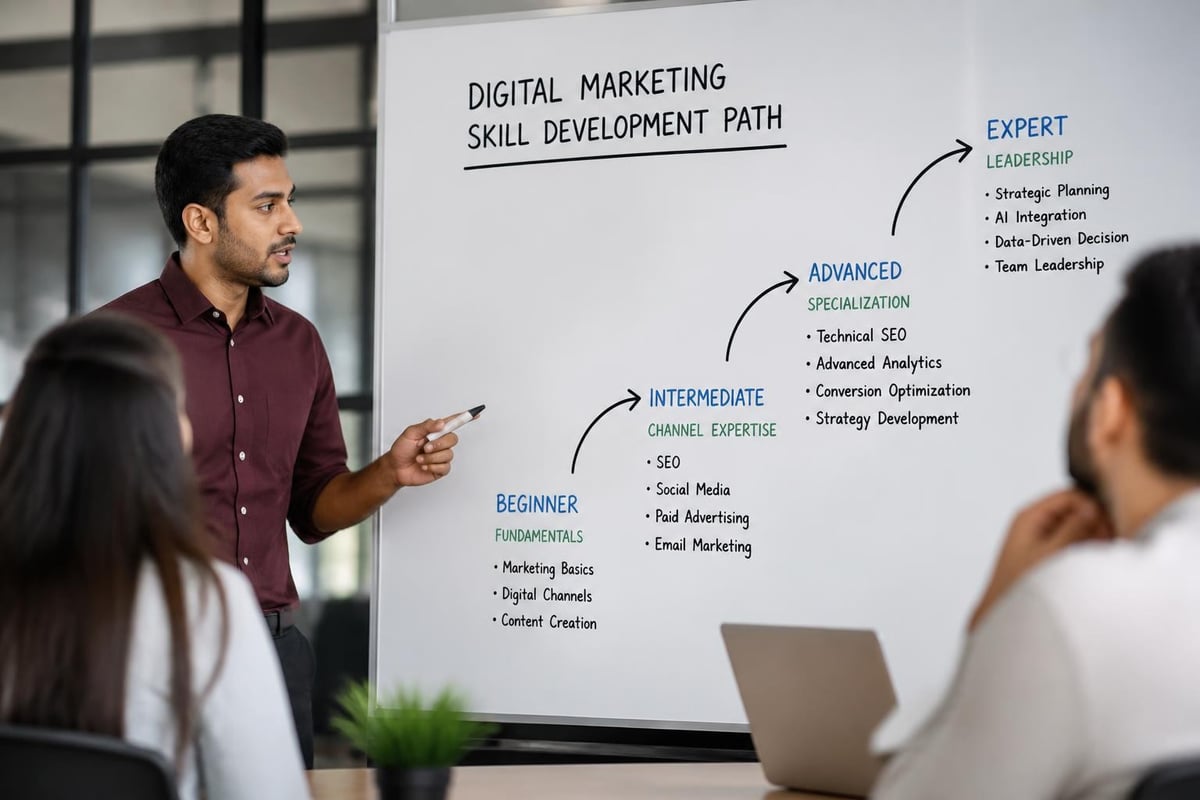
Your current skill level and career goals should determine which program represents the best course of digital marketing for you specifically. A beginner needs different content, pacing, and support than an experienced marketer updating their skills.
For Complete Beginners
If you're new to digital marketing, prioritize programs that:
- Start with fundamentals without assuming prior knowledge
- Build skills progressively from basic to advanced concepts
- Offer extensive support through mentors, tutors, or community forums
- Include career guidance on resume building and job searching
- Provide recognized credentials that employers understand and value
Avoid programs that dive immediately into advanced tactics or assume familiarity with marketing platforms. You need time to build foundational understanding before tackling complex optimization strategies.
For Career Switchers and Business Owners
Professionals transitioning from other fields or entrepreneurs building their own marketing capabilities need practical skills fast. The best course of digital marketing for this audience emphasizes:
- Hands-on platform training with immediate application to real projects
- Strategic frameworks for decision-making and priority setting
- Measurement and ROI focus to justify investments and guide optimization
- Accelerated pacing that respects your existing business acumen
- Flexibility to accommodate your existing work schedule
Business owners particularly benefit from understanding how to evaluate agency work, set realistic campaign goals, and interpret performance reports. The Certified Digital Marketing & AI Course addresses exactly these needs, combining strategic planning with tactical execution skills that apply immediately to your business.
For Marketing Professionals Updating Skills
Experienced marketers often need targeted skill development rather than comprehensive overviews. If you're already working in marketing, look for:
Advanced specialization options in areas like:
- Technical SEO and Answer Engine Optimization
- Advanced paid media buying and optimization
- Marketing automation and CRM integration
- Data analytics and visualization
- AI tool implementation and workflow design
Platform-specific certifications that prove deep expertise in key channels you manage daily.
Strategic and leadership development if you're moving into management roles where you'll guide teams and set departmental direction.
The modular structure offered by many 2026 programs lets experienced marketers skip basics and dive directly into advanced topics or emerging specializations.
Evaluating Course Quality and Provider Credibility
Marketing courses proliferate online, but quality varies from excellent to worthless. These evaluation criteria help you separate legitimate educational programs from content marketing disguised as courses.
Instructor Expertise and Industry Experience
The best instructors combine current industry practice with teaching ability. Look for course leaders who:
- Work actively in digital marketing, managing campaigns or consulting with clients, not just teaching
- Share specific results and case studies from real campaigns they've executed
- Update course content regularly to reflect platform changes and industry evolution
- Hold recognized certifications from Google, Meta, HubSpot, and other platform providers
- Contribute to the industry through speaking, research, or thought leadership
Check instructor LinkedIn profiles, published work, and online presence. Generic bios without verifiable achievements are red flags.
Student Outcomes and Job Placement
Course marketing claims matter less than verifiable student results. Quality programs share:
| Success Metric | What to Look For | Warning Signs |
|---|---|---|
| Job placement rate | Specific percentage with timeframe | Vague claims like "many students find jobs" |
| Salary increases | Average salary change post-completion | No data or testimonials only |
| Student testimonials | Detailed, specific outcome descriptions | Generic praise without context |
| Alumni network | Active community and career resources | No alumni engagement or support |
| Employer recognition | Companies that hire graduates | No employer relationships mentioned |
According to Pew Research data on professional development, 87% of workers who completed job-related training courses reported needing verification that the credential would be recognized by employers before enrolling.
Curriculum Relevance and Updates
Digital marketing changes monthly. A course built in 2023 and never updated teaches outdated tactics that may actively harm your campaigns in 2026.
Verify that courses cover:
- GA4 (not Universal Analytics, which sunset in 2023)
- Current platform interfaces and feature sets for Meta, Google, TikTok
- AI tools and integration across marketing functions
- Privacy-first measurement and first-party data strategies
- 2026 algorithm updates and platform policy changes
Ask directly when course content was last updated. Hesitation or vague answers suggest stale material.
Support, Community, and Ongoing Resources
Learning doesn't end when video modules finish. The best course of digital marketing includes:
- Regular office hours or Q&A sessions with instructors
- Active student communities where learners help each other
- Ongoing resources like updated guides, tool recommendations, and industry news
- Career support including resume reviews, interview prep, and job boards
- Alumni benefits such as continued learning access or community membership
These support structures dramatically improve completion rates, skill retention, and career outcomes compared to purely self-serve content.
Investment Considerations and ROI Calculation
Digital marketing courses range from free to over $15,000. Understanding the true cost and expected return helps you make smart investment decisions.
Total Cost Beyond Tuition
Course price tags rarely reflect total investment. Factor in:
- Time commitment and opportunity cost of hours spent learning versus working
- Software and tools required for assignments and practice
- Platform spend if running live campaigns as part of coursework
- Certification exam fees for Google, Meta, or other platform credentials
- Career transition costs if switching roles or industries post-completion
A $2,000 course requiring 200 hours over three months represents a larger investment than the tuition alone suggests, especially for working professionals.
Expected Returns and Payback Period
Calculate potential ROI using realistic scenarios:
For employees: Research salary data for digital marketing roles in your market. Entry-level positions average $45,000-$60,000, mid-level roles $60,000-$85,000, and senior positions $85,000-$120,000+ in major markets. A successful career switch or promotion typically recoups course investment within 3-6 months.
For business owners: Better marketing skills should increase customer acquisition efficiency, reduce cost per acquisition, or improve customer lifetime value. A 20% improvement in marketing ROI often pays for training within the first quarter of implementation.
For freelancers and consultants: Digital marketing skills command premium rates. Specialists charge $75-$200+ per hour depending on expertise and market. Landing 2-3 clients often covers course costs completely.
The best course of digital marketing for your situation delivers positive ROI within 12 months, whether through salary increases, business growth, or client acquisition.
Practical Steps to Choose Your Program
Moving from research to enrollment requires a systematic evaluation process. These steps ensure you select the program that best fits your needs, goals, and learning style.
Step 1: Define Your Specific Goals
Clarify exactly what you want to achieve:
- Career goals: Specific role, industry, or company type you're targeting
- Skill gaps: Particular competencies you need to develop or strengthen
- Timeline: When you need to complete training and apply new skills
- Budget: Total investment you can allocate to education
- Learning preferences: Structure, pacing, and support level that works for you
Write these down explicitly. Vague goals like "learn digital marketing" lead to poor course selection and low completion rates.
Step 2: Research and Shortlist Programs
Identify 4-6 candidates that align with your goals:
- Review curriculum details, not just course descriptions
- Check instructor backgrounds and credentials
- Read student reviews on independent platforms
- Verify update frequency and content relevance
- Confirm support structures and community access
- Calculate total investment including time and tools
Narrow to 2-3 finalists for deeper evaluation.
Step 3: Attend Information Sessions and Trial Content
Most quality programs offer:
- Free webinars or sample lessons showing teaching style and content quality
- Information sessions where you can ask questions directly
- Trial periods or money-back guarantees reducing enrollment risk
- Consultation calls to discuss your specific situation and goals
Take advantage of these before committing. A 10-minute preview video tells you more than hours of marketing material.
Step 4: Verify Fit and Commit Fully
Before enrolling, confirm:
- Schedule compatibility: You have protected time for coursework
- Technical requirements: Your systems meet platform needs
- Support access: You understand how to get help when stuck
- Completion plan: You've blocked calendar time and set deadlines
- Success metrics: You know how you'll measure your progress and ROI
Then commit completely. Half-hearted participation wastes money and time without delivering results. Block calendar time, inform family or colleagues of your commitment, and engage fully with the learning process.
How Training Translates to Business Results
The ultimate test of any digital marketing course isn't knowledge retention or certification completion. It's whether that training translates into measurable business outcomes: more leads, higher conversion rates, lower acquisition costs, or increased revenue.
From Tactics to Strategy
The best course of digital marketing teaches you to think strategically, not just execute tactics. This means understanding:
- Customer journey mapping: How prospects discover, evaluate, and purchase your offerings
- Channel integration: How search, social, content, and email work together rather than in silos
- Resource allocation: Where to invest time and budget for maximum impact
- Testing frameworks: How to run experiments that generate actionable insights
- Performance forecasting: Setting realistic goals based on historical data and market conditions
Tactical execution matters, but strategic thinking determines whether your campaigns drive business growth or just generate activity reports. Organizations like Intoact emphasize this strategic foundation throughout their training programs, ensuring marketers understand the "why" behind every tactic.
Measurement That Drives Decisions
Every campaign action should connect to business metrics that matter: customer acquisition cost, lifetime value, contribution margin, and return on ad spend. Quality training teaches you to:
- Set up proper tracking across all marketing channels
- Build custom dashboards that surface insights, not just data
- Calculate true ROI accounting for all costs and long-term value
- Identify optimization opportunities through data analysis
- Communicate results to stakeholders in business terms they understand
This measurement competency separates marketers who advance into leadership from those who remain tactical executors. The performance management approaches covered in comprehensive programs directly apply to real campaign optimization and business growth.
Continuous Learning and Adaptation
Digital marketing evolves constantly. Platforms update algorithms, new channels emerge, regulations change, and consumer behavior shifts. The best course of digital marketing instills a learning mindset and provides tools for continuous skill development:
- Framework thinking that adapts to new platforms and tactics
- Research skills to evaluate new tools and strategies critically
- Testing methodologies to validate approaches before full commitment
- Community connections for ongoing peer learning and support
- Resource access for continued education beyond the initial course
This foundation enables marketers to stay current throughout their careers, not just master 2026's specific tools and tactics.
Specialized vs. Generalist Approaches
As digital marketing matures, the specialist versus generalist debate intensifies. Should you pursue the best course of digital marketing that covers everything broadly, or develop deep expertise in specific channels or functions?
The Case for Generalist Training
Comprehensive programs that cover all major channels offer significant advantages:
Strategic thinking: Understanding how channels interact enables better integration and resource allocation decisions.
Career flexibility: Broad skills open more job opportunities and enable easier pivots as your interests or market demands change.
Team collaboration: Knowing basics across channels helps you work effectively with specialists and manage integrated campaigns.
Business ownership: Entrepreneurs and small business owners need competency across all marketing functions, not deep specialization in one.
For most professionals, especially those early in their careers or building their own businesses, comprehensive training provides the best foundation. You can always specialize later once you understand how different channels and tactics interconnect.
When Specialization Makes Sense
Deep expertise in specific areas commands premium compensation and solves complex business problems. Consider specialization when you:
- Have strong foundational knowledge and want to differentiate in the market
- Work in competitive markets where specialist expertise drives client or employer selection
- Enjoy particular channels or tactics and want to build a career around that focus
- Serve specific industries that require deep channel expertise (e.g., e-commerce needs advanced paid media skills)
Common specialization areas include technical SEO, paid search optimization, conversion rate optimization, marketing automation, and data analytics. Each offers career paths with six-figure earning potential for top practitioners.
Choosing the best course of digital marketing depends on your current skills, career goals, learning preferences, and budget constraints. Quality programs combine comprehensive curriculum coverage with practical application, recognized credentials, expert instruction, and ongoing support structures that drive completion and real-world results. Whether you select university-backed programs, online platforms, or intensive bootcamps, focus on training that emphasizes strategic thinking, measurement competency, AI integration, and privacy-first approaches that reflect 2026's marketing realities. Intoact offers practical digital marketing and AI training designed for professionals and business owners who need job-ready skills, ROI-focused strategies, and hands-on campaign experience that translates directly into business growth and career advancement.


