


A boutique social media agency offers specialized social media marketing services with a personalized approach that larger firms often cannot match. Unlike massive marketing conglomerates handling hundreds of clients, boutique agencies focus on building deep relationships with a select client roster, delivering tailored strategies that align with specific business objectives. In 2026, as platforms become increasingly sophisticated and audiences more fragmented, businesses are turning to these specialized partners to navigate the complexity of modern social media marketing while maintaining authentic brand voices and measurable return on investment.
What Defines a Boutique Social Media Agency
The defining characteristic of a boutique social media agency lies in its commitment to specialized expertise combined with personalized service. These agencies typically serve between 10 and 30 clients simultaneously, allowing team members to develop genuine understanding of each brand's voice, audience, and business goals.
Size and Structure
Most boutique agencies employ between 5 and 25 professionals, creating nimble teams that can pivot quickly based on platform updates or market shifts. This size allows for direct client communication with senior strategists rather than account coordinators who lack decision-making authority.
Key structural advantages include:
- Direct access to agency founders and senior strategists
- Faster decision-making processes without bureaucratic approval chains
- Customized service packages tailored to individual client needs
- Flexibility to experiment with emerging platforms and formats
Specialization Focus
A boutique social media agency often specializes in specific industries, platforms, or marketing objectives. Some focus exclusively on B2B LinkedIn strategies, while others excel in influencer partnerships for consumer brands. This specialization enables deeper expertise than generalist agencies can offer.
| Specialization Type | Example Focus Areas | Client Benefits |
|---|---|---|
| Platform-specific | TikTok, LinkedIn, Instagram | Deep algorithm knowledge and format expertise |
| Industry vertical | Healthcare, SaaS, E-commerce | Regulatory compliance and audience understanding |
| Service model | Influencer marketing, Community management | Specialized processes and relationships |
| Business stage | Startups, Enterprise, D2C brands | Growth-stage appropriate strategies |

Core Services Offered by Boutique Agencies
Modern boutique social media agencies extend far beyond basic content posting. Their service portfolios reflect the complexity of 2026's social ecosystem, where platform-specific best practices evolve constantly and audience expectations demand sophisticated approaches.
Strategy Development and Planning
Every engagement begins with comprehensive strategy development rooted in business objectives rather than vanity metrics. Boutique agencies conduct competitive analysis, audience research, and platform audits to identify optimal channels and content approaches.
The strategic planning process typically includes:
- Business objective alignment and KPI definition
- Target audience segmentation and persona development
- Competitive landscape analysis and differentiation strategies
- Platform selection based on audience presence and business goals
- Content pillar development and messaging framework creation
- Editorial calendar planning with campaign integration
Content Creation and Management
Content remains the foundation of social media success, and boutique agencies excel at producing platform-native content that resonates with specific audiences. Teams often include copywriters, graphic designers, video producers, and content strategists who collaborate on cohesive campaigns.
According to research from Pew Research Center, platform usage varies dramatically by demographic, requiring tailored content approaches for each channel. A boutique approach allows for this customization without the assembly-line production common at larger firms.
Paid Social Advertising
Most boutique agencies manage paid social campaigns across multiple platforms, optimizing budgets for maximum return on ad spend. This includes campaign setup, audience targeting, creative development, bid management, and continuous optimization based on performance data.
For businesses serious about mastering paid social themselves, comprehensive training like the Meta & TikTok Ads Course provides the strategic foundation and tactical skills needed to create, manage, and optimize campaigns effectively.

Community Management and Engagement
Building authentic relationships requires consistent community management. Boutique agencies monitor comments, messages, and mentions across platforms, responding in brand voice while escalating issues appropriately. This ongoing engagement builds loyalty and provides valuable customer insights.
Advantages of Working With Boutique Social Media Agencies
Businesses choosing boutique partners over large agency networks cite several compelling advantages that directly impact campaign performance and overall satisfaction.
Personalized Attention and Strategic Partnership
Unlike large agencies where clients compete for attention from overstretched account managers, boutique firms treat each relationship as a strategic partnership. Senior team members remain involved throughout engagements, ensuring strategic consistency and quality control.
This personalized approach delivers:
- Deeper understanding of business context and competitive landscape
- Proactive recommendations based on industry developments
- Rapid response to urgent needs or market opportunities
- Collaborative relationships that feel like team extensions
Agility and Responsiveness
When TikTok's algorithm changes overnight or a competitor launches a viral campaign, boutique agencies can pivot immediately. Without layers of approval bureaucracy, teams implement tactical adjustments within hours rather than days or weeks.
This agility proved critical in 2025 when several major platforms adjusted their content recommendation algorithms simultaneously. Boutique agencies adapted client strategies quickly while larger firms were still scheduling meetings to discuss potential responses.
Cost Efficiency and ROI Focus
Boutique social media agencies typically offer more transparent pricing and better cost efficiency than large networks. Without the overhead of massive office spaces and executive layers, they can deliver comparable or superior work at 20-40% lower costs.
| Cost Factor | Large Agency Network | Boutique Social Media Agency |
|---|---|---|
| Monthly retainer (mid-market) | $15,000 – $30,000 | $8,000 – $18,000 |
| Senior strategist involvement | Limited, periodic check-ins | Regular, hands-on participation |
| Contract flexibility | 12+ month commitments | 3-6 month terms with renewal options |
| Custom service packages | Standardized tiers | Fully customizable based on needs |
More importantly, boutique agencies focus on metrics that matter to business outcomes. Rather than celebrating follower counts, they track conversion rates, customer acquisition costs, and revenue attribution.

How to Select the Right Boutique Agency
Choosing the right boutique social media agency partner requires systematic evaluation beyond portfolio reviews and pricing comparisons. The following framework helps businesses identify agencies aligned with their specific needs and growth objectives.
Evaluate Specialized Expertise
Begin by assessing whether an agency's specialization matches your industry, platforms, and business model. Review case studies for similar companies, paying particular attention to results achieved and strategic approaches employed.
Critical questions to ask:
- What percentage of your clients operate in our industry or adjacent sectors?
- Which platforms do you consider your core expertise areas?
- How do you stay current with platform algorithm changes and best practices?
- Can you share specific examples of how you've solved challenges similar to ours?
Assess Team Capabilities and Chemistry
Request detailed information about who will actually work on your account. Meet the entire proposed team, not just the sales representatives or agency principals who may disappear after contract signing.
Chemistry matters significantly in boutique relationships. Since you'll work closely with a small team, personal compatibility and communication styles should align with your organizational culture.
Review Measurement and Reporting Approaches
Understanding how an agency defines success reveals whether they focus on meaningful business outcomes or superficial metrics. Request sample reports and ask detailed questions about their analytics capabilities.
According to IAB Tech Lab’s transparency standards, agencies should provide clear documentation of measurement methodologies, data sources, and attribution models. Boutique agencies following these standards demonstrate commitment to accountability and professional excellence.
Understand Compliance and Risk Management
Social media marketing involves regulatory considerations, particularly around influencer disclosures and endorsements. Agencies should demonstrate familiarity with FTC guidelines, platform advertising policies, and industry-specific regulations affecting your business.
For companies in regulated industries like healthcare, financial services, or legal sectors, compliance expertise becomes non-negotiable. Verify that prospective agencies have experience navigating these requirements.
Strategic Services That Set Boutique Agencies Apart
Beyond foundational social media management, leading boutique agencies offer specialized services that drive competitive advantage and measurable business impact.
Influencer Partnership Programs
Boutique agencies often maintain established relationships with micro and mid-tier influencers across multiple niches. These connections enable more authentic partnerships than transactional influencer marketplace platforms typically facilitate.
Research published in Harvard Business Review demonstrates that successful influencer collaborations require strategic alignment beyond audience size metrics. Boutique agencies excel at matching brands with creators whose values, content style, and audience demographics create authentic fit.
Social Commerce Integration
As platforms increasingly prioritize native shopping experiences, boutique social media agencies help businesses integrate commerce capabilities directly into social content. This includes Instagram Shopping setup, TikTok Shop optimization, and Facebook Marketplace strategies.
The process involves:
- Product catalog creation and platform integration
- Shoppable content development across formats (posts, Stories, Reels, live streams)
- Checkout experience optimization for mobile conversion
- Performance tracking and attribution modeling
- Customer service integration for social commerce inquiries
Crisis Management and Reputation Protection
When negative sentiment emerges on social platforms, quick and strategic responses prevent minor issues from escalating into brand crises. Boutique agencies develop crisis protocols, monitor brand mentions across platforms, and execute response strategies that protect reputation while maintaining authentic brand voice.
AI-Powered Content and Automation
Forward-thinking boutique agencies leverage artificial intelligence for content ideation, performance prediction, and workflow automation. Insights from Deloitte’s Digital Media Trends research show that AI adoption in social media marketing accelerated dramatically in 2025, with boutique agencies often leading implementation due to their agility.
Applications include automated caption generation, visual content optimization, sentiment analysis, optimal posting time prediction, and chatbot integration for customer service. For professionals looking to develop their own AI marketing capabilities, specialized training provides the practical skills needed to implement these tools effectively. Businesses working with digital content marketing agencies can access both done-for-you services and educational resources to build internal capabilities.
Building Effective Client-Agency Partnerships
Success with a boutique social media agency requires active partnership rather than passive vendor management. The most effective client relationships share specific characteristics that maximize results and ensure strategic alignment.
Establish Clear Communication Rhythms
Define regular touchpoint schedules including weekly status updates, monthly strategy reviews, and quarterly business planning sessions. Boutique agencies thrive on open communication, so establish preferred channels and response time expectations upfront.
Recommended communication structure:
- Weekly: Performance snapshot and tactical updates (email or brief call)
- Bi-weekly: Content review and approval cycles
- Monthly: Detailed analytics review and strategic discussion
- Quarterly: Business objective alignment and strategy refinement
Provide Comprehensive Brand Access
Equip your agency team with resources that enable authentic brand representation. This includes brand guidelines, product information, customer insights, competitive intelligence, and access to subject matter experts within your organization.
The more context an agency possesses about your business, customers, and market position, the more strategic and effective their work becomes. Treat them as an extension of your internal team rather than external vendors.
Set Realistic Expectations and Timelines
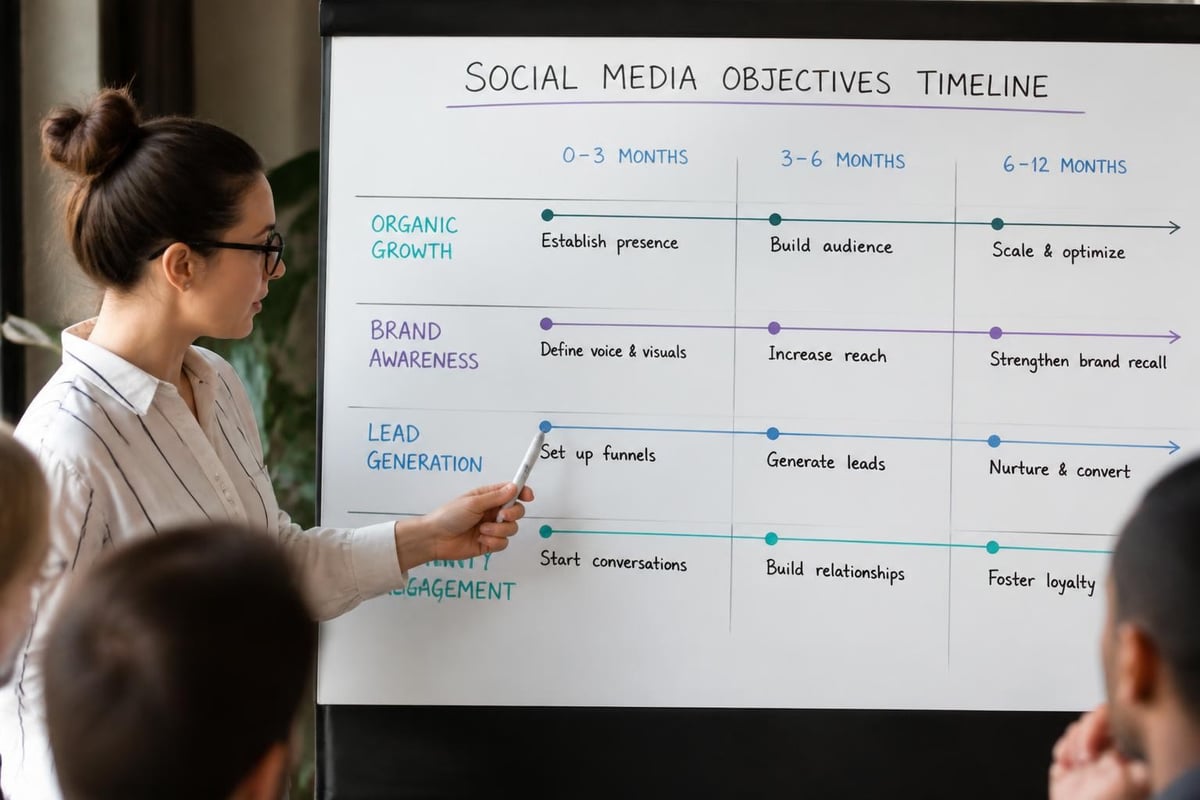
Social media success rarely happens overnight. Organic audience building requires consistent effort over months, while paid campaign optimization typically needs 60-90 days to achieve stable performance. Understanding these realities prevents frustration and premature strategy changes.
| Objective Type | Typical Timeline to Results | Key Success Factors |
|---|---|---|
| Organic audience growth | 4-6 months for meaningful traction | Content consistency, engagement strategy, platform algorithm alignment |
| Brand awareness expansion | 3-4 months to establish presence | Multi-platform approach, creative differentiation, strategic paid amplification |
| Lead generation programs | 2-3 months to optimize conversion paths | Landing page optimization, targeting refinement, offer testing |
| Community engagement | 6-8 weeks to build momentum | Authentic interaction, value-driven content, response consistency |
Collaborate on Content Development
While agencies handle execution, your team's subject matter expertise and customer knowledge enhance content authenticity and relevance. Establish workflows for internal stakeholders to contribute ideas, review content, and provide feedback without creating approval bottlenecks.
Many successful partnerships use collaborative tools like content calendars, shared asset libraries, and feedback platforms that streamline review cycles while maintaining quality standards.
Measuring Boutique Agency Performance
Accountability separates exceptional boutique social media agencies from mediocre ones. Establishing clear measurement frameworks ensures both parties understand success criteria and can make data-informed optimization decisions.
Define Business-Aligned KPIs
Move beyond platform-native metrics like impressions and reach to establish KPIs directly tied to business objectives. These might include website traffic from social channels, lead form completions, e-commerce transactions, customer acquisition costs, or brand sentiment scores.
Working with agencies experienced in performance management ensures that measurement frameworks track meaningful business outcomes rather than vanity metrics that look impressive but don't drive revenue.
Implement Proper Attribution Modeling
Social media's role in customer journeys often extends beyond last-click attribution. Boutique agencies should employ multi-touch attribution models that credit social touchpoints appropriately throughout awareness, consideration, and decision stages.
This requires integration between social platforms, website analytics, CRM systems, and marketing automation tools. Google’s marketing insights emphasize the importance of understanding full customer journeys rather than isolated channel performance.
Review Competitive Benchmarking
Understanding performance relative to competitors provides crucial context for absolute metrics. If your engagement rate increased 15% but competitors grew 40%, that signals strategic adjustments may be needed despite positive absolute trends.
Quality boutique agencies conduct regular competitive analysis, tracking share of voice, engagement benchmarks, content performance patterns, and platform strategy evolution across your competitive set.
Conduct Quarterly Business Reviews
Beyond monthly performance discussions, quarterly business reviews assess strategic alignment and identify opportunities for evolution. These sessions should address:
- Progress toward annual business objectives
- Emerging platform opportunities or threats
- Competitive landscape shifts requiring strategic response
- Budget optimization and resource allocation
- New service offerings or capability expansions
Future-Proofing Your Social Media Strategy
The social media landscape continues evolving rapidly, with platform algorithm updates, new format introductions, and shifting user behaviors requiring constant adaptation. Boutique social media agencies help businesses stay ahead of these changes through proactive strategy evolution.
Platform Diversification Strategies
Over-reliance on single platforms creates vulnerability when algorithms change or user demographics shift. Progressive agencies develop diversification strategies that maintain presence across multiple relevant platforms while focusing resources where audiences and opportunities align most strongly with business objectives.
This doesn't mean spreading resources equally across every platform. Instead, it involves strategic assessment of where target audiences spend time, which formats match your content strengths, and where competitive intensity allows differentiation.
Emerging Format Adoption
Short-form video dominated social media in 2024-2025, but new formats continuously emerge. Boutique agencies monitor platform beta programs, test emerging features early, and help clients capitalize on reduced competition during early adoption phases.
Current format trends worth monitoring include AI-generated avatars for brand representation, interactive shopping experiences within live streams, augmented reality try-on features, and cross-platform content syndication tools.
Privacy and Data Adaptation
Increasing privacy regulations and platform policy changes affect targeting capabilities and measurement accuracy. Boutique social media agencies help businesses adapt to these shifts through first-party data strategies, contextual targeting approaches, and privacy-compliant measurement implementations.
For businesses building internal capabilities alongside agency partnerships, resources like HubSpot’s social media guides provide practical frameworks for navigating these evolving requirements while maintaining campaign effectiveness.
Investment Considerations and Pricing Models
Understanding boutique social media agency pricing helps businesses budget appropriately and evaluate proposals effectively. Pricing varies based on scope, industry complexity, platform mix, and service level requirements.
Common Pricing Structures
Boutique agencies typically offer several pricing models, each with advantages depending on business needs and engagement maturity.
Monthly retainers provide predictable costs and ongoing strategic partnership. Retainers typically range from $5,000 to $25,000 monthly depending on platform count, content volume, paid media budgets, and strategic complexity.
Project-based pricing works well for defined initiatives like campaign launches, platform expansions, or social media audits. Projects range from $3,000 for basic audits to $50,000+ for comprehensive campaign development and execution.
Performance-based models tie agency compensation partially to results achievement, aligning incentives around business outcomes. These arrangements require clear attribution capabilities and realistic baseline establishment.
Hybrid approaches combine retainer foundations with performance bonuses or project add-ons, balancing predictability with results orientation.
Budget Allocation Guidelines
Beyond agency fees, successful social media programs require investment in content production, paid media, tools and technology, and influencer partnerships.
| Budget Component | Percentage of Total | Considerations |
|---|---|---|
| Agency fees | 30-40% | Strategic direction, execution, management |
| Paid media spend | 40-50% | Platform advertising across channels |
| Content production | 10-15% | Photography, videography, graphic design |
| Tools and technology | 3-7% | Analytics, scheduling, listening platforms |
| Influencer partnerships | Variable | Based on campaign strategy and goals |
For comprehensive guidance on optimizing marketing budgets across channels, businesses can benefit from strategic digital marketing consultancy services that assess resource allocation and identify high-impact investment opportunities.
ROI Expectations and Timelines
Realistic ROI expectations vary by industry, business model, and campaign objectives. E-commerce businesses often see clearer revenue attribution than B2B service providers with longer sales cycles, though both can achieve meaningful returns through properly measured programs.
Initial investments typically focus on foundation building, with compounding returns emerging after 4-6 months of consistent execution. Boutique social media agencies should provide transparent projections based on industry benchmarks while acknowledging that actual performance depends on numerous variables including offer competitiveness, market conditions, and execution quality.
Building Internal Capabilities Alongside Agency Partnerships
While boutique social media agencies provide valuable expertise and execution capacity, businesses benefit from developing internal knowledge that enables more strategic collaboration and reduces dependency over time.
Essential Internal Competencies
Even with strong agency partners, organizations should cultivate baseline social media literacy across marketing teams. This includes understanding platform algorithms, content performance drivers, paid advertising fundamentals, and analytics interpretation.
Training programs focused on practical digital marketing skills help teams develop capabilities that complement agency services, enabling more informed discussions and strategic decisions.
Collaborative Skill Development
Progressive boutique agencies view client education as partnership enhancement rather than threat. They share knowledge through regular training sessions, documentation of processes and strategies, and collaborative campaign planning that builds internal expertise.
This approach creates sustainable partnerships where agencies focus on strategic leadership and specialized execution while clients develop capabilities for tactical implementation and performance monitoring.
Transition Planning for Scale
As businesses grow, social media requirements often expand beyond boutique agency capacity or evolve toward in-house models. Thoughtful partnerships include transition planning that prepares organizations for these shifts through knowledge transfer, process documentation, and phased capability development.
Some businesses maintain hybrid models where boutique agencies handle specialized services like influencer partnerships or paid media optimization while internal teams manage community engagement and content creation for specific channels.
Boutique social media agencies deliver the specialized expertise, personalized service, and strategic flexibility that modern businesses need to succeed across increasingly complex social platforms. By focusing on business outcomes rather than vanity metrics and building genuine partnerships rather than transactional vendor relationships, these agencies help organizations achieve measurable results while adapting quickly to constant platform evolution. Whether you're looking to enhance your team's social media capabilities through expert training or seeking strategic partnership to optimize your social presence, Intoact offers comprehensive digital marketing services, practical courses, and performance-focused consultancy designed to drive measurable business results in 2026's competitive landscape.


