


Branding materials form the visual and tactical foundation of how businesses communicate their identity to customers, partners, and prospects. These assets range from logos and color palettes to templates, guidelines, and collateral that ensure every touchpoint reflects a cohesive brand presence. In 2026, as digital and physical channels converge more than ever, comprehensive branding materials aren't optional-they're strategic assets that directly impact recognition, trust, and marketing performance.
What Branding Materials Actually Include
The term "branding materials" encompasses far more than a logo on a business card. Modern branding systems consist of primary visual identifiers, application templates, and comprehensive documentation that governs how brand elements appear across every medium.
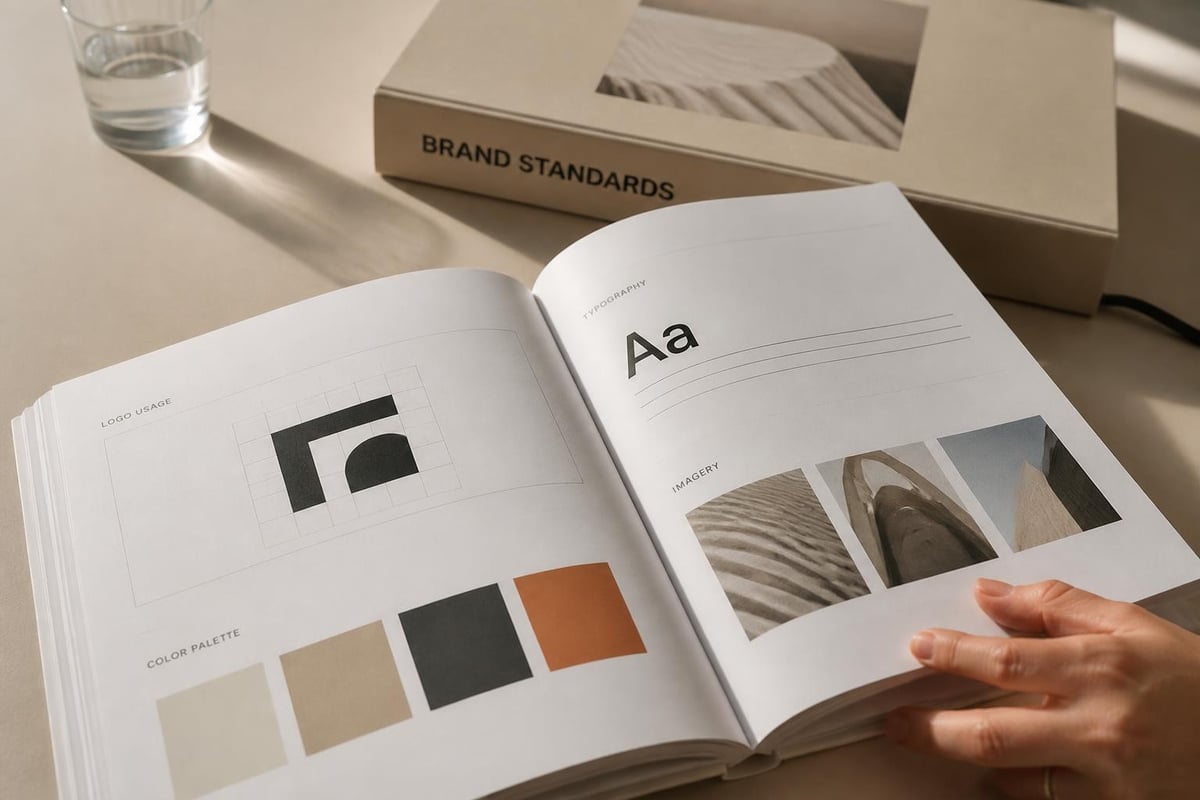
Core visual elements form the foundation. Your logo (often in multiple file formats and variations), defined color palettes with exact specifications, typography standards with approved font families, and imagery guidelines that dictate photography style, illustration approach, and graphic treatments all qualify as essential branding materials.
Primary Asset Categories
Visual Identity Components:
- Logo files in vector (SVG, AI, EPS) and raster (PNG, JPG) formats
- Lockup variations (horizontal, vertical, icon-only, reversed)
- Color systems with Pantone, CMYK, RGB, and HEX values
- Typography specifications including font files and usage rules
- Icon libraries and graphic element systems
Application Templates:
- Presentation decks (PowerPoint, Google Slides, Keynote)
- Document templates (proposals, reports, one-pagers)
- Social media templates (posts, stories, cover images)
- Email signatures and newsletter templates
- Digital ad templates for various platforms and dimensions
Collateral and Printed Materials:
- Business cards and stationery
- Brochures and sales sheets
- Trade show graphics and signage
- Packaging design (when applicable)
- Promotional items and merchandise
The Public Relations Society of America’s own brand guidelines demonstrate how professional organizations document these elements comprehensively, providing a practical reference for structure and scope.

Why Consistency in Branding Materials Matters for ROI
Marketing performance depends heavily on brand recognition, and recognition stems from consistent application of visual identity. The 2024 Nielsen Annual Marketing Report confirms that brands maintaining consistent presentation across channels see measurably higher returns on advertising spend and customer engagement.
When branding materials vary from campaign to campaign or channel to channel, customers process each interaction as if encountering something new. This fragments attention and dilutes recall. Standardized branding materials eliminate this inefficiency by creating instant visual recognition that compounds over time.
For businesses running paid advertising campaigns across Meta, TikTok, Google, and other platforms, consistent branding materials reduce creative fatigue while maintaining brand equity. Ad creatives that share color schemes, typography, and graphic treatments benefit from cumulative brand exposure, even when promoting different products or messages.
| Consistency Benefit | Business Impact |
|---|---|
| Instant recognition | Reduced customer acquisition cost |
| Professional appearance | Higher perceived credibility |
| Template efficiency | Faster campaign deployment |
| Cross-channel cohesion | Improved attribution and tracking |
| Reduced design time | Lower production costs |
Companies managing performance-focused digital campaigns understand that brand consistency isn't aesthetic preference, it's performance optimization. When every asset reinforces the same visual language, each impression builds on previous ones rather than starting from zero.
Building a Complete Branding Materials System
Creating effective branding materials starts with strategic decisions about identity, then expands into systematic documentation and asset creation. This process benefits from clear sequencing and thorough planning.
Strategic Foundation Phase
Before designing a single business card or social template, define your brand positioning, audience, and competitive context. Who you're targeting determines visual choices. A fintech startup targeting enterprise CFOs requires different branding materials than a DTC wellness brand targeting millennials.
Document your brand's core attributes: personality traits, value propositions, visual references, and differentiation points. These strategic inputs inform every subsequent design decision about branding materials.
Harvard Business Review’s guidance on brand building emphasizes that strong brands start with clear positioning, not arbitrary aesthetic choices. Branding materials succeed when they communicate strategy visually.
Design and Asset Development
With strategy documented, professional designers create the primary visual identity: logo, color palette, typography system, and supporting graphic elements. Quality matters tremendously here. Vector logos that scale cleanly, color palettes specified precisely across color spaces, and professionally licensed fonts create the quality foundation all subsequent branding materials require.
Color System Requirements:
- Define primary brand colors (typically 1-3 colors)
- Specify secondary/accent colors for flexibility
- Document exact values: Pantone for print, CMYK for offset printing, RGB for digital screens, HEX for web
- Test contrast ratios for accessibility compliance
- Provide usage guidance for backgrounds, text, and accents
Pantone’s color system resources remain the industry standard for ensuring color consistency across media. Without precise color specifications, branding materials will vary unpredictably between printers, screens, and production methods.
Typography receives similar rigor. Document primary typefaces for headlines and body copy, specify weights and styles available for use, provide font files in all required formats, and establish hierarchy rules for different content types.
Legal Protection and Trademark Considerations
Branding materials represent significant business assets that often warrant legal protection. Logos, brand names, taglines, and distinctive visual elements can qualify for trademark protection, preventing unauthorized use by competitors.
The USPTO trademark registration process provides federal protection for brand identifiers used in commerce. Registered trademarks give businesses exclusive rights to branding materials within their industry, plus legal recourse against infringement.
Before investing heavily in branding materials production and distribution, verify that your visual identity doesn't infringe existing trademarks. Professional trademark searches and legal review prevent costly rebranding after launch.
For businesses operating internationally, the World Intellectual Property Organization provides standards and coordination for trademark protection across multiple countries. Global branding materials require global trademark strategy.
Accessibility Standards for Digital Branding Materials
Digital branding materials must meet accessibility standards to ensure usability for people with visual, cognitive, and motor disabilities. Color contrast, text sizing, and interactive element design all impact whether branding materials function for all users.
The Web Content Accessibility Guidelines (WCAG) establish specific requirements for color contrast ratios. Text and interactive elements must maintain sufficient contrast against backgrounds to remain perceivable. The W3C explains these contrast requirements with practical examples showing compliant and non-compliant applications.
Recent research confirms widespread failures in meeting these standards. A 2026 academic audit of major websites found that color contrast violations remain among the most common accessibility failures. Brand color palettes that look attractive but fail contrast requirements create branding materials that exclude users and potentially violate accessibility laws.
Accessibility Checklist for Branding Materials:
- Verify all color combinations meet WCAG AA minimum contrast (4.5:1 for normal text)
- Provide text alternatives for logo images in digital contexts
- Ensure interactive elements meet minimum touch target sizes
- Test templates with screen readers and assistive technology
- Document accessible color combinations within brand guidelines
The MDN Web Docs color contrast guide offers technical implementation details for developers creating digital branding materials. Accessibility shouldn't be retrofitted later; build it into your brand system from the start.
Creating Application Templates That Scale
Comprehensive branding materials include templates for common business needs. These templates accelerate content creation while maintaining brand consistency across teams and departments.
Presentation templates deserve particular attention. Most businesses create dozens or hundreds of presentations annually for sales, training, reporting, and external communication. Professionally designed PowerPoint, Keynote, and Google Slides templates with branded layouts, color schemes, and graphic elements ensure every presentation reinforces brand identity.
Template Categories by Priority
| Template Type | Primary Users | Impact on Brand |
|---|---|---|
| Presentation decks | Sales, executives, marketing | High – frequently external-facing |
| Social media graphics | Marketing, communications | High – high volume, public visibility |
| Email signatures | All employees | Medium – every email touchpoint |
| Document templates | Multiple departments | Medium – proposals, reports, contracts |
| Digital ad templates | Marketing, agencies | High – paid media performance |
Social media templates form another critical category. Businesses publishing daily across LinkedIn, Instagram, Facebook, and other platforms need brand-compliant templates in correct dimensions for posts, stories, and cover images. Template libraries that include multiple layout options prevent visual repetition while maintaining consistency.
Email signature templates standardize how employees represent the organization in daily correspondence. Consistent signatures across the organization project professionalism and provide marketing opportunities through links to current campaigns or content.
Many organizations discover that comprehensive digital marketing training helps teams understand not just how to use branding materials, but why consistency matters strategically. When marketing and communications teams grasp the performance implications of brand consistency, they become better stewards of brand standards.

Managing and Distributing Branding Materials
Creating branding materials solves only half the challenge. Organizations must distribute assets effectively, maintain version control, and ensure teams access current, approved materials rather than outdated files.
Brand asset management systems provide centralized repositories where approved branding materials live. These systems (ranging from simple cloud folders to dedicated brand management platforms) should organize assets logically by type, include search functionality, maintain version history, and control access permissions based on user roles.
Effective Asset Organization Structure:
- Logos (organized by format, color variation, size)
- Color palettes (with downloadable swatches for design software)
- Typography (font files plus usage documentation)
- Templates (by application type and file format)
- Photography and imagery (categorized and rights-documented)
- Brand guidelines (comprehensive documentation PDF)
- Examples and case studies (showing correct application)
Documentation matters as much as the assets themselves. Comprehensive brand guidelines explain when to use each logo variation, how to apply color palettes correctly, what typography hierarchies to follow, and where branding materials can be modified versus where they must remain fixed.
Regular audits prevent branding materials from proliferating into inconsistent versions. Every quarter, review published materials across channels to verify compliance with current standards. When deviations appear, update the offending materials and reinforce guidelines with responsible teams.
Branding Materials Across Digital Marketing Channels
Digital marketing success increasingly depends on maintaining brand consistency while adapting to platform-specific requirements. Each channel demands different technical specifications while requiring recognizable brand presence.
Social media platforms each impose unique constraints on image dimensions, video lengths, and interactive formats. Effective branding materials for social include templates in all required specifications: square posts (1080×1080), portrait formats (1080×1350), stories (1080×1920), and cover images (varying by platform).
Paid advertising creative benefits tremendously from templated approaches. Ad platforms like Meta and TikTok require multiple creative variations for effective testing and optimization. Businesses running sophisticated campaigns need branding materials systems that support rapid creative production without sacrificing brand integrity.
Search engine optimization contexts present different requirements for branding materials. Website graphics, featured images, and visual content must incorporate proper alt text, appropriate file sizes for performance, and structured data markup where applicable. Organizations offering advanced SEO services understand that visual branding materials impact technical SEO through page speed, mobile usability, and user engagement signals.
Email marketing requires yet another set of branded templates: header graphics, email signatures, promotional banners, and responsive templates that render consistently across email clients. Brand consistency in email drives recognition and trust, particularly for automated sequences and regular newsletters.
| Marketing Channel | Key Branding Material Needs | Technical Considerations |
|---|---|---|
| Social organic | Post templates, story graphics, profile images | Platform-specific dimensions |
| Paid social | Ad creative templates, multiple sizes | Fast iteration, A/B testing support |
| Email marketing | Email headers, signatures, promotional graphics | HTML/responsive compatibility |
| Website/SEO | Page graphics, featured images, icons | File size, alt text, structured data |
| Video content | Intro/outro templates, lower thirds, thumbnails | Video editor compatibility |
Updating and Evolving Branding Materials
Brands evolve. Markets shift. Design trends change. Effective branding materials systems include processes for controlled evolution rather than disruptive overhauls.
Plan for periodic refreshes on predictable cycles. Every 3-5 years, most brands benefit from evaluating whether their visual identity still serves strategic goals. This doesn't necessarily mean comprehensive rebrands, but may involve refining color palettes, modernizing typography, or expanding template libraries to support new channels.
When updates occur, version control becomes critical. Clearly communicate effective dates for new branding materials, provide transition periods where both old and new materials may coexist in distribution, systematically replace outdated assets in repositories, and update all documentation to reflect current standards.
Document reasons for changes to prevent cyclical debates. If your organization consciously chose specific colors for accessibility reasons, document that rationale. Future stakeholders questioning those choices need historical context to make informed decisions rather than personal preferences.
Track how branding materials perform in actual use. Do certain templates see high adoption while others languish unused? Are teams consistently requesting variations not currently provided? User feedback reveals where branding materials systems succeed and where gaps require attention.
Measuring the Impact of Strong Branding Materials
Quantifying branding materials' business impact helps justify investment and refinement. Several metrics reveal whether your brand system delivers value.
Brand recognition tracking measures whether target audiences correctly identify your brand from visual cues alone. Professional market research firms conduct aided and unaided recognition studies, but simpler approaches work too. Show logo or branded materials to sample audiences and measure recognition rates over time.
Time-to-market for branded content provides operational metrics. How long does creating a compliant presentation, social post, or sales document take? Comprehensive template libraries and clear guidelines should reduce production time compared to designing from scratch each time.
Measurable Benefits of Systematic Branding Materials:
- Reduced creative production costs (compare agency/freelance spend before and after templates)
- Faster campaign deployment (measure time from concept to launch)
- Improved brand recall (track recognition in market research)
- Higher creative approval rates (fewer revision rounds when starting from approved templates)
- Better cross-channel performance (compare engagement metrics for branded versus unbranded content)
Ad performance metrics often show the impact of consistent branding. When running paid campaigns across platforms, track whether ads using consistent brand elements show different performance than those diverging from brand standards. Many advertisers discover that brand-consistent creative performs better long-term, even if novel approaches occasionally win short-term tests.
Organizations focused on digital marketing performance and ROI can attribute improvements partly to branding consistency. When every touchpoint reinforces the same identity, marketing efficiency compounds. Each impression builds on previous ones rather than starting fresh.
Training Teams on Branding Materials Usage
The most comprehensive branding materials deliver value only when teams understand and apply them correctly. Training ensures consistent execution across departments and seniority levels.
Onboarding new employees should include brand guidelines review. Every person representing the organization needs basic familiarity with visual identity standards and where to find approved assets. This prevents well-intentioned but off-brand content creation.
Role-specific training goes deeper. Marketing teams require detailed understanding of when templates can be customized versus when they're fixed, sales teams need proficiency with presentation templates and sales collateral, and executives benefit from understanding strategic rationale behind brand choices to reinforce standards in their communications.
Practical workshops beat passive documentation. Rather than simply distributing PDF guidelines, conduct hands-on sessions where teams practice using templates, explore the asset library, and ask questions about application scenarios. Interactive learning drives retention and confidence.
Regular refreshers prevent drift over time. Even with initial training, brand standards erode without reinforcement. Quarterly lunch-and-learns, updated example galleries, or brief video tutorials highlighting new templates keep brand top of mind.
Strategic branding materials create the visual consistency that drives recognition, builds trust, and improves marketing efficiency across every channel where your business appears. From comprehensive brand guidelines to platform-specific templates, these assets represent investments that compound in value as your organization grows. Whether you're building a brand system from scratch, refreshing existing materials for 2026's digital landscape, or training teams to apply brand standards effectively, Intoact provides the digital marketing expertise, training programs, and strategic consulting that transform brand assets into business performance. Explore how our courses and consultancy services help organizations maximize their marketing impact through strategic consistency.


