Content creation digital marketing has evolved from a nice-to-have skill into a core competency that drives measurable business results across every channel. For marketers and aspiring content creators in Lebanon and the UAE, mastering content creation means understanding not just how to write or design, but how to build strategic assets that attract audiences, support conversion goals, and deliver ROI. This comprehensive guide walks through the practical formats, tools, workflows, and career-building strategies that working content professionals use daily.
Understanding Content Creation in the Digital Marketing Context
Content creation digital marketing refers to the strategic process of planning, producing, and distributing valuable content that supports specific business objectives. Unlike traditional content writing, digital marketing content serves multiple purposes simultaneously: it builds brand awareness, improves search visibility, nurtures prospects, supports sales conversations, and retains existing customers.
The distinction matters because it shapes how you approach every piece of content. A blog article isn't just information sharing; it's a tool optimized for search intent, structured for readability, embedded with conversion opportunities, and measured against traffic and engagement metrics. A social media caption isn't casual communication; it's designed for platform algorithms, audience behavior patterns, and specific campaign goals.
The Modern Content Creator's Skillset
Today's content creators combine traditional communication skills with technical knowledge and strategic thinking. You need writing ability, but also understanding of SEO principles, analytics interpretation, platform-specific optimization, and increasingly, AI tool proficiency.
Core competencies include:
- Strategic content planning aligned with business goals
- Audience research and persona development
- SEO and keyword research implementation
- Multi-format content production (text, video, audio, visual)
- Platform-specific optimization and distribution
- Performance measurement and iteration
- AI-assisted content workflows and quality control
The Content Marketing Institute’s research consistently shows that organizations prioritizing these integrated skills see higher content performance than those treating content creation as purely creative work.

Essential Content Formats for Digital Marketing
Content creation digital marketing spans numerous formats, each serving different audience needs and marketing objectives. Understanding when and how to deploy each format creates a more effective content ecosystem.
Written Content Formats
Blog articles remain the foundation of most content strategies because they serve multiple purposes: they attract organic search traffic, demonstrate expertise, support thought leadership, and provide shareable assets for social promotion. Effective blog content in 2026 focuses on comprehensive coverage of specific topics, clear structure for skimming, and integration with broader content hubs.
Email newsletters deliver owned-channel communication directly to engaged audiences. Unlike social content that depends on algorithmic distribution, email gives you direct access to subscribers who've expressed interest. The format works particularly well for relationship building, product announcements, and nurturing prospects through longer decision cycles common in B2B contexts across the Middle East.
Long-form guides and ebooks serve as lead magnets and authority builders. These comprehensive resources tackle complex topics in depth, positioning your brand as a trusted source while capturing contact information from prospects interested enough to exchange their email for valuable content.
| Written Format | Primary Goal | Typical Length | Production Time |
|---|---|---|---|
| Blog Article | SEO traffic, authority | 1,500-2,500 words | 4-8 hours |
| Email Newsletter | Engagement, nurture | 300-800 words | 2-4 hours |
| Social Post | Awareness, engagement | 50-300 words | 30-60 minutes |
| Guide/Ebook | Lead generation | 3,000-8,000 words | 15-30 hours |
Visual and Video Content
Video content continues expanding across platforms, from short-form vertical videos on Instagram Reels and TikTok to longer YouTube tutorials and webinars. For content creators in the Middle East, video offers particular advantages in markets with high mobile usage and strong preference for visual storytelling.
Infographics transform complex data or processes into shareable visual assets. They perform well on social platforms, enhance blog content, and can be repurposed across multiple channels. The key is ensuring they remain valuable rather than purely decorative-each infographic should communicate information more effectively than text alone could.
Building Your Content Creation Workflow
Systematic workflows separate sustainable content operations from sporadic, stressful production cycles. A clear process ensures consistent output quality while reducing the decision fatigue that slows many content creators.
Research and Planning Phase
Effective content starts with understanding what your audience needs and how they search for solutions. Keyword research tools reveal the actual phrases people use, search volumes, and competitive landscape. But research extends beyond keywords to include competitor content analysis, audience questions from forums and social platforms, and trending topics within your niche.
Topic clustering organizes content around pillar themes rather than isolated articles. This approach, detailed in Moz’s SEO guide, helps build topical authority while creating logical internal linking structures that benefit both users and search engines.
Research workflow steps:
- Identify core topics aligned with business objectives
- Conduct keyword research for search demand validation
- Analyze competitor content for gaps and opportunities
- Map topics to audience journey stages
- Create editorial calendar with production deadlines
- Assign formats based on topic complexity and audience preference

Content Production Systems
Production efficiency comes from templates, style guides, and repeatable processes. Professional content creators don't reinvent structure with each piece-they adapt proven frameworks to new topics.
Creating templates for common formats saves time and ensures consistency. A blog article template might include sections for introduction, problem statement, solution explanation, practical examples, and implementation steps. Social media templates define post structure, hashtag strategy, and call-to-action patterns for each platform.
Style guides maintain voice consistency across team members and time periods. They document decisions about tone, terminology, formatting preferences, and brand-specific language rules. For businesses serving diverse markets across Lebanon and the UAE, style guides also address cultural considerations and localization requirements.
Distribution and Promotion Tactics
Creating content represents only half the work-distribution determines whether anyone actually sees it. Strategic promotion amplifies reach beyond organic discovery.
Cross-platform repurposing maximizes content value by adapting core ideas across multiple channels. A comprehensive blog article becomes a LinkedIn carousel, email newsletter feature, Twitter thread, Instagram Reel script, and podcast episode topic. Each adaptation considers platform-specific best practices while maintaining core messaging.
Paid promotion accelerates results for strategic content. Boosting high-performing organic posts extends reach to broader audiences. Promoting lead magnets through targeted ads builds email lists. Retargeting website visitors with relevant content keeps your brand visible throughout consideration periods. According to HubSpot’s content marketing guide, combining organic and paid distribution typically outperforms either approach alone.
Leveraging AI Tools for Content Creation
AI tools have fundamentally changed content creation digital marketing workflows, enabling faster production without sacrificing quality when used strategically. The key is understanding AI as an assistant that enhances human creativity rather than replacing it.
AI Applications in Content Workflows
Research acceleration represents one of AI's most practical applications. Tools can quickly summarize competitor content, identify content gaps, generate topic ideas based on seed keywords, and even draft initial outlines. This compression of research time allows creators to focus more energy on unique insights and strategic positioning.
First draft generation speeds the production process when properly directed. Effective AI prompting requires clear instructions about audience, purpose, tone, and structure. The output serves as raw material that human creators refine, fact-check, enhance with original examples, and optimize for brand voice.
Content optimization suggestions help improve existing content. AI tools can analyze readability, suggest headline alternatives, identify SEO improvement opportunities, and recommend structural changes based on top-performing content patterns.
Practical AI workflow integration:
- Use AI for research summaries and topic brainstorming
- Generate structured outlines to accelerate planning
- Create first drafts as starting points, not final products
- Apply AI editing suggestions while preserving unique voice
- Automate repetitive tasks like meta description variations
- Generate image prompts for visual content creation
The AI Course for Marketing & Business provides hands-on training specifically designed for marketers who want to integrate these tools into their daily workflows without generic theory.

Maintaining Quality and Authenticity
AI assistance must enhance rather than diminish content quality. Original insights, specific examples, data from actual experience, and authentic brand voice cannot come from AI alone-they require human expertise and judgment.
Fact-checking AI-generated content is essential. These tools can produce confident-sounding information that's partially or completely incorrect. Every claim, statistic, or technical detail requires verification against authoritative sources before publication.
Content Creation Career Paths in Lebanon and the UAE
The Middle East digital economy continues expanding, creating growing demand for skilled content creators across industries. Understanding career pathways helps aspiring professionals build relevant skills and position themselves for opportunities.
In-House Content Roles
Companies across sectors now employ dedicated content creators to manage their digital presence. Banks in Lebanon, real estate developers in Dubai, hospitality brands across the Emirates, and technology companies region-wide all need professionals who understand both content creation and business objectives.
In-house roles offer stability, deep industry knowledge development, and direct connection to business results. Content creators in these positions often work closely with product teams, sales departments, and executives, giving them strategic exposure beyond pure content production.
Salary ranges vary significantly by company size, industry, and location. Entry-level positions in 2026 typically start around $1,500-2,500 monthly in Lebanon and AED 4,000-7,000 in the UAE, with experienced professionals earning considerably more plus benefits.
Agency and Freelance Opportunities
Digital marketing agencies serving regional clients consistently seek content creators who can manage multiple projects simultaneously. Agency work exposes you to diverse industries, varied content challenges, and fast-paced production environments that accelerate skill development.
Freelancing offers flexibility and income potential for creators who build strong portfolios and client networks. The remote nature of content work means professionals based in Lebanon or the UAE can serve clients globally while maintaining lifestyle preferences and managing costs.
Building a sustainable freelance practice requires more than content skills-you need client acquisition, project management, pricing strategy, and business administration capabilities. Many successful freelancers start with agency experience or part-time clients before transitioning to full-time independent work.
Measuring Content Performance
Content creation digital marketing must demonstrate measurable impact on business objectives. Understanding analytics transforms content from creative expression into strategic business function.
Key Performance Indicators by Content Type
Different content formats serve different purposes and therefore require different measurement approaches. Blog content focused on awareness and traffic growth tracks organic sessions, page views, average engagement time, and scroll depth. Lead generation content measures conversion rates, lead quality scores, and cost per acquisition.
Social content analytics examine reach, engagement rate, follower growth, and click-through to owned properties. Email content performance includes open rates, click rates, conversion rates, and subscriber retention metrics.
| Content Type | Primary Metrics | Secondary Metrics |
|---|---|---|
| SEO Blog | Organic traffic, rankings | Time on page, conversions |
| Social Media | Engagement rate, reach | Follower growth, clicks |
| Open rate, click rate | Conversion rate, unsubscribe | |
| Video | View duration, completion | Shares, comments, conversions |
Attribution and ROI Calculation
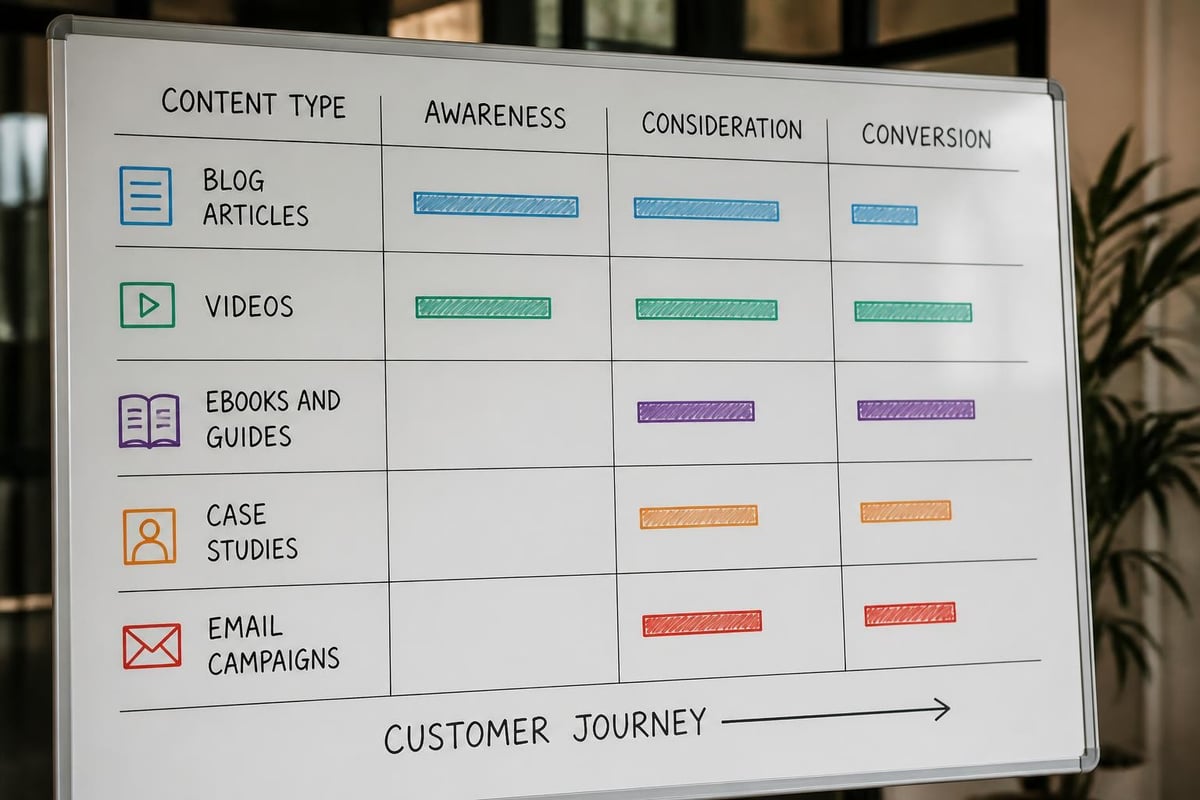
Understanding how content contributes to revenue requires attribution modeling that tracks the customer journey across touchpoints. First-touch attribution credits the initial discovery content, while last-touch credits the final content before conversion. Multi-touch models distribute credit across all content interactions.
For many Middle East businesses, content ROI calculation must account for longer sales cycles and offline conversion components. A prospect might discover your brand through a blog article, engage with social content over weeks, attend a webinar, and then complete purchase through a sales representative. Proper tracking systems connect these touchpoints to demonstrate content's full contribution.
Building Your Content Creation Skillset
Aspiring content creators should approach skill development strategically, focusing on capabilities that employers and clients actually need rather than trying to master every possible tool or technique simultaneously.
Foundational Skills to Prioritize
Writing clarity forms the base of all content work. Before exploring advanced tactics, ensure you can communicate ideas clearly, structure information logically, and adapt tone for different audiences and purposes. Practice doesn't require formal training-regular writing with feedback accelerates improvement more than passive learning.
SEO fundamentals separate content that gets discovered from content that languishes unseen. Understanding how search engines evaluate content, how to conduct keyword research, and how to optimize without compromising readability makes your work more valuable across contexts. Resources like Google’s Search Central documentation provide authoritative guidance on creating helpful, people-first content.
Platform knowledge enables effective distribution. Each social platform, search engine, and content channel has specific requirements, best practices, and algorithm considerations. Content creators don't need to master every platform, but should deeply understand those most relevant to their target audience and industry.
Structured Learning Paths
Self-taught creators often struggle with knowledge gaps and lack feedback on their work. Structured programs provide curriculum designed around real-world requirements, expert instruction, and portfolio-building opportunities.
Professional content creation training should cover strategy development, multiple content formats, SEO and distribution, analytics and optimization, and AI tool integration. Hands-on projects that build portfolio pieces provide more value than theoretical instruction alone.
Programs that include certification demonstrate credible skill levels to potential employers and clients. Industry-recognized certifications carry particular weight in competitive markets like Dubai and Abu Dhabi where employers often receive numerous applications for content positions.
The Intoact content creator program addresses these requirements with practical training designed specifically for professionals building content careers in the Middle East digital marketing landscape.
Continuous Skill Development
Content creation digital marketing evolves continuously as platforms update, audience behaviors shift, and new technologies emerge. Recent marketing trend analysis highlights the accelerating pace of change across content formats, distribution channels, and creation tools.
Successful content creators build learning into their ongoing practice. This might include dedicating time weekly to testing new AI tools, analyzing top-performing content in your niche, experimenting with emerging formats, attending webinars and workshops, or participating in professional communities where creators share tactics and insights.
Content Strategy for Middle East Markets
Content creators serving businesses in Lebanon and the UAE navigate specific cultural, linguistic, and market considerations that shape effective content approaches.
Language and Localization Considerations
Many businesses across the region operate in both Arabic and English, requiring content creators comfortable with bilingual or multilingual content strategies. Even when creating exclusively in English, understanding local dialect preferences, cultural references, and regional terminology improves resonance.
Translation alone rarely suffices for localization-true adaptation considers how concepts, examples, and even content formats perform differently across cultural contexts. A content approach successful in Western markets may need significant modification for Gulf audiences based on communication preferences, trust-building patterns, and decision-making processes.
Regional Platform Preferences
While global platforms like Instagram, LinkedIn, and YouTube dominate across the Middle East, usage patterns and content preferences vary. Lebanese audiences may engage differently with content formats than Emirati audiences. Business decision-makers in different industries show distinct platform preferences that shape distribution strategy.
Understanding these nuances comes from data analysis and market familiarity rather than assumptions. Reviewing analytics from existing content, studying competitor performance, and testing different approaches reveals what actually works for your specific audience rather than what general advice suggests.
Content creation digital marketing combines strategic thinking, creative execution, technical knowledge, and analytical rigor-a skillset increasingly essential for marketing careers across the Middle East and globally. Whether you're building content capabilities for career advancement, launching a freelance practice, or strengthening your business's marketing performance, systematic skill development produces better results than scattered learning. Intoact offers practical digital marketing and AI training programs designed specifically for professionals, entrepreneurs, and businesses in Lebanon and the UAE, with hands-on courses, expert instruction, and recognized certifications that support measurable career and business growth.