


Searching for a "digital agency near me" has become one of the most common queries for business owners looking to improve their online presence. The right agency partnership can transform your digital marketing performance, while the wrong choice costs money, time, and opportunity. Understanding how to evaluate local agencies, what questions to ask, and which services truly drive return on investment helps you make a decision that supports your business goals.
Why Local Digital Agencies Matter in 2026
Geographic proximity matters less than it did five years ago, but working with a digital agency in your area still offers distinct advantages. Face-to-face meetings allow for deeper strategic conversations, faster feedback cycles, and stronger working relationships built on trust.
Local agencies understand regional market dynamics, consumer behavior patterns specific to your area, and competitive landscapes that national firms might overlook. They can attend your events, visit your location, and integrate into your team more seamlessly than remote partners.
Key benefits of local agency partnerships:
- Direct access for urgent campaign adjustments
- Understanding of local customer demographics and preferences
- Easier collaboration across marketing, sales, and product teams
- Ability to support time-sensitive launches and promotions
- Shared business network and potential partnership introductions
According to Statista’s digital advertising data, U.S. businesses invested over $200 billion in digital advertising in 2026, with small and medium businesses increasingly seeking specialized agency support to compete effectively.

Services Every Full-Service Digital Agency Should Offer
When evaluating a digital agency near me, understanding their service portfolio reveals whether they can support your complete digital ecosystem or only handle isolated tactics. Complete agencies integrate multiple channels into cohesive strategies rather than selling disconnected services.
Paid Advertising Management
Performance-driven paid advertising requires constant optimization, testing, and strategic adjustment. Quality agencies focus on return on investment metrics, not vanity numbers like impressions or reach.
| Service Component | What to Expect | Red Flags |
|---|---|---|
| Campaign Strategy | Audience research, customer journey mapping, channel selection | Generic plans without business-specific insights |
| Platform Management | Meta Ads, Google Ads, TikTok, LinkedIn campaigns | Focus on only one platform |
| Performance Tracking | ROI measurement, conversion attribution, regular reporting | Reporting only on clicks or impressions |
| Optimization | A/B testing, bid strategies, creative iteration | Set-it-and-forget-it approach |
Agencies should demonstrate how they've improved client ROI over time through structured testing and data-driven decisions. When meeting with potential partners, ask for case studies showing percentage improvements in cost per acquisition or return on ad spend.
Search Engine Optimization and Visibility
SEO has evolved beyond traditional keyword optimization into a complex discipline encompassing technical performance, content strategy, and emerging channels like AI-powered search platforms. Modern agencies now offer AEO (Answer Engine Optimization) and GEO (Generative Engine Optimization) alongside traditional SEO.
The Google Search Central documentation outlines current best practices, but applying these principles to your specific business requires expertise and ongoing adaptation as algorithms evolve.
Comprehensive SEO services include:
- Technical audits identifying crawl issues, site speed problems, and mobile usability gaps
- Keyword research aligned with actual business value, not just search volume
- Content optimization supporting both user intent and search visibility
- Link building through genuine relationships and valuable content
- Local SEO for businesses serving geographic markets
- Tracking rankings, organic traffic, and conversions from search
For businesses investing in digital marketing education, understanding these fundamentals yourself creates more productive agency relationships. Intoact’s comprehensive training programs help business owners ask better questions and evaluate agency recommendations with confidence.
Content Strategy and Production
Content drives most digital marketing channels, from social media to email to organic search. Agencies should develop content strategies tied to business objectives, not just publishing calendars filled with generic blog posts.
Strategic content addresses specific stages of your customer journey, answers questions your prospects actually ask, and differentiates your brand from competitors. Quality agencies audit your existing content, identify gaps, and create frameworks that your team can sustain long-term.

Questions to Ask When Interviewing Digital Agencies
The discovery conversation reveals whether an agency truly understands your business or simply wants to sell standardized packages. Smart business owners come prepared with questions that uncover expertise, process, and cultural fit.
Strategy and Approach Questions
Start by understanding how the agency thinks about digital marketing strategy. Ask them to walk through their typical onboarding and strategy development process. Quality agencies invest time in understanding your business model, customer lifecycle, competitive position, and internal capabilities before proposing solutions.
Critical strategy questions:
- How do you determine which channels and tactics to prioritize for a new client?
- What metrics do you track to measure campaign success, and how do those connect to our revenue goals?
- How do you integrate paid and organic channels into unified strategies?
- What role does AI play in your campaign management and optimization?
The U.S. Chamber of Commerce marketing resources provide helpful frameworks for small businesses evaluating whether to build in-house capabilities or partner with agencies.
Performance and Results Questions
Past performance indicates future results better than promises or credentials. Request specific case studies from companies similar to yours in size, industry, or business model.
Ask about their biggest campaign failure and what they learned from it. This reveals self-awareness and commitment to continuous improvement. Agencies that only share successes either haven't managed enough campaigns or lack the honesty needed for strong partnerships.
| Question Category | Specific Questions | Why It Matters |
|---|---|---|
| Client Results | What percentage improvement in ROI have you delivered for clients in our industry? | Demonstrates relevant experience and outcome focus |
| Reporting | What does your standard performance report include, and how often do you provide updates? | Shows transparency and communication standards |
| Problem Solving | Describe a campaign that underperformed and how you turned it around | Reveals troubleshooting ability and accountability |
| Team Access | Who will actually work on our account day-to-day? | Clarifies whether you get senior strategists or junior staff |
Process and Communication Questions
Smooth collaboration requires clear processes, defined responsibilities, and consistent communication rhythms. Understand how the agency manages projects, handles feedback, and escalates issues.
Discuss their typical meeting cadence, reporting schedule, and approval workflows. Clarify who owns which assets and what happens if the partnership ends. Strong agencies document these details in clear service agreements that protect both parties.
Evaluating Agency Expertise and Specialization
Not all digital agencies excel at every service. Some specialize in e-commerce paid advertising, others in B2B content and SEO, still others in brand-building social media. Matching their strengths to your needs matters more than choosing the largest or most established firm.
Platform and Channel Expertise
Review the specific platforms and channels where the agency demonstrates proven results. An agency claiming expertise in "all digital marketing" likely excels at nothing. Look for depth in the channels most important to your business.
For companies heavily investing in social advertising, agencies with Meta and TikTok Ads expertise deliver better results than generalists spreading attention across too many platforms.
Industry Experience
Industry-specific experience accelerates results because agencies understand your customers, competitive dynamics, and regulatory constraints from day one. However, fresh perspectives from agencies serving different industries sometimes uncover innovative approaches your competitors miss.
Balance industry experience with strategic thinking ability. An agency with strong analytical skills and curiosity can often outperform one that relies solely on industry tenure without evolving their approach.
Technology and Tool Proficiency
Modern digital marketing requires mastery of numerous platforms, analytics tools, and automation systems. According to Deloitte Digital’s research, agencies investing in technology integration and AI capabilities deliver significantly better client outcomes than those relying on manual processes.
Ask which tools they use for:
- Campaign management and automation
- Analytics and attribution
- Competitive research and market intelligence
- Content creation and optimization
- Reporting and data visualization
Agencies should also demonstrate accessibility awareness in their website development and content creation, ensuring your digital properties serve all potential customers.
Understanding Pricing Models and Contracts
Digital agency pricing varies dramatically based on service scope, expertise level, and engagement structure. Understanding common models helps you compare proposals and negotiate fair terms.
Common Pricing Structures
Retainer agreements provide ongoing monthly services for a fixed fee. This model works well for continuous optimization of paid campaigns, regular content production, and sustained SEO efforts. Retainers typically range from $2,500 to $15,000+ monthly for small to mid-sized businesses.
Project-based pricing suits defined initiatives like website redesigns, campaign launches, or strategic audits. Projects offer clear scope and deliverables but can create gaps between engagements when you need ongoing support.
Performance-based compensation ties agency fees to results like leads generated, revenue driven, or cost savings achieved. While attractive in theory, this model requires sophisticated tracking and clear baseline metrics. Many agencies avoid pure performance pricing due to factors outside their control affecting results.
Percentage of ad spend charges 10-20% of your advertising budget as the management fee. This aligns agency incentives with campaign growth but can create conflicts if agencies recommend higher budgets primarily to increase their fees.
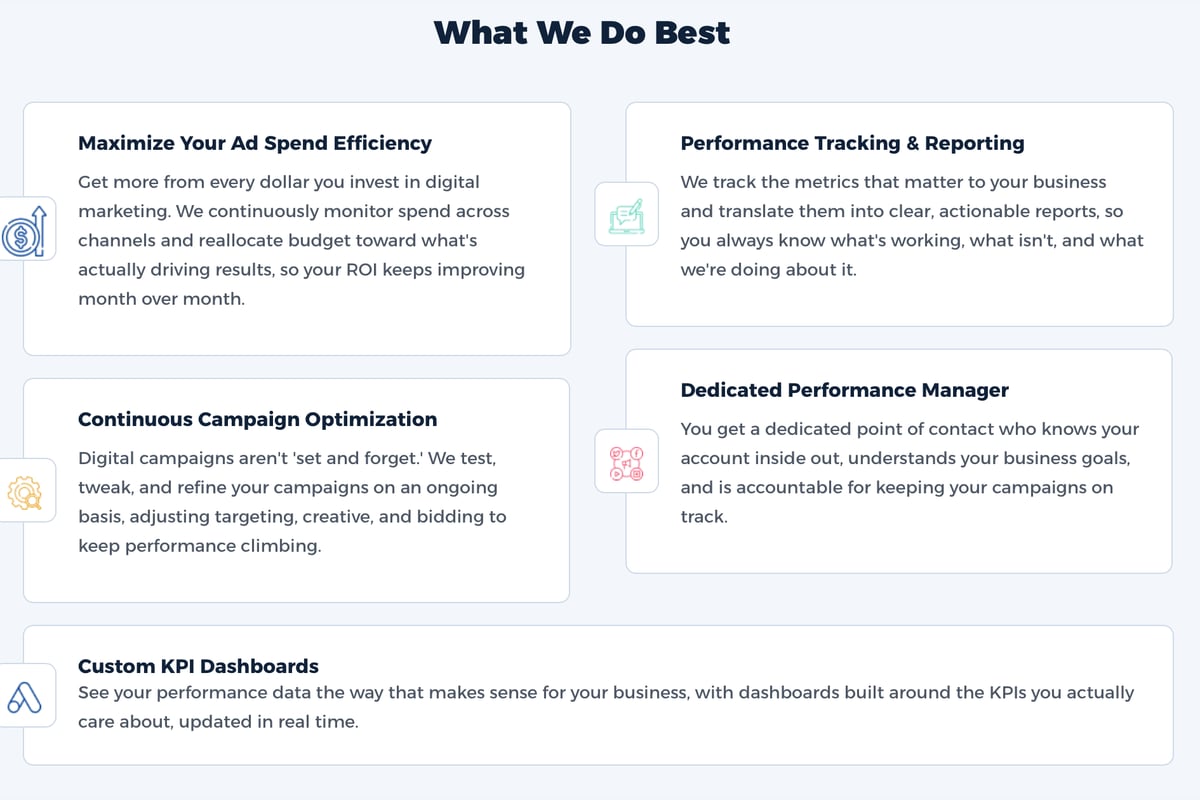
For businesses seeking ongoing optimization and accountability, performance management services that combine strategic oversight with hands-on campaign execution often deliver the strongest return on investment.
Contract Terms and Exit Clauses
Review contract length, termination requirements, and asset ownership carefully. Reasonable agencies offer 30-90 day termination clauses after an initial commitment period, allowing you to exit if results don't meet expectations.
Clarify who owns campaign data, creative assets, audience lists, and website content created during the engagement. Your contract should guarantee you retain access to all business-critical assets if the partnership ends.
Red Flags When Choosing a Digital Agency
Certain warning signs indicate an agency will likely underdeliver, overcomplicate, or overpromise. Recognizing these patterns protects you from costly partnerships that waste months before you realize they're not working.
Guaranteed rankings or specific result promises: No agency can guarantee first-page rankings or specific conversion numbers. Google’s algorithm documentation makes clear that hundreds of factors influence search visibility, many beyond any agency's control.
Vague reporting and reluctance to share data: Quality agencies provide transparent access to campaign dashboards and detailed performance reports. Hesitation to share login credentials or resistance to explaining methodology suggests they're hiding poor results or using questionable tactics.
Focus on activities rather than outcomes: Agencies that report "we posted 20 times this month" instead of "we generated 50 qualified leads" prioritize busywork over results. Measure partners on business impact, not task completion.
One-size-fits-all packages: Your business has unique goals, customers, and competitive challenges. Agencies offering identical service packages to every client lack the strategic thinking needed to drive meaningful results.
Pressure to sign immediately: Legitimate agencies understand that choosing a marketing partner requires careful consideration. High-pressure sales tactics indicate they need your deposit more than they care about fit or long-term success.
Building a Productive Agency Partnership
Selecting the right digital agency near me represents only the first step. Strong partnerships require ongoing collaboration, clear communication, and mutual accountability.
Onboarding and Knowledge Transfer
Effective onboarding sets expectations, transfers essential context, and establishes collaboration patterns. Prepare background materials including:
- Business goals and KPIs for the next 6-12 months
- Customer personas and journey maps
- Brand guidelines and messaging frameworks
- Historical performance data from previous campaigns
- Competitive analysis and market positioning
- Access credentials for relevant platforms and tools
The more context you provide upfront, the faster your agency delivers strategic recommendations and measurable results.
Establishing Communication Rhythms
Define regular touchpoints that balance oversight with efficiency. Most successful partnerships include:
- Weekly status updates via email or project management platform
- Bi-weekly optimization calls reviewing performance and adjustments
- Monthly strategic reviews assessing progress toward goals
- Quarterly business reviews aligning digital strategy with evolving objectives
Adjust frequency based on campaign complexity and your involvement preference, but maintain consistent rhythms that prevent surprises.
Measuring Partnership Success
Track both campaign metrics and partnership health indicators. Campaign performance includes standard digital marketing KPIs like traffic, leads, conversions, and ROI. Partnership quality encompasses responsiveness, proactive recommendations, strategic thinking, and collaborative spirit.
| Success Metric | Measurement Approach | Review Frequency |
|---|---|---|
| Campaign ROI | Revenue/profit generated vs. agency fees + ad spend | Monthly |
| Lead Quality | Conversion rate of agency-generated leads to customers | Monthly |
| Responsiveness | Average time to respond to questions or issues | Ongoing |
| Strategic Value | Number of proactive recommendations implemented | Quarterly |
| Knowledge Transfer | Your team's growing digital marketing capabilities | Quarterly |
The best agency relationships help you build internal expertise while they handle execution. Consider complementing agency partnerships with digital marketing training for your team to create more informed collaboration and reduce long-term dependence.
Alternative Models: Consultants and Training
Not every business needs a full-service digital agency. Smaller companies or those with existing marketing teams might benefit more from strategic consulting or skills development that builds internal capabilities.
When Consulting Makes More Sense
Digital marketing consultants provide strategic guidance, audit existing efforts, and recommend improvements without handling day-to-day execution. This model works well when you have capable team members who need direction rather than outsourced labor.
Consulting costs less than full-service agency retainers while still providing expert insights. However, it requires internal resources to implement recommendations, creating a trade-off between cost savings and execution capacity.
Building Internal Capabilities
Companies investing in employee development often achieve stronger long-term results than those perpetually dependent on agencies. Training your team creates institutional knowledge, faster decision-making, and better collaboration with any external partners.
Structured programs covering digital strategy, paid advertising, content marketing, and analytics fundamentals transform marketing teams from order-takers to strategic contributors. This approach particularly benefits companies planning sustained digital investment over multiple years.
Making Your Decision
Choosing the right digital agency near me requires balancing multiple factors: expertise, cultural fit, pricing, service scope, and strategic alignment with your business goals. No single perfect agency exists for every company.
Prioritize agencies demonstrating:
- Clear results in channels most important to your business
- Transparent communication about both successes and challenges
- Strategic thinking beyond tactical execution
- Cultural alignment with your values and working style
- Reasonable pricing that reflects expertise without exploiting urgency
Trust your instincts during discovery conversations. Agencies that listen more than they talk, ask thoughtful questions about your business, and resist premature recommendations typically make stronger long-term partners.
Schedule consultations with 3-5 agencies, compare proposals carefully, and check references before committing. The right partnership transforms your digital marketing from an expense into a growth engine.
Finding the right digital agency near me comes down to matching their capabilities with your specific business needs and ensuring alignment on strategy, communication, and results measurement. Whether you need comprehensive agency support, strategic consulting, or prefer building internal expertise through training, the key is choosing partners focused on measurable return on investment rather than activity metrics. Intoact helps businesses navigate these decisions through practical digital marketing and AI training, strategic consulting, and performance-focused campaign management designed to drive real business outcomes.


