


Sales teams need more than traditional outreach to hit revenue targets in 2026. Digital marketing for sales has evolved from a support function into a revenue-generating engine that attracts qualified prospects, nurtures them through the buyer journey, and delivers measurable pipeline growth. Organizations that align their digital marketing efforts with sales objectives see 36% higher customer retention rates and 38% higher sales win rates, according to research on marketing and sales alignment from HubSpot.
The Revenue Impact of Digital Marketing for Sales
Digital marketing for sales creates measurable business outcomes when executed with clear revenue objectives. Every campaign, content asset, and customer touchpoint should connect to pipeline metrics, not just vanity numbers like impressions or followers.
The shift from marketing as a cost center to a revenue driver requires performance-based measurement frameworks. Instead of tracking website visits alone, modern digital marketing for sales focuses on lead quality scores, cost per qualified lead, marketing-sourced revenue, and customer acquisition cost. These metrics directly reflect how digital efforts contribute to closed deals and recurring revenue.

Building a Demand Generation System
Effective demand generation through digital channels requires a systematic approach across awareness, consideration, and decision stages. Each phase demands different tactics and content types aligned with buyer readiness.
Awareness stage tactics include:
- Paid search campaigns targeting problem-focused keywords
- SEO content answering early-stage questions
- Social media advertising to cold audiences
- Thought leadership content distribution
- Educational webinars and workshops
Consideration stage approaches involve:
- Retargeting campaigns to engaged visitors
- Email nurture sequences with case studies
- Comparison guides and product education
- Interactive tools and assessments
- Industry-specific solution content
Decision stage conversion tactics feature:
- Demo request campaigns
- Free trial or consultation offers
- ROI calculators and pricing information
- Customer testimonials and proof points
- Sales enablement content for direct conversations
| Funnel Stage | Primary Goal | Key Metrics | Typical Conversion Rate |
|---|---|---|---|
| Awareness | Reach target audience | Impressions, reach, traffic | 2-5% to consideration |
| Consideration | Educate and nurture | Engagement rate, email opens, content downloads | 10-20% to decision |
| Decision | Convert to sales opportunity | MQL to SQL ratio, demo requests, trial signups | 20-40% to closed deal |
Organizations using Google’s integrated marketing approaches see significant improvements in conversion rates by delivering timely, relevant messages at each funnel stage.
Paid Advertising for Direct Sales Impact
Paid digital advertising delivers immediate sales pipeline when campaigns focus on intent-driven targeting and conversion optimization. Meta Ads, Google Ads, LinkedIn Ads, and TikTok Ads each serve different roles in a comprehensive digital marketing for sales strategy.
Platform Selection and Strategy
LinkedIn Ads excel for B2B sales with precise job title, company size, and industry targeting. Cost per lead averages $75-$100 but delivers higher-quality enterprise prospects. Campaign types include sponsored content for awareness, message ads for direct outreach, and lead gen forms for friction-free conversion.
Meta Ads (Facebook and Instagram) provide broader reach with sophisticated interest and behavior targeting. Average cost per lead ranges from $15-$45 depending on industry. Video ads showcasing customer results outperform static images by 35-50% in conversion rates.
Google Search Ads capture active buyer intent through keyword targeting. Commercial intent keywords (pricing, demo, trial) convert 3-5 times higher than informational terms. Quality Score optimization reduces cost per click while improving ad position.
TikTok Ads reach younger decision-makers and emerging B2B audiences. Short-form video content demonstrating product value or customer success drives engagement rates 2-3 times higher than traditional platforms.
Professionals looking to master paid advertising across platforms benefit from specialized training that covers campaign strategy, creative testing, audience segmentation, and performance optimization. Intoact’s Meta & TikTok Ads Course provides practical training for marketers who want to create, manage, and optimize paid social campaigns that deliver measurable sales results.

Attribution and Revenue Tracking
Multi-touch attribution models reveal how different digital channels contribute to sales conversions. First-touch attribution credits the initial interaction, last-touch assigns value to the final touchpoint before conversion, and linear models distribute credit equally across all touchpoints.
Advanced attribution approaches include:
- Time-decay models giving more weight to recent interactions
- Position-based attribution crediting first and last touch heavily
- Data-driven attribution using machine learning to assign value
- Custom models based on your specific sales cycle patterns
CRM integration connects marketing activity directly to closed revenue. When digital marketing platforms sync with sales systems, you track which campaigns, keywords, and content assets generate actual customers, not just leads that disappear into a black hole.
Content Marketing that Enables Sales Conversations
Content serves dual purposes in digital marketing for sales: attracting prospects through search and social channels while equipping sales teams with assets that move deals forward. Content Marketing Institute research shows that 82% of successful B2B marketers create content specifically designed to help sales teams during active deals.
Sales Enablement Content Types
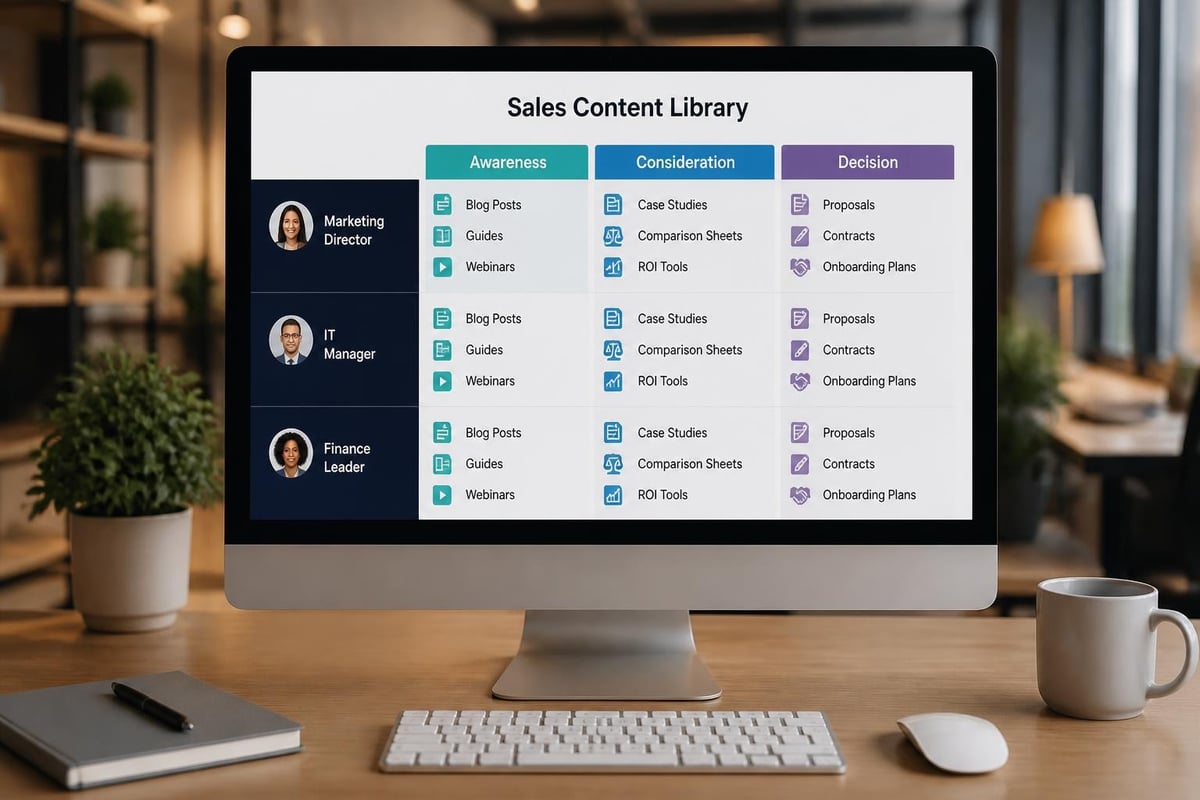
Different content formats address specific objections and questions throughout the sales process. Case studies prove results for similar companies. ROI calculators quantify potential value. Comparison guides position your solution against alternatives. Product demo videos show functionality without requiring sales time.
High-performing sales enablement assets:
- One-page solution briefs for quick email sharing
- Industry-specific use case documentation
- Video testimonials from recognizable customers
- Technical specification sheets for evaluation teams
- Implementation timeline and success plan templates
Sales teams close deals 15-20% faster when armed with relevant, current content for each buying stage. Marketing must create a searchable content library organized by industry, use case, objection type, and buyer role.
SEO and Organic Visibility for Sales Pipeline
Search engine optimization builds compounding sales pipeline by capturing buyer intent at scale. Unlike paid advertising that stops when budget runs out, SEO creates ongoing lead flow from prospects actively researching solutions.
Commercial Intent Keyword Strategy
Keywords fall into three categories based on search intent: informational (learning), navigational (finding specific sites), and commercial (ready to evaluate or buy). Digital marketing for sales prioritizes commercial and transactional keywords that indicate buying readiness.
Commercial intent signals include:
- "Best for [use case]"
- "[Product] pricing" or "[Product] cost"
- "[Product] vs [competitor]" comparisons
- "[Product] demo" or "[Product] trial"
- "[Solution] for [industry]" vertical searches

Content targeting these terms converts 5-10 times higher than informational blog posts. Create dedicated landing pages optimized for commercial keywords with clear calls-to-action, social proof, and conversion forms.
| Content Type | Search Intent | Conversion Rate | Sales Cycle Impact |
|---|---|---|---|
| Problem-focused blog posts | Informational | 0.5-1.5% | Early awareness |
| Solution comparison guides | Commercial | 3-7% | Active evaluation |
| Pricing and demo pages | Transactional | 8-15% | Ready to buy |
| Industry solution pages | Commercial | 4-9% | Targeted consideration |
Organizations seeking comprehensive visibility across traditional search and AI-powered platforms should explore advanced optimization approaches. Intoact’s SEO, AEO & GEO Services help businesses increase their visibility across search engines and AI search platforms through strategic keyword research, technical optimization, and content development.
Technical SEO for Conversion
Page speed directly impacts conversion rates. Every second of load time delay reduces conversions by approximately 7%. Mobile responsiveness is non-negotiable as 60-70% of B2B research now happens on smartphones.
Structured data markup helps search engines understand your content context and can earn rich snippets that increase click-through rates by 20-40%. Schema types for products, services, FAQs, and reviews make your listings more compelling in search results.
Email Marketing for Nurture and Conversion
Email remains the highest-ROI digital marketing channel for sales, delivering $36-$42 for every dollar spent. Effective email marketing for sales requires segmentation, personalization, and behavioral triggers that respond to prospect actions.
Automated Nurture Sequences
Drip campaigns guide prospects from initial interest to sales-ready status through scheduled educational content. Behavior-triggered emails respond to specific actions like content downloads, pricing page visits, or demo video views with contextually relevant follow-up.
High-performing email automation workflows:
- Welcome series introducing brand value and key resources
- Content upgrade sequences delivering promised assets plus related education
- Re-engagement campaigns reviving cold leads with new offers
- Event promotion and follow-up sequences for webinars
- Product education series for trial users or demo requesters
Personalization beyond first names improves performance significantly. Dynamic content blocks showing industry-specific examples, company size-relevant case studies, or role-based messaging increase click-through rates by 25-50%.
Marketing and Sales Alignment for Revenue Growth
The disconnect between marketing and sales teams costs businesses millions in lost revenue and wasted effort. Harvard Business Review research reveals that aligned organizations achieve 19% faster revenue growth and 15% higher profitability compared to misaligned peers.
Service Level Agreements and Lead Definitions
Formal SLAs between marketing and sales establish clear expectations for lead volume, lead quality, and follow-up timing. Marketing commits to delivering a specific number of qualified leads monthly. Sales commits to contacting leads within defined timeframes and providing feedback on lead quality.
Lead definition framework components:
- Marketing Qualified Lead (MQL) criteria based on engagement and fit
- Sales Qualified Lead (SQL) requirements indicating buying intent
- Lead scoring models assigning points for demographic fit and behavior
- Disqualification criteria to prevent wasted sales time
- Feedback loops for continuous definition refinement
Shared revenue targets create joint accountability. When both teams own the same pipeline and revenue goals, finger-pointing stops and collaboration increases. Weekly alignment meetings review campaign performance, lead quality trends, deal progress, and optimization opportunities.
Technology Integration and Visibility
CRM and marketing automation platform integration provides single-source-of-truth reporting on campaign performance and sales outcomes. Sales teams see which campaigns generated each lead. Marketing teams track lead-to-customer conversion rates and revenue attribution by channel.
Closed-loop reporting tracks the complete journey from first touchpoint through closed deal and customer lifetime value. This visibility enables data-driven budget allocation, focusing investment on channels and campaigns that generate actual revenue, not just activity metrics.
Performance Measurement and Optimization
Digital marketing for sales demands rigorous measurement frameworks that connect marketing spend to revenue outcomes. Vanity metrics like social media followers or website traffic mean nothing without conversion and revenue context.
Revenue-Focused KPIs
Top-level metrics for board reporting:
- Customer Acquisition Cost (CAC) across all channels
- Marketing-sourced revenue as percentage of total sales
- Return on Ad Spend (ROAS) for paid campaigns
- Lead-to-customer conversion rate by source
- Customer Lifetime Value to CAC ratio
Channel-specific performance indicators:
- Cost per Marketing Qualified Lead by platform
- Content engagement to conversion rate
- Email nurture sequence conversion velocity
- SEO traffic to sales opportunity percentage
- Paid search Quality Score and conversion rate trends
Monthly performance reviews identify winning tactics to scale and underperforming efforts to optimize or eliminate. Forrester’s analysis of marketing-sales alignment emphasizes that organizations reviewing performance data together make better strategic decisions than siloed teams.
Testing and Continuous Improvement
A/B testing reveals what actually drives conversions versus what marketers assume works. Test landing page headlines, calls-to-action, form lengths, social proof elements, and value propositions systematically.
Testing prioritization framework:
- High traffic, low conversion pages first (biggest impact potential)
- Major conversion points like demo requests and trial signups
- Expensive paid traffic landing pages to improve ROAS
- Email subject lines and send times for nurture sequences
- Ad creative and targeting for paid campaigns
Statistical significance matters. Running tests for insufficient duration or with inadequate sample sizes produces misleading results. Most tests need 2-4 weeks and several hundred conversions per variant to reach valid conclusions.
AI and Automation in Digital Marketing for Sales
Artificial intelligence transforms digital marketing efficiency and effectiveness across campaign management, content creation, lead scoring, and personalization. AI-powered tools handle repetitive tasks while humans focus on strategy and creative direction.
Intelligent Lead Scoring and Prioritization
Machine learning models analyze thousands of data points to predict which leads are most likely to convert. Behavioral signals like page views, content downloads, email engagement, and website return visits combine with demographic fit factors to generate dynamic lead scores.
Predictive lead scoring identifies buying signals humans miss. AI detects patterns in successful customer journeys and flags prospects exhibiting similar behaviors for priority sales outreach. This targeting precision increases sales team efficiency by 20-30% by focusing effort on highest-probability opportunities.
AI-Powered Content and Campaign Optimization
Generative AI accelerates content production for email campaigns, ad copy, landing pages, and social media posts. AI tools draft initial versions based on prompts, target audience parameters, and desired outcomes. Marketers then refine and customize the output for brand voice and strategic positioning.
Campaign optimization algorithms continuously adjust bids, budgets, targeting, and creative elements based on performance data. Platform AI like Meta's Advantage+ campaigns and Google's Performance Max leverage machine learning to maximize conversions within budget constraints.
Professionals seeking to leverage AI effectively in their marketing work can develop practical skills through focused training. Modern digital marketing demands fluency with AI tools for content creation, strategy development, research, and campaign optimization.
Digital marketing for sales succeeds when every campaign, content piece, and customer interaction connects to measurable revenue outcomes. Organizations that align marketing and sales teams around shared goals, implement data-driven measurement frameworks, and continuously optimize based on performance create sustainable competitive advantages in their markets. Whether you need comprehensive training, strategic consulting, or ongoing performance management, Intoact provides the expertise and support to transform your digital marketing into a predictable revenue engine through practical courses, hands-on AI training, and ROI-focused services.


