


The demand for structured, practical digital marketing education has never been higher. Professionals across the Middle East are seeking training that delivers measurable career advancement, while companies need teams equipped with current strategies for social media, paid advertising, SEO, and AI-powered marketing tools. Digital marketing training courses now range from focused short programs to comprehensive certifications and customized corporate solutions, each serving distinct learning objectives and business requirements.
Understanding Digital Marketing Training Course Formats
Training providers structure digital marketing education in three primary formats, each addressing different learner needs and time constraints. Short courses target specific skills such as Meta advertising, content strategy, or AI implementation, typically spanning one to three days. Full certification programs offer comprehensive curricula covering all core disciplines, usually delivered over several weeks or months with structured assessments and recognized credentials. Corporate training programs provide customized team learning tailored to organizational goals, industry context, and existing skill gaps.
Short Courses for Targeted Skill Development
Short-format training delivers focused expertise in single disciplines without the time commitment of full certifications. These programs suit working professionals who need to close specific knowledge gaps or add new capabilities to their existing marketing toolkit.
Common short course topics include:
- Social media marketing and content strategy
- Meta and TikTok advertising campaigns
- SEO, AEO, and search visibility optimization
- AI tools for content creation and automation
- Email marketing and marketing automation
- Analytics, measurement, and performance tracking
The typical duration ranges from six to twenty-four hours, delivered as intensive one-day workshops, multi-day programs, or weekly evening sessions. This format works exceptionally well for business owners who need practical solutions quickly and marketers who want to stay current with platform updates and emerging tools.

Comprehensive Certification Programs
Full certification courses provide structured progression through all essential digital marketing disciplines, combining theoretical frameworks with practical application. These programs typically include modules on digital strategy, content marketing, social media, paid advertising, SEO, email marketing, analytics, and increasingly, AI integration across marketing functions.
Accredited certifications carry significant weight in the job market. The Digital Marketing Institute’s Certified Digital Marketing Associate (CDMA) credential, for example, provides internationally recognized validation of comprehensive digital marketing competency. According to research on emerging job skills and marketing competencies, digital marketing expertise continues to rank among the fastest-growing professional capabilities across industries.
| Program Type | Duration | Coverage | Best For |
|---|---|---|---|
| Short Course | 1-3 days | Single topic | Specific skill gaps, quick updates |
| Full Certification | 8-16 weeks | All core disciplines | Career transition, comprehensive knowledge |
| Corporate Training | Customized | Tailored to business needs | Team upskilling, aligned strategies |
Certification programs typically include hands-on projects, real campaign development, performance analysis assignments, and ongoing instructor support. This structure ensures learners don't just consume information but actively apply concepts to realistic marketing scenarios.
Corporate Training for Team Development
Organizations face distinct challenges when upskilling marketing teams. Different departments need different depths of knowledge: sales teams might require focused training on social selling and LinkedIn strategy, while product marketing teams need comprehensive content and positioning expertise. Corporate Digital Marketing & AI Training programs address these varied requirements through customized curricula that align with specific business objectives, industry context, and existing team capabilities.
Corporate programs typically address:
- Unified digital strategy aligned with business goals
- Platform-specific training for channels the company actively uses
- AI integration for marketing efficiency and content production
- Campaign optimization and performance improvement
- Cross-functional collaboration between marketing, sales, and product teams
- Industry-specific tactics and competitive positioning
Custom corporate training delivers efficiency that off-the-shelf courses cannot match. When ten team members need training, a tailored program focusing on your actual products, customers, and marketing challenges produces faster results than sending individuals to generic public courses covering irrelevant industries and scenarios.
Essential Curriculum Components in Quality Programs
Digital marketing training courses should cover foundational principles while incorporating current tools and platforms. The digital landscape evolves continuously, but certain core competencies remain constant even as specific tactics and platforms change.
Core Discipline Coverage
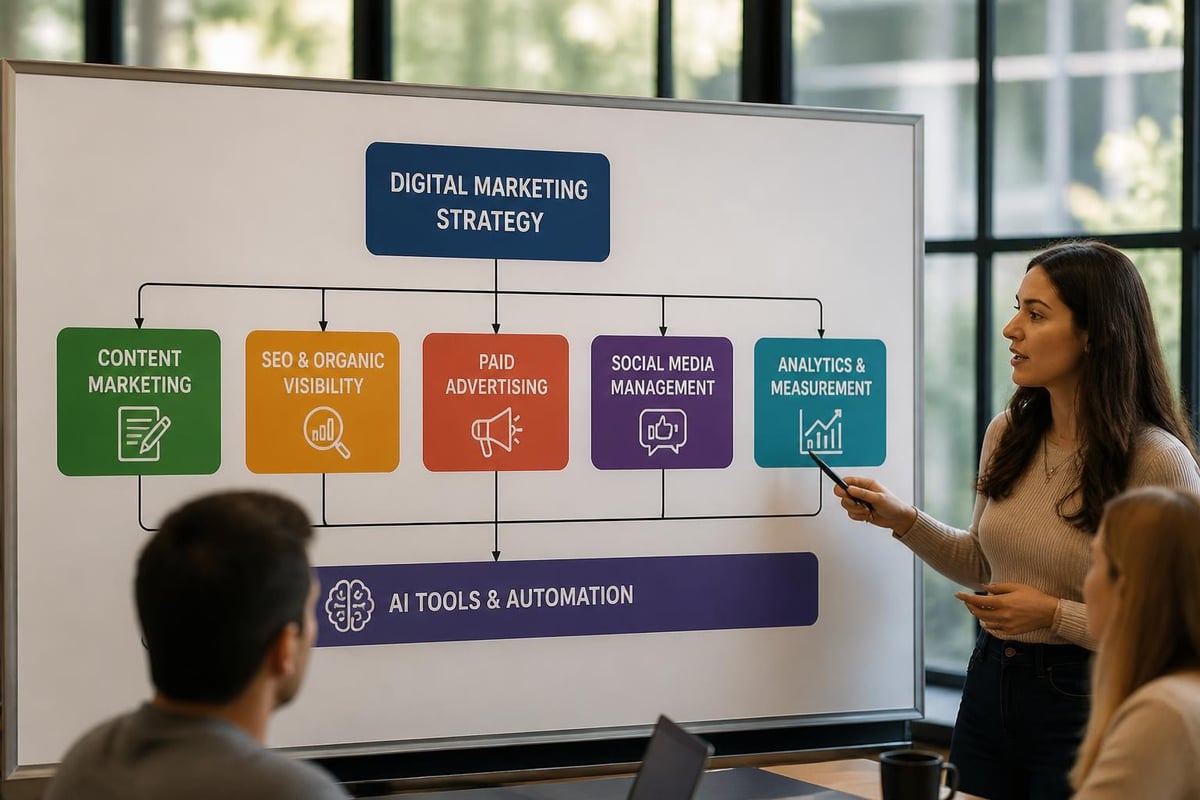
Comprehensive programs structure content across interconnected disciplines rather than treating each channel as isolated. Strategy forms the foundation, followed by audience research, content planning, channel execution, and performance measurement.
Strategic planning modules teach how to define objectives, identify target audiences, map customer journeys, and select appropriate channels based on business goals rather than trends. This strategic foundation prevents the common mistake of executing tactics without clear purpose or measurement frameworks.
Content marketing and creation sections address both strategy and production. Quality programs cover content planning, storytelling frameworks, copywriting principles, visual content creation, and increasingly, AI-assisted content development. Understanding how to use tools like ChatGPT for research, ideation, and draft creation has become as fundamental as understanding keyword research.
Paid advertising training must go beyond button-clicking platform tutorials. Effective programs teach campaign architecture, audience targeting strategy, creative development, budget optimization, and conversion tracking. Platforms like Meta and TikTok update their interfaces regularly, but the underlying principles of audience segmentation, message-market fit, and ROI measurement remain stable.
Practical Application and Live Projects
Theory without application produces limited learning retention. The most effective digital marketing training courses incorporate hands-on assignments that mirror real-world marketing challenges. Students might develop complete campaign strategies, create content calendars, build and optimize ad campaigns with actual budgets, or conduct competitive SEO analysis.
Live projects provide several advantages over theoretical instruction:
- Immediate feedback loops where instructors review actual work and provide specific improvement guidance
- Portfolio development that demonstrates practical competency to employers or clients
- Mistake-safe environments where learners can test approaches without risking real marketing budgets
- Peer learning through reviewing classmates' strategies and approaches
Programs that include mentorship or instructor feedback on student projects typically deliver superior outcomes compared to self-paced video courses without interaction. The ability to ask questions about your specific situation and receive expert guidance accelerates learning significantly. Reviewing a digital marketing academy‘s instructor support, feedback and curriculum depth can help you judge which training delivers the best results.
Current Tool and Platform Training
Digital marketing execution requires proficiency with numerous tools and platforms. Quality training integrates these tools throughout the curriculum rather than treating them as separate "bonus" modules.
Analytics platforms like Google Analytics 4, Meta Business Suite insights, and TikTok Analytics form the measurement foundation. Students should learn not just how to navigate dashboards but how to extract actionable insights, identify performance patterns, and make data-driven optimization decisions.
AI and automation tools have transformed marketing workflows. Training should cover practical applications: using AI for keyword research, content ideation, image generation, ad copy testing, audience research, and competitive analysis. The focus should remain on strategic AI use that enhances human creativity rather than replacing strategic thinking.
Design and content creation tools including Canva, video editing platforms, and content management systems enable marketers to execute campaigns without depending entirely on external resources. Basic proficiency with these tools significantly increases marketing agility and reduces campaign execution timelines.
Choosing Between Individual and Corporate Training
The decision between individual enrollment and corporate team training depends on learning objectives, team size, budget constraints, and organizational readiness for change. Each approach offers distinct advantages in different scenarios.
When Individual Courses Make Sense
Individual digital marketing training courses work best for professionals managing their own career development, freelancers building service capabilities, or business owners wearing the marketing hat themselves. Solo learners benefit from diverse peer groups, exposure to multiple industries and approaches, and networking with professionals from different sectors.
Individual programs excel when:
- You're transitioning careers into digital marketing
- You need recognized credentials for job applications
- You want exposure to marketing challenges across multiple industries
- Your organization has only one or two people requiring training
- You prefer self-directed learning at your own pace
- Budget constraints make individual enrollment more accessible
The networking component of individual courses often proves unexpectedly valuable. Connecting with marketers from e-commerce, B2B services, hospitality, education, and other sectors exposes you to creative approaches and solutions you might never encounter within a single company or industry.
Strategic Value of Corporate Team Training
Organizations benefit substantially when multiple team members receive aligned training simultaneously. Shared language, common frameworks, and unified strategies emerge when teams learn together, eliminating the confusion that occurs when different team members apply conflicting methodologies learned from different sources.
Corporate training delivers unique advantages:
- Customized content addressing your specific products, services, customers, and competitive landscape
- Immediate application to current campaigns and marketing challenges
- Team alignment around shared strategies, measurement approaches, and campaign workflows
- Confidential discussion of actual performance data, competitive intelligence, and business strategies
- Schedule flexibility adapted to business cycles and team availability
- Cost efficiency when training multiple team members
Organizations frequently discover that internal barriers preventing effective marketing stem not from individual incompetence but from misaligned understanding and conflicting approaches. When the social media manager learned platform best practices from one source, the content team from another, and the paid media specialist from a third, the resulting strategies often conflict rather than reinforce each other.
| Factor | Individual Course | Corporate Training |
|---|---|---|
| Cost per person | Fixed course fee | Volume discounts available |
| Content relevance | General best practices | Tailored to business context |
| Scheduling | Fixed public dates | Flexible, customized timing |
| Peer learning | Cross-industry networking | Team collaboration and alignment |
| Application | Student's own projects | Company's actual campaigns |
| Duration | Standard program length | Compressed or extended as needed |
Evaluating Course Quality and Provider Credentials
The digital marketing training industry includes providers ranging from internationally accredited institutions to individual consultants offering weekend workshops. Quality varies dramatically, making due diligence essential before committing time and budget.
Accreditation and Recognition
Formal accreditation provides third-party validation of curriculum quality, instructor qualifications, and learning outcomes. In the UAE, the Knowledge and Human Development Authority (KHDA) accredits training providers meeting specific educational standards. International bodies like the Digital Marketing Institute (DMI) set global benchmarks for digital marketing education.
Accreditation matters particularly when credentials support career advancement or job applications. Employers recognize established certification bodies and may specifically require credentials from known institutions. Research from academic analyses of marketing program structures suggests that accredited programs demonstrate stronger alignment between curriculum and actual marketing job requirements.
Questions to assess provider credibility:
- Does the provider hold recognized accreditation from educational authorities?
- Are instructors active marketing practitioners or purely academic theorists?
- Can the provider share alumni outcomes and career progression data?
- Does the curriculum reflect current platforms, tools, and strategies?
- Are course materials regularly updated to match platform changes?
Instructor Expertise and Industry Experience
The best digital marketing training courses are taught by professionals who actively practice what they teach. Instructors managing live campaigns, consulting for businesses, and working directly with platforms bring current insights that academic-only educators cannot match.
Verify instructor backgrounds through LinkedIn profiles, published case studies, client testimonials, and their own digital presence. Marketing educators should demonstrate marketing competency through their own content, social media presence, and thought leadership. An SEO instructor whose website ranks poorly for relevant terms, or a social media teacher with minimal engagement, raises legitimate credibility questions.
Curriculum Currency and Platform Updates
Digital marketing platforms update features, algorithms, and advertising policies continuously. Training created eighteen months ago may contain outdated information about Meta's campaign structures, Google's ranking factors, or TikTok's advertising capabilities. Quality providers update course materials quarterly or more frequently to reflect platform changes.
Ask specific questions about curriculum updates: When was content last revised? How does the provider track platform changes? What process ensures students learn current rather than legacy approaches? Programs that acknowledge their update schedule and methodology demonstrate commitment to educational quality.
Digital Marketing Training in Lebanon and the UAE
The Middle East digital landscape presents unique opportunities and challenges that generic international training often overlooks. Local market dynamics, platform usage patterns, language considerations, and regulatory environments require region-specific context within digital marketing education.
Market Context and Opportunities
Both Lebanon and the UAE feature highly mobile-first populations with sophisticated social media usage. According to global digital progress research, the Middle East demonstrates strong digital adoption rates and increasing demand for digital skills across industries. This creates significant opportunities for marketers who understand regional platforms, content preferences, and consumer behaviors.
Regional considerations that affect strategy:
- Bilingual content requirements mixing Arabic and English across campaigns
- Cultural sensitivity in messaging, imagery, and campaign timing
- Platform preferences varying between demographics and countries
- Payment infrastructure affecting e-commerce and transaction capabilities
- Regulatory environments including UAE's advertising standards and data protection requirements
Training that incorporates regional case studies, local brand examples, and Middle East market data provides more relevant learning than programs built exclusively around Western markets and brands.
UAE Training Landscape and Accreditation
The UAE's commitment to knowledge economy development has created robust frameworks for professional training quality. KHDA accreditation ensures training providers meet educational standards covering instructor qualifications, facility requirements, curriculum quality, and student support services.
Dubai and Abu Dhabi serve as regional hubs for professional development, attracting learners from across the GCC and wider Middle East. The concentration of multinational companies, startups, and ambitious local businesses creates strong demand for advanced digital marketing capabilities. Organizations increasingly recognize that competitive advantage stems from marketing sophistication, making team training investments strategic priorities rather than discretionary expenses.
The UAE's diverse business landscape means training must address varied scenarios: luxury retail marketing differs fundamentally from B2B technology marketing, which differs from education sector marketing. Quality UAE-based programs acknowledge this diversity through flexible examples and instructor expertise across multiple sectors.
Lebanon's Evolving Digital Economy
Lebanon's economic challenges have paradoxically accelerated digital transformation and remote work adoption. Businesses that previously relied on traditional marketing channels have shifted budgets to digital platforms, creating urgent demand for digital marketing expertise. Freelancers and agencies serving international clients through remote work arrangements need credentials and skills that compete globally.
Digital marketing training in Lebanon must address practical constraints including power availability for virtual learning, payment processing for international tools and platforms, and strategies for serving both local and international client bases. Lebanese marketers increasingly serve GCC clients remotely, requiring understanding of both markets and cultural contexts.
The Lebanese market's bilingual nature, combining Arabic, English, and French in various professional contexts, requires particular attention to content localization, audience segmentation, and message adaptation across languages. Training that treats language as an afterthought rather than a strategic consideration misses critical campaign success factors.

Specialized Training Areas and Advanced Topics
Beyond foundational digital marketing training courses, specialized programs address advanced topics and emerging capabilities that experienced marketers need to maintain competitive advantage.
AI Integration for Marketing Efficiency
Artificial intelligence has transformed marketing workflows across content creation, audience research, campaign optimization, and performance analysis. Advanced training focuses on strategic AI implementation rather than superficial tool familiarity.
Practical AI applications marketers should master:
- Content ideation and research using AI for topic discovery, keyword expansion, and competitive analysis
- Copy and content drafting with prompt engineering techniques that produce usable first drafts
- Image and visual generation for social media, ad creatives, and content marketing
- Audience insight development through AI analysis of customer feedback, reviews, and conversations
- Campaign optimization recommendations using AI to identify improvement opportunities
- Predictive analytics for forecasting campaign performance and budget allocation
Quality AI training emphasizes human strategic thinking enhanced by AI capabilities rather than AI replacement of marketing judgment. The marketer defines objectives, provides strategic direction, and evaluates AI outputs against business goals and brand standards.
Search Visibility Across Traditional and AI Platforms
Search engine optimization continues evolving as Google integrates AI-generated answers, ChatGPT develops search capabilities, and platforms like Perplexity change how people discover information. Modern SEO training must address traditional search optimization alongside Answer Engine Optimization (AEO) and Generative Engine Optimization (GEO).
Understanding how AI systems extract, summarize, and present information differs from traditional keyword-focused SEO. Content must satisfy both human readers and AI systems that parse information for inclusion in generated responses. This requires attention to structured data, clear information architecture, authoritative sourcing, and answer-focused content formats.
The Web Content Accessibility Guidelines (WCAG 2.2) increasingly intersect with search optimization, as accessible content structures often align with machine-readable formats that AI systems parse effectively. Training that integrates accessibility principles with search optimization addresses both ethical obligations and algorithmic preferences.
Programmatic Advertising and Technical Media Buying
Advanced paid media training goes beyond platform interfaces to address programmatic advertising, demand-side platforms, supply-side dynamics, and the technical infrastructure underlying digital advertising. Understanding IAB Tech Lab standards and protocols becomes essential for marketers managing substantial advertising budgets or working with sophisticated attribution models.
Topics include header bidding, real-time bidding mechanisms, private marketplaces, data management platforms, customer data platforms, multi-touch attribution, and privacy-compliant tracking methodologies. This level of training typically serves media buyers, performance marketing specialists, and marketing technologists rather than generalist marketers.
Social Commerce and Influencer Marketing Strategy
Social platforms increasingly integrate shopping capabilities, transforming them from awareness channels into complete sales environments. Advanced training addresses social commerce strategy, shoppable content creation, in-platform checkout optimization, and integration between social selling and broader e-commerce operations.
Research from Pew on social media’s role in shopping behavior demonstrates that younger demographics particularly rely on social platforms and influencer recommendations for purchase decisions. Training must address influencer identification, partnership structures, campaign measurement, authenticity requirements, and disclosure compliance.
Building Long-Term Learning Strategies
Digital marketing training should not be viewed as one-time credential acquisition but rather as ongoing professional development that matches industry evolution. The most successful marketers commit to continuous learning through structured programs, industry resources, and practical experimentation.
Continuous Skill Development Frameworks
Organizations should build learning cultures where marketing team members regularly update skills, test new approaches, and share knowledge across the team. This might include quarterly training sessions on platform updates, monthly knowledge-sharing meetings where team members present new tools or techniques they've discovered, or structured time for experimentation with emerging channels.
Elements of effective continuous learning programs:
- Scheduled training budgets allocated annually for team professional development
- Learning time allocation where team members dedicate work hours to courses and skill building
- Knowledge sharing protocols ensuring individual learning benefits the entire team
- Experimentation frameworks with small budgets for testing new platforms or approaches
- External expertise access through consultants, agency partners, or specialized trainers
- Performance correlation tracking measuring how training investments affect campaign results
Companies that view training as ongoing investment rather than occasional expense maintain marketing competence as platforms, algorithms, and consumer behaviors evolve. The cost of outdated strategies and missed opportunities typically exceeds training investments many times over.
Combining Training with Hands-On Consulting
Some learners benefit most from hybrid approaches combining structured training with hands-on consulting on their actual campaigns and challenges. Rather than learning theory in isolation and later attempting application, this model integrates instruction with immediate implementation.
For business owners managing their own marketing or small teams handling diverse responsibilities, personalized guidance addressing specific campaigns, performance data, and competitive situations often delivers faster results than generic coursework. When a consultant reviews your actual Meta campaigns, identifies specific optimization opportunities, and explains why particular changes will improve performance, the learning sticks far more effectively than abstract best practices.
The landscape of digital marketing training courses continues expanding to meet growing demand from professionals, business owners, and organizations across the Middle East. Whether you need focused skills through short courses, comprehensive credentials through certification programs, or customized team development through corporate training, selecting the right format and provider directly impacts your marketing effectiveness and career trajectory. Intoact delivers KHDA-accredited digital marketing and AI training tailored to Middle East markets, offering individual certifications, specialized courses, and corporate programs that address the specific challenges and opportunities facing marketers in Lebanon and the UAE.


