


Marketing programs form the foundation of how businesses attract, engage, and convert customers in 2026. Unlike isolated campaigns or one-off initiatives, structured marketing programs create repeatable systems that deliver consistent results across multiple channels, touchpoints, and customer segments. Organizations that invest in well-designed marketing programs see significantly higher returns than those running disconnected tactical efforts.
Understanding Marketing Programs in the Modern Digital Landscape
Marketing programs represent coordinated, ongoing initiatives designed to achieve specific business objectives through integrated strategies and tactics. These programs differ from individual campaigns by their scope, duration, and systematic approach to customer engagement.
A marketing program typically encompasses multiple campaigns, channels, and initiatives working toward a unified goal. For instance, a customer acquisition program might include paid search campaigns, social media advertising, content marketing, email nurture sequences, and conversion optimization efforts, all orchestrated to work together.
Key characteristics of effective marketing programs include:
- Clear business objectives tied to revenue or growth metrics
- Defined target audiences with detailed buyer personas
- Multi-channel coordination and consistent messaging
- Ongoing optimization based on performance data
- Measurement frameworks that track ROI and attribution
The distinction between programs and campaigns matters significantly. While campaigns are finite efforts with specific start and end dates, marketing programs operate continuously, evolving based on performance insights and market conditions. Research from Forrester shows that marketers who implement structured programs with sophisticated measurement see 23% higher confidence in their marketing effectiveness.
Program Types and Strategic Applications
Different business objectives require different program structures. B2B organizations often prioritize demand generation programs, while B2C companies may focus on customer retention or loyalty programs. Understanding which program type aligns with your business model determines success.
Common marketing program categories include:
- Demand generation programs that create awareness and capture qualified leads
- Account-based marketing (ABM) programs targeting high-value accounts with personalized engagement
- Customer acquisition programs optimizing the full conversion funnel
- Retention and loyalty programs increasing customer lifetime value
- Product launch programs coordinating go-to-market activities
- Brand awareness programs building market presence and perception

Building Marketing Programs That Deliver Results
Strategic planning separates successful marketing programs from expensive failures. Before launching any program, organizations must establish clear objectives, success metrics, and resource allocation frameworks.
Start by defining what success looks like in measurable terms. Revenue targets, cost per acquisition, customer lifetime value, and market share all provide concrete benchmarks. According to Deloitte’s CMO Survey, companies that align marketing programs to specific financial outcomes see 31% better performance than those using vanity metrics.
Audience Research and Segmentation
Understanding your audience determines every subsequent program decision. Detailed buyer personas, behavioral data, and psychographic insights shape messaging, channel selection, and offer development.
Modern marketing programs leverage both first-party data from customer interactions and third-party research to build comprehensive audience profiles. Pew Research Center data reveals significant shifts in platform usage and content preferences across demographics, information that directly impacts channel strategy.
Segmentation enables personalization at scale. Rather than treating all prospects identically, effective marketing programs deliver tailored experiences based on industry, company size, role, pain points, or buying stage.
| Segmentation Dimension | Program Application | Example |
|---|---|---|
| Demographic | Age, location, income-targeted messaging | Regional offers, generational content themes |
| Behavioral | Engagement-based nurture tracks | Active users receive advanced content, inactive users get re-engagement campaigns |
| Firmographic (B2B) | Company size, industry-specific programs | Enterprise programs with dedicated support, SMB self-service programs |
| Psychographic | Values, interests, lifestyle alignment | Sustainability-focused messaging for environmentally conscious segments |
Channel Selection and Integration
The most effective marketing programs orchestrate multiple channels rather than relying on single touchpoints. Harvard Business Review research demonstrates that integrated multi-channel programs generate 3x higher engagement than single-channel approaches.
Channel selection depends on where your audience spends time, how they prefer to consume information, and what drives their purchase decisions. B2B technology buyers might respond well to LinkedIn advertising, industry publications, and webinar programs, while direct-to-consumer brands may prioritize Instagram, TikTok, and influencer partnerships.
Integration creates synergy. Your paid social campaigns should reinforce messaging from email programs, while organic content supports paid acquisition efforts. Each channel plays a specific role within the broader program architecture.
Execution and Performance Management
Once strategy and planning are complete, execution determines whether marketing programs achieve their potential. Operational excellence, agile optimization, and disciplined performance management separate high-performing programs from underperformers.
Critical execution elements include:
- Campaign calendar coordination across teams and channels
- Creative asset development with consistent brand expression
- Technology stack configuration and integration
- Attribution modeling to understand channel contribution
- Regular performance reviews and optimization cycles
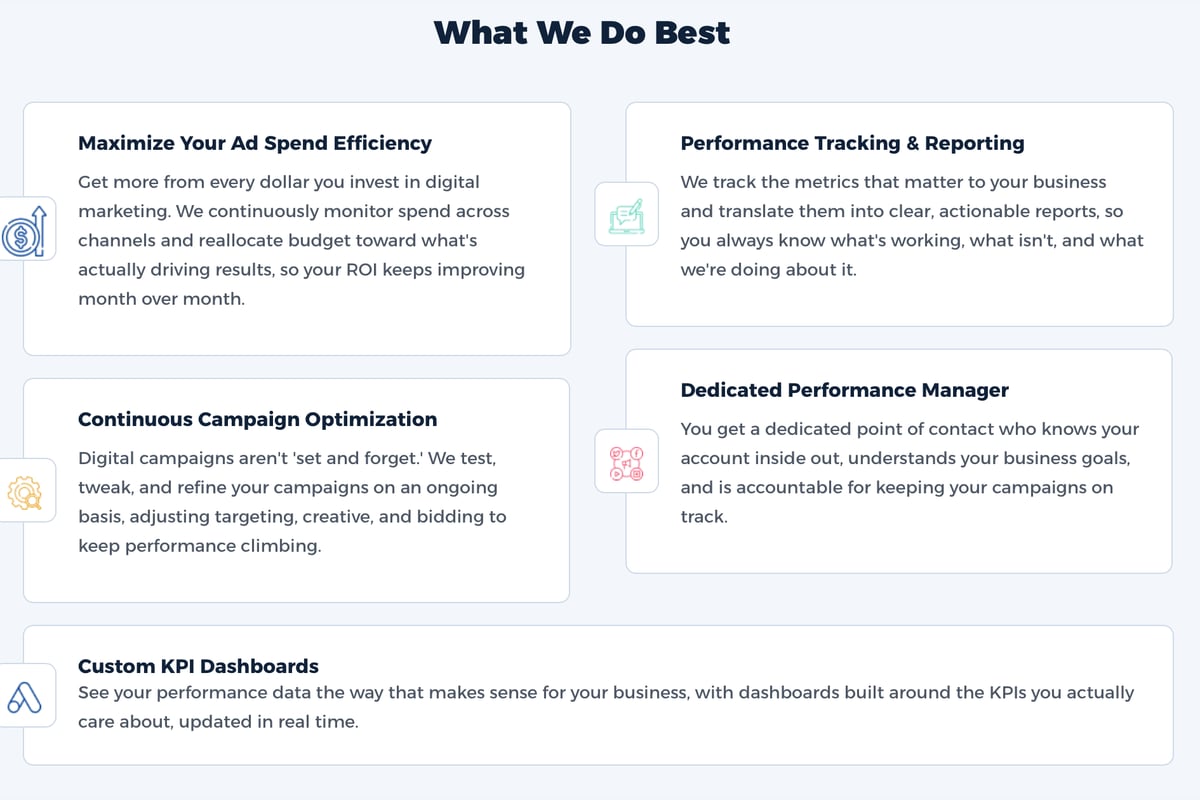
At Intoact, we've seen companies transform their marketing effectiveness through structured performance management. Our approach focuses on continuous optimization based on real data rather than assumptions or best practices that may not apply to your specific business context.
Measurement Frameworks and ROI Tracking
Measuring marketing program performance goes beyond surface-level metrics. While impressions, clicks, and engagement provide tactical feedback, program-level measurement requires connecting marketing activities to business outcomes.
Modern attribution models help marketers understand how different touchpoints contribute to conversions. Multi-touch attribution recognizes that customer journeys involve multiple interactions across channels before purchase decisions occur.
Essential metrics for marketing program evaluation:
- Customer Acquisition Cost (CAC) across channels and segments
- Return on Ad Spend (ROAS) for paid programs
- Customer Lifetime Value (CLV) to assess long-term program impact
- Marketing Qualified Leads (MQLs) and conversion rates through the funnel
- Program ROI comparing total investment to revenue generated
- Attribution models showing channel and touchpoint contribution
Deloitte research on marketing-finance alignment shows that organizations with strong measurement discipline achieve 20% higher marketing effectiveness scores. The key is establishing measurement frameworks before program launch, not retrofitting analytics after campaigns are running.

Optimization and Iteration
Static marketing programs decay over time as audience preferences shift, competitors adapt, and market conditions change. Continuous optimization keeps programs relevant and effective.
Test systematically across creative elements, audience segments, offers, and messaging angles. A/B testing provides clear data on what drives better performance, while multivariate testing explores interactions between multiple variables.
| Optimization Area | Testing Approach | Impact Potential |
|---|---|---|
| Ad creative | A/B test headlines, images, calls-to-action | 15-40% improvement in click-through rates |
| Landing pages | Multivariate testing of layout, copy, forms | 20-50% conversion rate increases |
| Audience targeting | Segment performance comparison | 25-60% reduction in cost per acquisition |
| Offer structure | Discount levels, incentive types, urgency messaging | 10-35% improvement in conversion rates |
Budget allocation should remain fluid within marketing programs. Shift resources toward highest-performing channels and campaigns while reducing investment in underperformers. Think with Google’s planning resources recommend monthly reallocation reviews for paid programs and quarterly reviews for longer-cycle initiatives.
Technology and AI Integration in Marketing Programs
Marketing technology stacks enable program execution at scale. The average enterprise uses 91 different marketing technologies according to recent industry benchmarks, though program effectiveness depends more on strategic integration than tool quantity.
Core platform categories for modern marketing programs include:
- Customer Relationship Management (CRM) systems for contact management and sales alignment
- Marketing automation platforms handling email nurture, lead scoring, and workflow triggers
- Advertising platforms for paid search, social, and programmatic buying
- Analytics and business intelligence tools tracking performance across channels
- Content management systems (CMS) supporting website and content programs
- Customer data platforms (CDP) unifying data from multiple sources
Integration between these systems creates seamless data flow and enables sophisticated automation. When your CRM connects to your marketing automation platform and advertising accounts, you can build programs that automatically adjust based on customer behavior, stage, and engagement patterns.
Artificial Intelligence and Machine Learning Applications
AI transforms marketing programs through enhanced personalization, predictive analytics, and automated optimization. Machine learning algorithms identify patterns humans miss, predict customer behavior, and optimize bidding strategies in real-time.
Practical AI applications in marketing programs:
- Predictive lead scoring identifying highest-value prospects
- Dynamic creative optimization testing thousands of ad variations
- Chatbots handling initial customer inquiries and qualification
- Content recommendation engines personalizing website experiences
- Automated bid management maximizing ROAS in paid programs
- Sentiment analysis monitoring brand perception across channels
Organizations implementing AI in their marketing programs report 25-40% efficiency gains and 15-30% performance improvements. The technology handles repetitive optimization tasks, freeing marketers to focus on strategy and creative development.
Those looking to build AI capabilities can explore specialized training that covers practical applications across marketing functions, ensuring teams understand both the technology and its strategic implementation.
Content-Driven Marketing Programs
Content serves as fuel for modern marketing programs. Whether you're running demand generation, thought leadership, or customer education programs, content creation and distribution determine program effectiveness.
Content program elements include:
- Blog articles and long-form content addressing customer questions and pain points
- Video content for education, product demonstrations, and brand storytelling
- Podcasts and audio content reaching audiences during commute and multitasking time
- Infographics and visual assets simplifying complex information
- Case studies and customer stories providing social proof and specific examples
- Webinars and virtual events generating leads and demonstrating expertise
Content Marketing Institute research shows that B2B organizations with documented content strategies are 60% more likely to rate their programs as effective compared to those without formal documentation.
Content marketing programs require editorial calendars, production workflows, and distribution strategies. The most successful programs align content themes with buyer journey stages, delivering educational content early in the research process and more specific, product-focused content as prospects near purchase decisions.
Distribution determines whether your content reaches target audiences. Organic search, social media, email, and paid promotion each play distinct roles in comprehensive content programs. SEO optimization ensures content remains discoverable long after publication, while paid distribution accelerates initial reach.

Industry Standards and Compliance Considerations
Marketing programs must operate within regulatory frameworks and industry standards. Privacy regulations, advertising guidelines, and platform-specific policies all constrain program design and execution.
The General Data Protection Regulation (GDPR) in Europe and similar privacy laws globally require explicit consent for data collection and processing. Marketing programs must include consent management, data protection protocols, and customer rights fulfillment processes.
IAB standards and guidelines provide authoritative frameworks for digital advertising, programmatic buying, and measurement. Following these standards ensures brand safety, viewability, and accurate performance tracking.
Compliance checklist for marketing programs:
- Privacy policy transparency and consent mechanisms
- Email marketing compliance with CAN-SPAM and similar regulations
- Advertising disclosures for sponsored content and influencer partnerships
- Accessibility standards (WCAG) for digital properties
- Industry-specific regulations (financial services, healthcare, etc.)
- Platform policies for Facebook, Google, LinkedIn, and other channels
Non-compliance creates legal risk, platform account suspensions, and reputational damage. Building compliance into program design from the start prevents costly retrofitting or program shutdowns.
Building Team Capabilities and Organizational Structure
Marketing programs succeed or fail based on team capabilities. The shift toward integrated, data-driven programs requires skills in strategy, analytics, technology, and creative execution.
Modern marketing teams need both specialists with deep channel expertise and generalists who understand how different elements connect within broader programs. A paid search specialist optimizes campaigns effectively, but program success requires understanding how paid search connects to SEO, content, and conversion optimization efforts.
Critical marketing program skills include:
- Strategic planning and business alignment
- Data analysis and performance measurement
- Channel-specific execution (paid search, social, email, etc.)
- Marketing technology platform management
- Creative development and brand expression
- Project management and cross-functional coordination
Organizations face build-versus-buy decisions when developing marketing program capabilities. Internal teams provide deep business knowledge and long-term continuity, while agencies and consultants offer specialized expertise and fresh perspectives.
Training programs help teams develop skills across strategy, execution, and emerging technologies. Structured learning ensures consistent capabilities across team members rather than relying on individual initiative or scattered online resources.
For companies building internal marketing capabilities, Intoact’s corporate training programs provide customized curriculum addressing specific business needs, from foundational digital marketing skills to advanced AI applications and performance management.
Global and Localization Strategies
Organizations operating across multiple markets must balance global brand consistency with local market relevance. Marketing programs require adaptation for language, cultural preferences, regulatory environments, and competitive landscapes.
Centralized program strategy provides efficiency and brand coherence, while localized execution enables market-specific optimization. The "think global, act local" principle applies directly to marketing program design.
Localization considerations for marketing programs:
- Language translation and cultural adaptation of messaging
- Channel preferences varying by geography (WeChat in China, WhatsApp in Latin America)
- Payment methods and currency handling for e-commerce programs
- Local regulations and compliance requirements
- Time zones affecting email send times and campaign scheduling
- Competitive dynamics and market maturity levels
Technology platforms increasingly support multi-market programs through language variants, geographic targeting, and centralized reporting with local breakouts. These capabilities enable scaled execution while maintaining local relevance.
Testing reveals unexpected local preferences. Offers, creative styles, and messaging that perform well in one market often require significant adaptation for others. Systematic testing across markets identifies these differences and informs optimization.
Budget Planning and Resource Allocation
Marketing program budgets reflect strategic priorities and expected returns. Organizations typically allocate 6-12% of revenue to marketing, with significant variation based on industry, growth stage, and competitive intensity.
Budget allocation across programs and channels should follow performance data rather than historical precedent or executive preferences. High-performing programs deserve increased investment, while underperformers require optimization or elimination.
Budget allocation framework:
| Budget Category | Percentage Range | Purpose |
|---|---|---|
| Paid advertising | 30-50% | Customer acquisition and awareness |
| Content creation | 15-25% | Organic reach, SEO, thought leadership |
| Technology platforms | 10-20% | Marketing automation, analytics, CRM |
| Team and agencies | 20-35% | Personnel costs and external support |
| Testing and innovation | 5-10% | New channel exploration and optimization |
Reserve budget for testing and learning. Programs that allocate 100% of resources to proven tactics miss opportunities to discover more effective approaches. The 5-10% innovation budget enables controlled experimentation without risking core program performance.
Financial planning cycles should align with program timelines. Annual budgets provide strategic direction, but quarterly reviews enable reallocation based on performance trends and market changes. Monthly reviews work well for fast-moving paid programs where optimization happens continuously.
Marketing programs that combine strategic planning, disciplined execution, and continuous optimization consistently outperform fragmented tactical efforts. Success requires clear objectives, audience understanding, multi-channel integration, sophisticated measurement, and ongoing adaptation based on performance data. Whether you're building new programs or optimizing existing initiatives, structured approaches deliver measurable improvements in customer acquisition, engagement, and ROI. Intoact helps businesses develop these capabilities through practical training in digital marketing strategy, AI applications, and performance management, along with consulting services that optimize campaign execution and measurement frameworks.


