


Paid digital marketing represents one of the most measurable and scalable approaches to customer acquisition available to businesses today. Unlike organic strategies that require months to build momentum, paid channels deliver immediate visibility and traffic when executed properly. For companies seeking predictable growth, understanding how to strategically allocate budgets across search, social, display, and emerging platforms while maintaining positive returns has become a competitive necessity.
Understanding the Paid Digital Marketing Landscape
The paid advertising ecosystem has evolved dramatically over the past five years. According to the IAB Internet Advertising Revenue Report, digital advertising revenues reached new highs in 2024, with search, social, and video formats commanding the largest share of advertiser budgets. This growth reflects both increased digital adoption and the sophistication of targeting and measurement capabilities.
Paid digital marketing encompasses several distinct channel categories:
- Search advertising (Google Ads, Microsoft Advertising, Amazon Ads)
- Social media advertising (Meta, TikTok, LinkedIn, Pinterest)
- Display and programmatic advertising
- Video advertising (YouTube, streaming platforms, connected TV)
- Retail media networks (Amazon Advertising, Walmart Connect)
- Native advertising placements
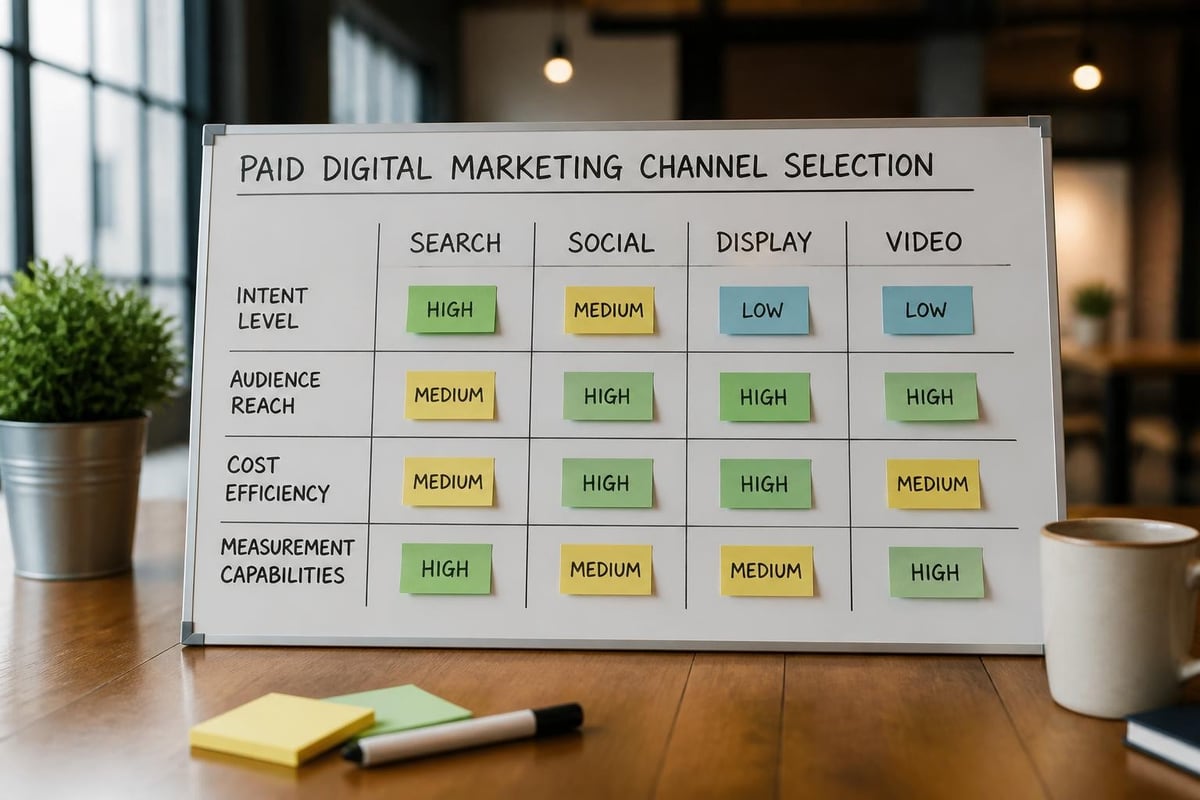
Each channel serves different strategic purposes. Search advertising captures existing demand from users actively researching solutions. Social platforms excel at demand generation and brand building among defined audience segments. Display and programmatic advertising support awareness and retargeting objectives across the open web.
Channel Selection Based on Business Objectives
Selecting the right mix of paid channels requires alignment with specific business goals and customer journeys. Performance-focused businesses typically prioritize search advertising for its high intent and conversion efficiency. Brands building awareness among younger demographics often allocate substantial budgets to TikTok and Instagram. B2B companies find value in LinkedIn's professional targeting capabilities despite higher cost-per-click rates.
The most effective paid digital marketing strategies recognize that channels work synergistically. A prospect might first encounter your brand through a social ad, research your solutions via search, and convert after seeing a retargeting display campaign. Microsoft Advertising data shows that multi-channel campaigns consistently outperform single-channel approaches in both conversion rates and customer lifetime value.
Campaign Structure and Audience Targeting
Proper campaign architecture forms the foundation of efficient paid digital marketing performance. Well-structured campaigns enable precise budget control, accurate performance measurement, and rapid optimization. Most platforms organize campaigns hierarchically with campaigns, ad sets or ad groups, and individual ads.
| Campaign Element | Purpose | Best Practice |
|---|---|---|
| Campaign | Budget allocation and objective | One objective per campaign |
| Ad Set/Group | Audience and placement targeting | Single audience segment per ad set |
| Ad Creative | Messaging and visual elements | 3-5 variations for testing |
Audience targeting capabilities have become increasingly sophisticated while simultaneously facing privacy-related constraints. First-party data strategies now anchor most advanced targeting approaches. Businesses that invest in proper customer data collection, segmentation, and activation gain substantial competitive advantages.
The most effective targeting strategies layer multiple signals:
- Demographic attributes (age, location, income, education)
- Behavioral indicators (purchase history, website interactions, content engagement)
- Contextual signals (current browsing content, search queries, time of day)
- Lookalike or similar audiences based on existing customer profiles
At Intoact, our consultancy work frequently reveals that businesses underutilize their first-party data for audience creation. Companies sitting on email lists, CRM databases, and website visitor data often fail to activate these assets effectively across paid channels.
Creative Development and Testing
Creative assets drive the majority of performance variance in paid digital marketing campaigns. Even perfect targeting delivers poor results without compelling ad creative. Platform algorithms increasingly optimize toward engagement signals, making creative quality more important than ever.
Effective creative strategies incorporate several principles. Message-market fit ensures your value proposition resonates with the targeted audience segment. Format optimization adapts creative assets to each platform's native specifications and user behaviors. Systematic testing identifies winning combinations through structured experimentation rather than guesswork.
Video content has emerged as the highest-performing format across most platforms. Short-form vertical video (15-30 seconds) particularly dominates mobile feeds on TikTok, Instagram Reels, and YouTube Shorts. Static image ads remain cost-effective for direct response objectives, while carousel formats enable product storytelling and feature comparisons.
Measurement, Attribution, and ROI Optimization
Accurate measurement separates profitable paid digital marketing programs from budget-wasting exercises. The degradation of third-party cookies and mobile identifiers has forced advertisers to rebuild measurement frameworks around privacy-compliant approaches. Google’s integrated measurement solutions emphasize combining multiple measurement methods for a complete performance picture.
Modern measurement strategies typically integrate:
- Platform conversion tracking (pixel-based, conversion APIs)
- Marketing mix modeling (statistical attribution across channels)
- Incrementality testing (controlled experiments measuring true lift)
- Multi-touch attribution (credit assignment across customer touchpoints)
No single measurement approach provides perfect accuracy. Platform reporting inflates results due to attribution windows and last-click bias. Marketing mix models offer directional guidance but lack granular optimization insights. Smart marketers triangulate across multiple methods to establish ground truth.
Key Performance Indicators Beyond ROAS
Return on ad spend (ROAS) provides a simple efficiency metric but rarely tells the complete story. Paid digital marketing performance should be evaluated against multiple dimensions aligned with business economics and customer lifecycle value.
Essential KPIs include:
- Customer acquisition cost (CAC) relative to lifetime value (LTV)
- New customer percentage versus repeat purchaser rate
- Blended metrics that account for organic lift from paid activity
- Contribution margin ROAS using actual product margins, not revenue
Businesses optimizing solely for short-term ROAS often underinvest in upper-funnel awareness campaigns that drive long-term growth. The most sophisticated advertisers maintain separate budgets and success metrics for demand generation versus demand capture activities.
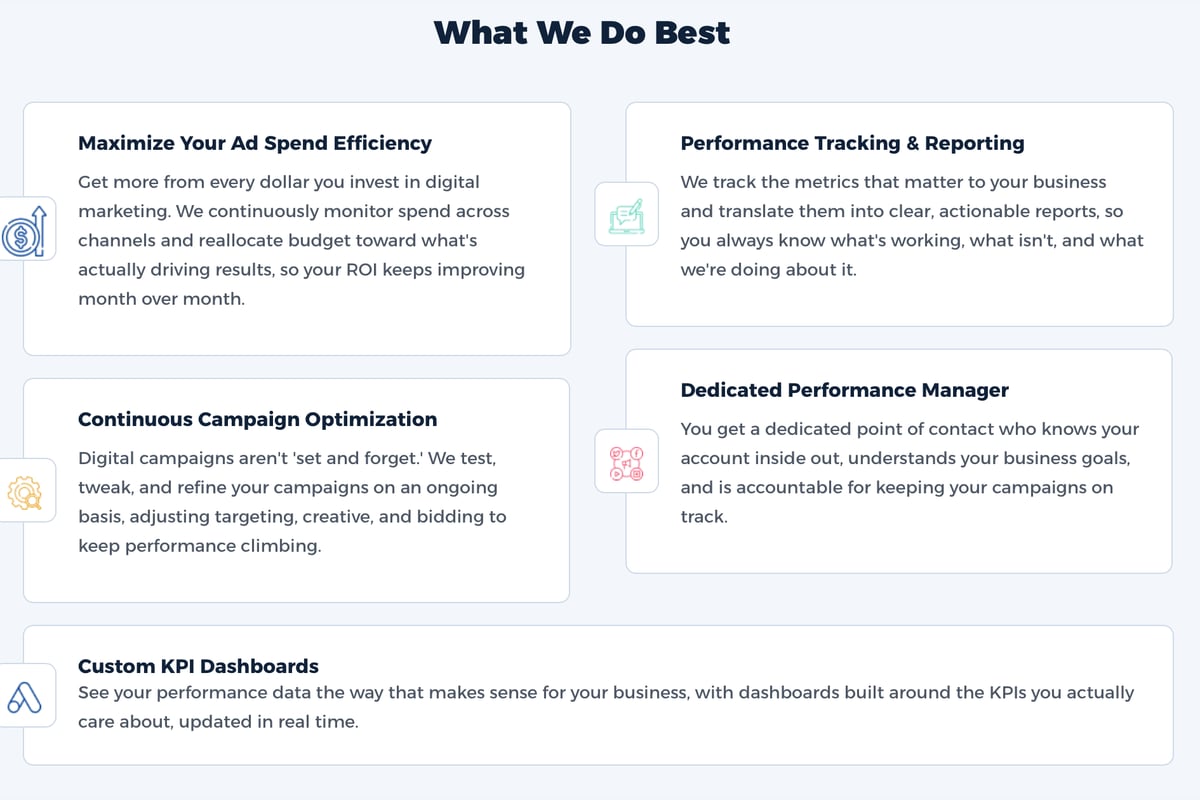
For companies seeking expert guidance on campaign optimization and ROI improvement, Digital Marketing Performance Management services provide ongoing monitoring, analysis, and strategic recommendations tailored to specific business goals.

Platform-Specific Strategy Considerations
Search Advertising Fundamentals
Search advertising remains the highest-intent channel for most businesses. Users entering commercial queries demonstrate active purchase consideration. Google Ads dominates search advertising with approximately 90% market share, but Microsoft Advertising provides incremental reach at often lower costs.
Successful search campaigns require continuous keyword research, ad copy testing, and landing page optimization. Keyword match types balance reach and relevance. Broad match with smart bidding algorithms captures wider query variations. Exact and phrase match preserve control for high-value terms.
Quality Score significantly impacts cost efficiency. This Google metric evaluates ad relevance, expected click-through rate, and landing page experience. Higher Quality Scores reduce cost-per-click while improving ad positions. Businesses should align ad copy with keyword intent and ensure landing pages deliver on ad promises.
Social Media Advertising Dynamics
Social platforms operate fundamentally differently than search. Rather than capturing existing demand, social paid digital marketing interrupts users browsing feeds. Success requires stopping scrolling behavior with compelling creative and relevant messaging.
Meta's advertising ecosystem (Facebook and Instagram) offers the most mature targeting and optimization capabilities among social platforms. Campaign objectives align with funnel stages from awareness through conversion. The platform's machine learning algorithms optimize ad delivery toward desired outcomes when provided sufficient conversion data.
TikTok has rapidly emerged as a critical channel for brands targeting younger demographics and building cultural relevance. The platform's algorithm prioritizes content quality over follower count, enabling new advertisers to achieve significant reach. However, creative requirements differ substantially from other platforms with entertainment value and authenticity ranking above polished brand messaging.
| Platform | Strength | Typical CPC Range | Best Use Case |
|---|---|---|---|
| Google Search | High commercial intent | $1-$6 | Direct response, lead generation |
| Meta (Facebook/Instagram) | Precise targeting, scale | $0.50-$3 | E-commerce, app installs, local |
| TikTok | Engaged younger audience | $0.50-$2 | Brand awareness, product launches |
| Professional targeting | $5-$12 | B2B lead generation, recruitment |
Privacy, Compliance, and the Cookieless Future
The advertising industry faces fundamental transformation as third-party cookies phase out and privacy regulations expand. Google's Privacy Sandbox initiative represents the most significant technical change, though industry analysis reveals gaps between advertiser needs and proposed solutions.
Advertisers must adapt through several strategies:
First-party data activation becomes the primary competitive differentiator. Businesses that collect email addresses, implement customer data platforms, and build direct relationships control their targeting destiny. Server-side tracking implementations and conversion APIs maintain measurement accuracy as browser-based tracking degrades.
Data clean rooms enable privacy-preserving collaboration between brands and publishers. IAB Tech Lab’s clean room guidance provides technical standards for secure data matching and measurement without exposing individual-level information. Major platforms including Google, Amazon, and Snowflake offer clean room solutions.
Contextual targeting experiences renewed relevance as behavioral signals become restricted. Advertisers place ads based on page content rather than user profiles. Modern contextual solutions use AI to understand semantic meaning beyond simple keyword matching.
Regulatory Compliance Requirements
Paid digital marketing operates under increasing regulatory scrutiny. The Federal Trade Commission provides specific guidance on endorsement disclosures requiring clear labeling of sponsored content and material connections between advertisers and endorsers.
Key compliance considerations include:
- Disclosure requirements for sponsored content and affiliate relationships
- Data privacy obligations under GDPR, CCPA, and emerging state laws
- Industry-specific regulations (financial services, healthcare, legal)
- Platform policies governing prohibited content and targeting practices
Non-compliance carries substantial risks including account suspensions, legal penalties, and reputational damage. Businesses should implement compliance reviews as standard practice before launching campaigns.
Budget Allocation and Bidding Strategies
Strategic budget allocation across channels and campaigns determines overall paid digital marketing efficiency. The most effective approach maintains flexibility while establishing guardrails around minimum efficient scale and maximum acceptable costs.
Channel budget allocation should reflect both performance data and strategic priorities. Many businesses apply a 70-20-10 framework: 70% to proven performers, 20% to optimization and expansion, 10% to experimental channels. This balances efficiency with growth exploration.
Within platforms, automated bidding strategies have largely superseded manual bid management. Machine learning algorithms process billions of signals to optimize bids in real-time. However, automation requires proper setup and monitoring:
- Target CPA (cost per acquisition) works when you have clear acquisition cost targets
- Target ROAS optimizes toward revenue efficiency goals
- Maximize conversions drives volume within budget constraints
- Manual CPC retains control but requires active management
Seasonal businesses and product launches require flexible budgeting approaches. Rather than rigid monthly allocations, effective programs scale budgets with demand patterns and inventory availability.

Integration with Organic Marketing Efforts
The artificial separation between paid and organic marketing creates missed opportunities. The most sophisticated programs recognize how these disciplines reinforce each other and structure teams and strategies accordingly.
Search integration provides the clearest synergies. Paid search data reveals high-converting keywords for organic content development. SEO visibility on branded terms reduces paid costs. At Intoact, our work in SEO, AEO, and GEO services demonstrates how search visibility across traditional and AI-powered platforms creates compounding advantages when combined with strategic paid search investment.
Content marketing and paid distribution form natural partnerships. Organic content provides the assets and landing pages for paid campaigns. Paid promotion extends content reach beyond organic limitations. High-performing organic content earns additional investment through paid amplification.
Social media strategies should integrate paid and organic approaches. Organic posts identify resonant content themes for paid promotion. Paid campaigns drive followers who then see organic content. Influencer partnerships combine organic credibility with paid reach.
Advanced Tactics for Performance Improvement
Experienced paid digital marketing practitioners implement sophisticated tactics that newer advertisers often overlook. These approaches deliver incremental improvements that compound into significant competitive advantages.
Audience sequencing guides prospects through strategic message progressions. Users who engage with awareness content see consideration-focused ads. Previous website visitors receive conversion-optimized creative. This narrative approach outperforms static campaigns that show identical messages regardless of engagement history.
Creative versioning at scale enables message personalization across audience segments. Dynamic creative optimization automatically tests headline, image, and call-to-action combinations. Advanced implementations customize creative based on demographic attributes, behavioral signals, or predicted intent.
Bid strategy layering combines automated algorithms with strategic adjustments. Businesses apply bid modifiers based on:
- Device type (mobile vs. desktop conversion rates)
- Geographic performance variations
- Time-of-day and day-of-week patterns
- Audience segment value differences
Cross-platform frequency management prevents oversaturation when running campaigns across multiple channels simultaneously. Nielsen’s research on media fragmentation shows that unmanaged frequency across platforms leads to diminishing returns and audience fatigue.
Building In-House Capabilities vs. Agency Support
Organizations face strategic decisions about whether to develop internal paid digital marketing expertise or engage external specialists. Neither approach universally outperforms the other. The optimal choice depends on scale, complexity, strategic importance, and available talent.
In-house management provides several advantages:
- Direct business knowledge and faster decision-making
- Proprietary data access and integration capabilities
- Long-term cost efficiency at sufficient scale
- Organizational learning and capability development
External expertise offers complementary benefits:
- Specialized knowledge across platforms and industries
- Cross-client learning and best practice application
- Flexible capacity without fixed overhead
- Objective performance evaluation
Many businesses pursue hybrid models. Internal teams manage strategy, budgets, and data while agencies execute platform management and creative production. Others develop in-house capabilities for core channels while engaging specialists for emerging platforms or complex initiatives.
For businesses building internal capabilities, structured training programs accelerate team development. Intoact’s courses provide practical, job-ready skills across digital marketing disciplines including paid advertising strategy, campaign management, and ROI optimization.
Emerging Trends Reshaping Paid Advertising
The paid digital marketing landscape continues evolving rapidly. Several trends are reshaping best practices and creating new opportunities for early adopters.
Artificial intelligence integration extends beyond automated bidding into creative production, audience insights, and strategic planning. Generative AI tools create ad variations, analyze performance patterns, and recommend optimization actions. However, human oversight remains essential for strategic direction and brand alignment.
Retail media networks have emerged as the fastest-growing ad channel category. Amazon Advertising pioneered the model, but Walmart, Target, Instacart, and numerous other retailers now operate advertising platforms. These networks offer purchase-intent targeting and closed-loop measurement unavailable in traditional channels.
Connected TV advertising brings digital targeting and measurement capabilities to premium video content. As streaming viewership surpasses traditional television, advertisers shift budgets toward addressable CTV inventory. Programmatic buying enables precise targeting while maintaining the brand-building impact of video creative.
First-party data strategies increasingly differentiate performance as third-party signals degrade. Research from the Advertising Research Foundation demonstrates that advertisers with robust first-party data collection, unification, and activation capabilities maintain targeting and measurement effectiveness while competitors struggle with signal loss.
Operational Excellence in Campaign Management
Systematic processes separate high-performing paid digital marketing operations from inconsistent programs. Operational excellence requires structured workflows, clear accountability, and continuous improvement mechanisms.
Campaign launch checklists prevent common setup errors:
- Conversion tracking validation across platforms
- Audience exclusions (existing customers, irrelevant segments)
- Budget pacing and schedule settings
- Negative keyword implementation (search campaigns)
- Ad approval and policy compliance verification
Performance monitoring cadences establish regular review rhythms. Daily checks identify technical issues and pacing problems. Weekly reviews assess performance trends and make tactical optimizations. Monthly analyses evaluate strategic effectiveness and inform budget reallocation.
Testing roadmaps institutionalize experimentation rather than leaving it to individual initiative. Structured testing plans specify hypotheses, success metrics, sample size requirements, and decision criteria. This discipline prevents premature conclusions from insufficient data while ensuring learnings inform future strategies.
Documentation practices preserve institutional knowledge as team members change. Campaign architectures, naming conventions, testing results, and optimization learnings should be centrally accessible. Many organizations maintain playbooks that codify successful approaches for consistent execution.
Mastering paid digital marketing requires strategic thinking, analytical rigor, and continuous adaptation to platform evolution and market dynamics. The businesses that treat paid advertising as a systematic discipline rather than tactical execution consistently outperform competitors in customer acquisition efficiency and sustainable growth. Whether you're looking to build internal expertise, optimize existing campaigns, or launch strategic initiatives across emerging platforms, Intoact provides the training, consulting, and performance management services to accelerate your results and maximize return on investment.


