


A paid media agency specializes in planning, executing, and optimizing advertising campaigns across digital channels where businesses pay for placement. Unlike organic marketing efforts, paid media delivers immediate visibility and measurable results through platforms like Google Ads, Meta, TikTok, LinkedIn, and programmatic networks. For companies looking to scale quickly while maintaining strong return on investment, partnering with the right agency can transform marketing performance.
What a Paid Media Agency Actually Does
A paid media agency manages your advertising budget across multiple platforms to generate qualified traffic, leads, and sales. The scope goes far beyond simply launching campaigns.
Strategic Planning and Channel Selection
Agencies begin by analyzing your business goals, target audience, and competitive landscape. They determine which channels will deliver the best return based on where your customers spend time and how they make purchase decisions.
Core planning responsibilities include:
- Budget allocation across platforms and campaign types
- Audience segmentation and targeting strategy
- Campaign structure and naming conventions
- Bid strategy selection based on performance goals
- Creative brief development for ad assets
The most effective agencies don't simply spread your budget across every available channel. They identify the specific platforms where your ideal customers are most receptive to your message and concentrate resources there.
Campaign Execution and Platform Management
Once strategy is defined, agencies handle the technical implementation across advertising platforms. This includes setting up tracking pixels, configuring conversion events, building audience segments, and structuring campaigns for optimal performance.
Modern campaign management requires technical expertise in impression counting, viewability standards, and attribution modeling. Agencies ensure your tracking infrastructure captures accurate data while respecting privacy regulations.

Core Services Provided by Paid Media Agencies
Different agencies offer varying levels of service, but comprehensive paid media management typically includes several key components.
Search and Shopping Campaigns
Google Ads and Microsoft Advertising remain critical channels for capturing high-intent searches. Agencies manage keyword research, ad copy testing, bid optimization, and shopping feed management to maximize visibility when prospects are actively searching for solutions.
Performance optimization involves continuous testing of ad extensions, responsive search ad combinations, audience layering, and landing page alignment. Top agencies analyze search query reports weekly to identify new keyword opportunities and eliminate wasted spend on irrelevant searches.
Social Media Advertising
Meta platforms (Facebook and Instagram), TikTok, LinkedIn, Twitter, and Pinterest each require platform-specific strategies. A paid media agency develops creative formats, targeting approaches, and bidding strategies tailored to each network's unique algorithm and user behavior.
| Platform | Primary Use Case | Typical CPM Range | Best Ad Format |
|---|---|---|---|
| Meta | Brand awareness, retargeting | $8-$15 | Video, Carousel |
| TikTok | Younger audiences, viral reach | $6-$12 | Short video |
| B2B, professional services | $15-$30 | Sponsored content | |
| Google Display | Wide reach, remarketing | $3-$8 | Responsive display |
Social platforms increasingly leverage AI for optimization. AI in advertising now influences creative testing, audience expansion, and bid adjustments in real time.
Programmatic Display and Video
Programmatic advertising automates media buying through demand-side platforms (DSPs), allowing agencies to reach specific audiences across millions of websites and apps. This approach provides scale while maintaining precise targeting based on demographics, interests, and browsing behavior.
Agencies managing programmatic campaigns must understand supply-side platforms, ad exchanges, private marketplaces, and deals. They also navigate brand safety concerns, ad fraud prevention, and measurement standards for viewability and verification.
Performance Tracking and Reporting
Transparent reporting distinguishes strong agencies from mediocre ones. Comprehensive dashboards should connect ad spend to business outcomes like revenue, customer acquisition cost, and lifetime value.
Essential metrics tracked include:
- Click-through rate (CTR) and engagement rates
- Conversion rate by campaign and channel
- Cost per acquisition (CPA) or cost per lead (CPL)
- Return on ad spend (ROAS)
- Attribution across touchpoints
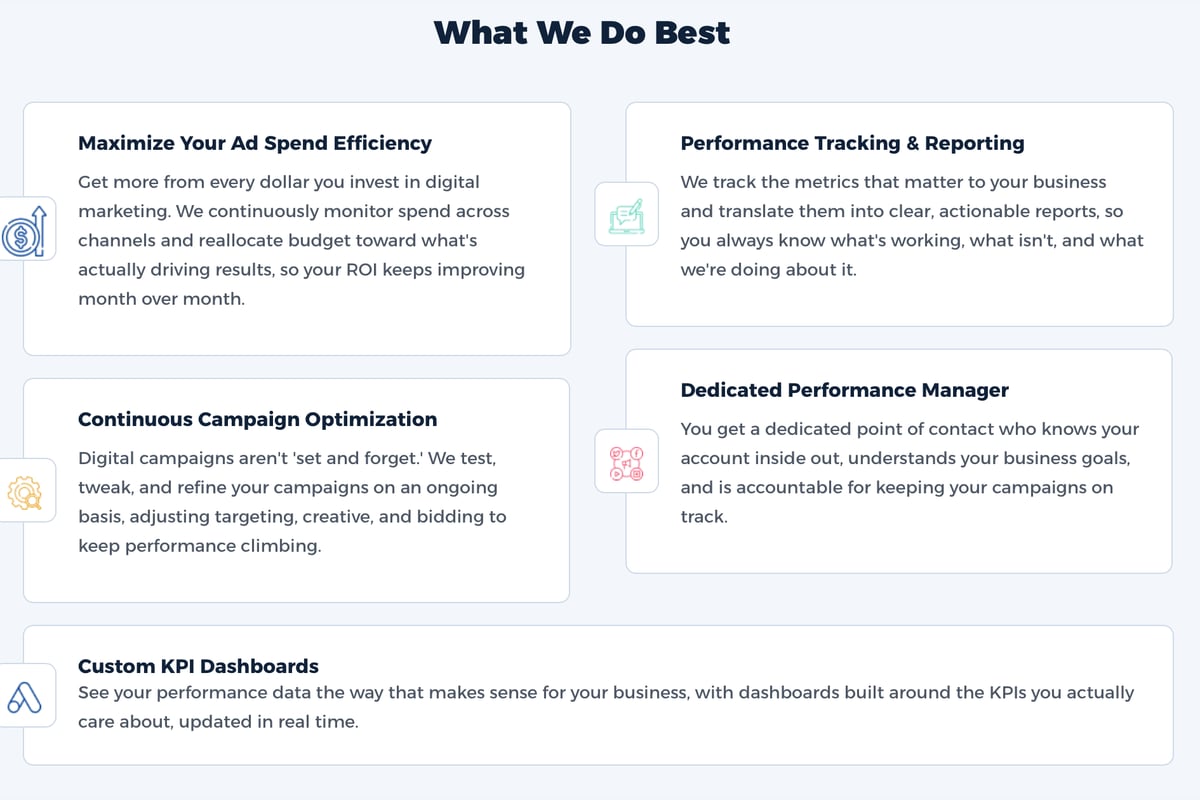
At Intoact, our performance management services focus specifically on connecting digital marketing activities to measurable ROI. We help businesses understand not just how many clicks they received, but which campaigns actually drove revenue growth.
How to Select the Right Paid Media Agency
Choosing a paid media agency requires evaluating capabilities beyond portfolio presentations and case studies.
Assess Platform Certifications and Partnerships
Official platform partnerships indicate an agency meets certain spending thresholds and maintains certified professionals. Google Partner status, Meta Business Partner designation, and LinkedIn Partner credentials demonstrate technical competency and platform access.
However, certifications alone don't guarantee results. Evaluate the specific team members who will manage your account, not just the agency's overall credentials.
Evaluate Industry Experience and Client Results
Agencies with experience in your specific industry understand your customer journey, typical conversion rates, and competitive dynamics. Ask for case studies from similar businesses and request references you can contact directly.
Critical questions during evaluation:
- What average ROAS do you achieve for clients in our industry?
- How do you approach testing and optimization?
- What tools do you use for tracking and attribution?
- How frequently will we receive performance reports?
- What happens if campaigns underperform initial projections?
Review guidance on agency selection from industry associations to understand best practices for pitch processes and relationship structures.
Understand Pricing Models and Contract Terms
Paid media agencies typically charge through one of several models. Fixed retainers provide predictable monthly costs regardless of ad spend. Percentage-of-spend pricing scales with your budget, typically ranging from 10% to 20% of media investment. Performance-based models tie agency compensation to specific outcomes.
Clarify what services are included in the base fee versus additional charges. Media buying fees, creative production, landing page development, and advanced analytics often carry separate costs.

Key Capabilities That Separate Top Agencies
The paid media landscape evolves rapidly. Agencies that stay ahead possess specific capabilities that drive superior results.
Advanced Audience Targeting and Segmentation
With third-party cookies phasing out, top agencies excel at contextual targeting and cookieless strategies. They build first-party data strategies, leverage platform-native audiences, and create sophisticated customer match lists.
Effective segmentation goes beyond basic demographics. Agencies analyze purchase behavior, content engagement, site interaction patterns, and cross-device activity to build precise audience definitions.
Creative Strategy and Testing Frameworks
Ad creative often determines campaign success more than targeting or bidding strategy. Strong agencies develop systematic testing frameworks that evaluate messaging, visual approaches, format variations, and calls to action.
Testing methodology includes:
- Structured A/B tests with statistical significance thresholds
- Multivariate testing for complex creative combinations
- Sequential testing to build on winning variations
- Platform-specific creative requirements (aspect ratios, character limits)
Agencies should collaborate with your internal team or provide in-house creative services. The feedback loop between performance data and creative iteration accelerates improvement.
Attribution and Cross-Channel Measurement
Understanding how different channels work together requires sophisticated attribution modeling. Top agencies move beyond last-click attribution to evaluate first-touch, linear, time-decay, and data-driven models.
Multi-touch attribution reveals how awareness channels like display and video contribute to conversions even when they're not the final click. This insight prevents over-investment in bottom-funnel tactics while starving top-of-funnel awareness.
Emerging Trends Shaping Paid Media in 2026
Several technological and regulatory shifts are transforming how paid media agencies operate.
AI-Powered Campaign Optimization
Artificial intelligence in marketing has moved from experimental to essential. Platforms now use machine learning for automated bidding, dynamic creative optimization, and predictive audience modeling.
Agencies leverage AI tools for campaign forecasting, budget pacing, anomaly detection, and creative generation. Smart agencies balance platform automation with strategic human oversight to ensure AI optimization aligns with business goals.
For businesses looking to understand how AI integrates across their digital marketing efforts, comprehensive training programs provide hands-on experience with these tools in realistic scenarios.
Privacy-First Advertising Approaches
Regulatory changes including GDPR, CCPA, and platform privacy updates require new approaches to audience targeting and measurement. Agencies must navigate consent management, reduced data availability, and shifting attribution windows.
Server-side tracking, conversion APIs, and enhanced conversions help maintain measurement accuracy despite browser restrictions. Privacy-focused strategies actually strengthen customer relationships by demonstrating data responsibility.
Performance Max and Automated Campaign Types
Google's Performance Max campaigns and Meta's Advantage+ automate campaign management across multiple placements. These formats reduce manual control but can deliver strong results when properly configured with clear conversion signals and brand assets.
Agencies must balance automation benefits with strategic oversight, ensuring automated campaigns don't cannibalize brand search traffic or drive low-quality conversions.
| Trend | Impact on Agencies | Strategic Response |
|---|---|---|
| AI optimization | Reduced manual bidding work | Focus on strategy and creative |
| Privacy regulations | Limited third-party data | Build first-party data assets |
| Automated campaigns | Less granular control | Stronger conversion tracking |
| Video content growth | Higher production needs | Video-first creative approach |
Retail Media Networks and Commerce Advertising
Platforms like Amazon Ads, Walmart Connect, and Instacart Ads have created new paid media opportunities. Retail media combines high purchase intent with rich commerce data, making it increasingly important for product-focused businesses.
Agencies expanding into retail media must understand platform-specific requirements, attribution models, and how these channels integrate with broader paid media strategy.
Building an Effective Agency Partnership
Success with a paid media agency requires active collaboration and clear communication.
Establishing Clear Performance Goals
Define specific, measurable objectives before campaigns launch. Vague goals like "increase awareness" make optimization impossible. Concrete targets like "achieve $4 ROAS on Meta campaigns" or "generate leads at $75 CPA or lower" provide clear success criteria.
Goal-setting framework:
- Identify primary business objective (revenue, leads, app installs)
- Set specific numeric targets with timeframes
- Define acceptable cost thresholds
- Establish secondary metrics that indicate progress
- Document how success will be measured
Align on attribution methodology and reporting frequency from the start. Disagreements about how to measure results damage relationships and delay optimization.
Providing Access and Resources
Agencies need comprehensive platform access, analytics data, and business context to perform effectively. Grant admin access to advertising accounts, read access to analytics platforms, and visibility into CRM or sales data when possible.
Share customer insights, competitive intelligence, seasonal business patterns, and product roadmaps. The more context an agency has about your business, the better they can optimize toward meaningful outcomes.
Maintaining Regular Communication Cadence
Weekly or bi-weekly check-ins keep campaigns on track and address issues before they impact results. Monthly business reviews provide opportunity to assess strategic direction and plan upcoming initiatives.
Productive meeting structure:
- Week 1: Performance review and immediate optimizations
- Week 2: Testing results and creative pipeline
- Week 3: Strategic planning and upcoming campaigns
- Week 4: Monthly business review and forecasting
Document decisions, action items, and performance benchmarks to maintain accountability on both sides.
When to Bring Paid Media In-House
Not every business needs an external paid media agency indefinitely. As digital marketing capabilities mature, some companies build internal expertise.
Indicators You're Ready for In-House Management
Consider transitioning to in-house management when you have dedicated staff with platform expertise, sufficient campaign volume to justify full-time resources, and established processes for creative production and performance analysis.
Companies with highly specialized products, frequent product launches, or unique audience dynamics sometimes achieve better results with internal teams who understand nuances external agencies struggle to grasp.
Hybrid Models That Combine Agency and Internal Teams
Many organizations adopt hybrid approaches where internal teams handle day-to-day execution while agencies provide strategic oversight, specialized capabilities, or handle specific channels.
This model works well when internal teams manage search campaigns (where product knowledge is critical) while agencies handle programmatic display, video production, or new platform testing.
For businesses building internal capabilities, professional digital marketing training equips teams with the technical skills and strategic frameworks needed to manage campaigns effectively.

Common Paid Media Agency Challenges
Understanding frequent pitfalls helps businesses set realistic expectations and avoid problematic relationships.
Misaligned Incentives and Optimization Goals
Agencies paid as a percentage of ad spend may prioritize budget growth over efficiency. Performance-based models can incentivize short-term tactics that hurt long-term brand value.
Structure contracts with balanced incentives that reward both efficiency improvements and appropriate scaling. Include clauses that protect against gaming metrics through low-quality traffic or conversions.
Lack of Transparency in Bidding and Placement
Some agencies add undisclosed markups to media costs or direct campaigns to owned-and-operated inventory without client knowledge. Insist on transparent media billing where you see actual platform costs separate from agency fees.
Review placement reports regularly to ensure ads appear in brand-safe environments that reach your target audience. Industry measurement standards provide benchmarks for viewability and verification.
Generic Strategies That Ignore Business Context
Cookie-cutter approaches that apply the same tactics across all clients rarely deliver exceptional results. Your paid media agency should demonstrate understanding of your specific customer journey, competitive position, and business model.
Push back on generic recommendations. Ask why specific tactics are appropriate for your business versus alternatives. Strong agencies articulate clear strategic rationale backed by data.
The ROI Question: What Results Should You Expect?
Performance expectations vary dramatically based on industry, business model, and campaign objectives.
Realistic Performance Benchmarks by Industry
E-commerce typically targets 4:1 to 8:1 ROAS depending on profit margins and customer lifetime value. B2B lead generation often accepts $50 to $300 cost per lead based on average deal size. SaaS companies focus on customer acquisition cost relative to lifetime value, typically aiming for 3:1 LTV:CAC ratio or better.
Industry benchmark ranges:
- E-commerce: 4:1 to 8:1 ROAS, 2% to 4% conversion rate
- B2B services: $75 to $250 CPL, 3% to 8% lead-to-customer rate
- SaaS: $200 to $800 CAC, 25% to 35% trial-to-paid conversion
- Local services: $30 to $150 CPL, 15% to 30% booking rate
These ranges reflect mature campaigns after initial testing periods. New campaigns typically require 60 to 90 days to optimize and reach steady-state performance.
Timeline for Achieving Target Performance
Immediate results are unrealistic. Platform algorithms need data to optimize bidding and targeting. Expect the first 30 days to focus on data collection and baseline establishment.
Months two and three involve systematic testing and refinement as agencies identify winning audience segments and creative approaches. Most campaigns reach target efficiency by month four if properly structured and optimized.
Market forecasts and advertising trends from research firms provide broader context for planning realistic performance targets within your industry.
Beyond Direct Response: Measuring Brand Impact
Not all paid media value appears in immediate conversions. Display campaigns, video advertising, and social engagement build awareness that influences future purchase decisions.
Track assisted conversions, view-through conversions, branded search lift, and site engagement from paid media audiences. Survey-based brand lift studies quantify awareness and consideration changes among exposed audiences versus control groups.
Balance your paid media mix between direct response tactics that drive immediate sales and awareness efforts that build long-term brand equity. The optimal ratio depends on business maturity and growth objectives.
A paid media agency can accelerate growth when you choose the right partner and establish clear performance expectations. Success requires strategic alignment, transparent communication, and focus on business outcomes rather than vanity metrics. Whether you're exploring agency partnerships, building internal capabilities, or optimizing existing campaigns, Intoact offers comprehensive digital marketing training and consultancy services that help businesses maximize return on investment across all paid channels.


