


Paid media marketing represents one of the most powerful levers for business growth in 2026, delivering immediate visibility and measurable results when executed strategically. Unlike organic channels that build momentum over months, paid media puts your message in front of target audiences within hours, making it essential for businesses seeking predictable, scalable customer acquisition.
Understanding Paid Media Marketing Fundamentals
Paid media marketing encompasses any marketing effort where you pay for placement, impressions, clicks, or conversions across digital platforms. This includes search advertising, social media ads, display networks, video platforms, and emerging channels like connected TV.
The distinction between paid, owned, and earned media remains critical for strategic planning. While owned media includes your website and email list, and earned media covers organic social shares and press mentions, paid media marketing offers something neither can guarantee: immediate, controlled distribution at scale.
Key characteristics of effective paid media:
- Direct attribution to business outcomes
- Granular audience targeting capabilities
- Budget flexibility and scalable spend
- Real-time performance data and optimization
- Predictable traffic generation
According to the IAB and PwC Internet Advertising Revenue Report, U.S. digital advertising revenues reached unprecedented levels in 2025, with search, social, and video formats dominating spend allocation. This growth reflects the measurable return businesses achieve when campaigns align with strategic objectives.
Strategic Value Beyond Traffic Generation
Many businesses approach paid media marketing narrowly, viewing it solely as a traffic driver. The strategic value extends far beyond click generation. Well-structured campaigns build brand awareness, gather audience intelligence, test messaging hypotheses, and create data assets that inform broader marketing decisions.
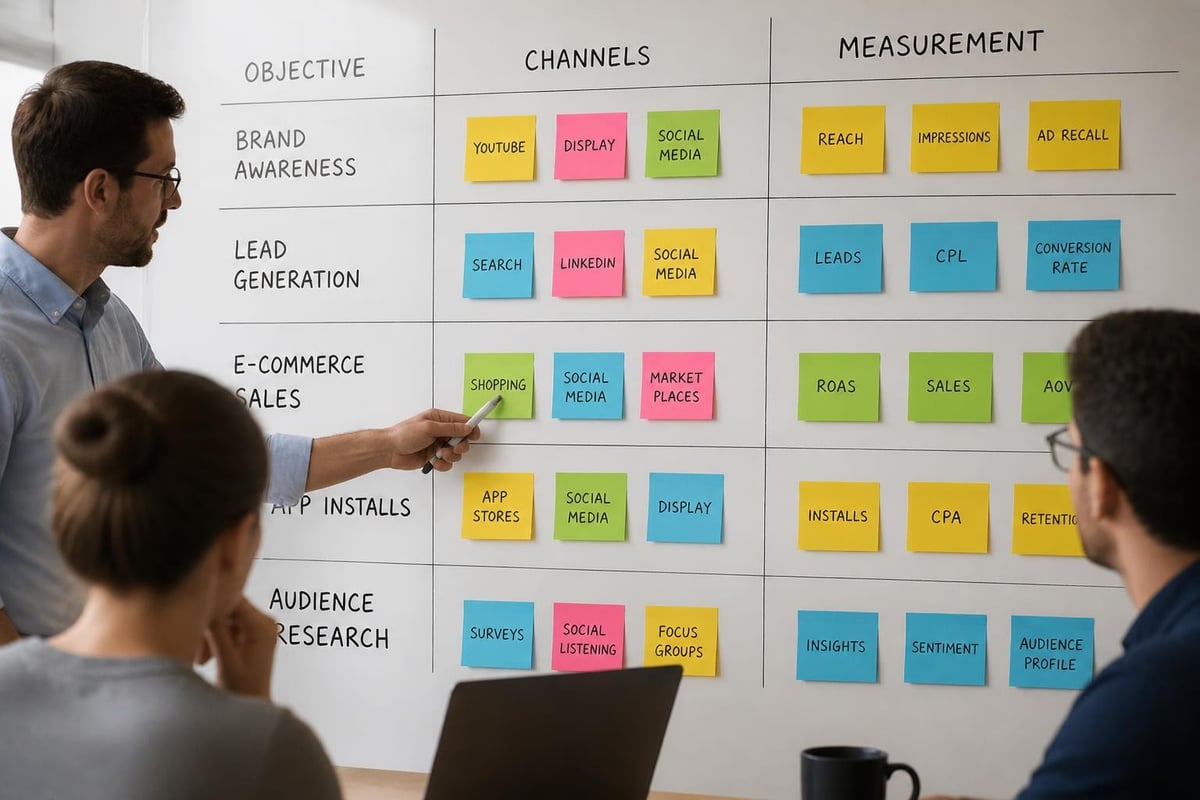
Core Paid Media Marketing Channels
Channel selection determines campaign effectiveness more than budget size. Each platform serves different audience behaviors, purchase stages, and business objectives.
Search Advertising Excellence
Search ads intercept high-intent users actively seeking solutions. Google Ads dominates this space, but Microsoft Advertising offers valuable reach among professional demographics and often lower cost-per-click rates.
Search campaign success depends on keyword strategy, ad copy relevance, and landing page experience. Match types control query reach, while negative keywords prevent wasted spend on irrelevant searches.
| Search Campaign Element | Beginner Approach | Advanced Optimization |
|---|---|---|
| Keyword Strategy | Broad match, high volume terms | Granular ad groups, match type layering |
| Ad Copy | Generic benefits | Dynamic keyword insertion, value props |
| Bidding | Manual CPC | Smart bidding with conversion data |
| Landing Pages | Homepage routing | Dedicated, message-matched pages |
Social Media Advertising Platforms
Social platforms offer unmatched targeting precision based on demographics, interests, behaviors, and custom audience segments. Meta’s Reels ad formats exemplify how platforms evolve creative opportunities to match user consumption patterns.
Facebook and Instagram remain essential for most B2C businesses and increasingly effective for B2B. LinkedIn commands premium pricing but delivers decision-maker access. TikTok captures younger demographics with creative-first advertising that feels native to platform culture.
Platform selection criteria:
- Where your audience actively engages (not just exists)
- Creative format alignment with your brand assets
- Platform algorithm maturity for your campaign objective
- Cost efficiency relative to customer lifetime value
- Attribution and tracking capabilities
The most successful paid media marketing strategies treat social platforms as distinct channels rather than applying identical creative and targeting across all networks. Platform-specific optimization typically outperforms copy-paste approaches by 40-60% in our campaign management experience.
Display and Programmatic Advertising
Display advertising reaches users across millions of websites through networks like Google Display Network and programmatic exchanges. While often delivering lower direct response rates than search, display builds awareness and enables sophisticated retargeting strategies.
Programmatic buying automates ad placement through real-time bidding, allowing advertisers to target specific audience segments across premium inventory. Success requires clear audience definitions, appropriate creative sizes, and frequency capping to avoid oversaturation.
Building Performance-Driven Campaign Architecture
Campaign structure directly impacts both performance and optimization efficiency. Organized accounts enable faster testing, clearer insights, and more precise budget allocation.
Start with business objectives, then work backward to campaign types, ad groups, and individual ads. A common structure organizes campaigns by product line, audience segment, or funnel stage, with ad groups containing tightly themed keywords or targeting parameters.
Audience Segmentation Strategy
Generic targeting wastes budget on low-probability prospects. Sophisticated segmentation separates audiences by purchase intent, lifecycle stage, demographic fit, and behavioral signals.
High-performing audience segments:
- Retargeting audiences: Website visitors, cart abandoners, past customers
- Lookalike audiences: Users similar to your best customers
- In-market audiences: Actively researching relevant products
- Custom intent: Specific search and browse behaviors
- Demographic overlays: Age, income, location refinements
Businesses working with integrated digital marketing strategies see stronger results by aligning paid media audiences with content marketing, email nurturing, and sales processes rather than treating each channel in isolation.
Budget Allocation and Bid Management
Budget distribution should reflect channel performance, audience value, and testing requirements. Allocate 70-80% to proven performers, 15-20% to optimization experiments, and 5-10% to new channel exploration.
Bid strategies evolved significantly with machine learning advancement. Manual bidding offers maximum control but requires constant monitoring. Automated strategies like Target CPA or Target ROAS leverage platform algorithms to optimize toward specific conversion goals.

Creative Development for Paid Media Success
Creative quality determines whether sophisticated targeting and bidding deliver results. Platforms increasingly reward ads that generate engagement, relevance, and positive user experiences.
Platform-Specific Creative Requirements
Each platform has technical specifications and creative best practices. Video content dominates 2026 paid media, with digital video ad spend projected to exceed $80 billion according to IAB research. Short-form vertical video particularly drives engagement on social platforms.
Static images still perform effectively for certain objectives and audiences. The key is matching creative format to user context and campaign goal rather than defaulting to a single format across all placements.
Creative testing priorities:
- Value proposition clarity and differentiation
- Visual stopping power in crowded feeds
- Call-to-action specificity and urgency
- Mobile optimization (where 70%+ of impressions occur)
- Brand consistency across touchpoints
Companies investing in AI tools for marketing can dramatically accelerate creative production, testing multiple variations that would previously require extensive design resources.
Ad Copy That Converts
Effective ad copy speaks directly to specific audience pain points with concrete solutions. Vague benefits like "grow your business" underperform compared to specific outcomes like "reduce customer acquisition cost by 40% in 90 days."
Headlines carry disproportionate weight. Test multiple angles: problem-focused ("Struggling with high ad costs?"), solution-focused ("Cut CPA in half with smart bidding"), and outcome-focused ("Join 500+ companies achieving 5X ROAS").
Measurement and Attribution Excellence
Paid media marketing generates extensive performance data. The challenge lies in identifying which metrics actually correlate with business outcomes versus vanity metrics that feel good but don't drive revenue.
Metrics That Matter
Primary performance indicators:
- Return on ad spend (ROAS)
- Cost per acquisition (CPA)
- Customer lifetime value (LTV)
- Contribution margin per channel
- Conversion rate by funnel stage
Secondary optimization metrics:
- Click-through rate (CTR)
- Cost per click (CPC)
- Impression share
- Quality Score or Relevance Score
- Engagement rate
Industry benchmarks provide context, but your historical performance matters most. A 2% conversion rate might be excellent for complex B2B services but poor for e-commerce consumables.
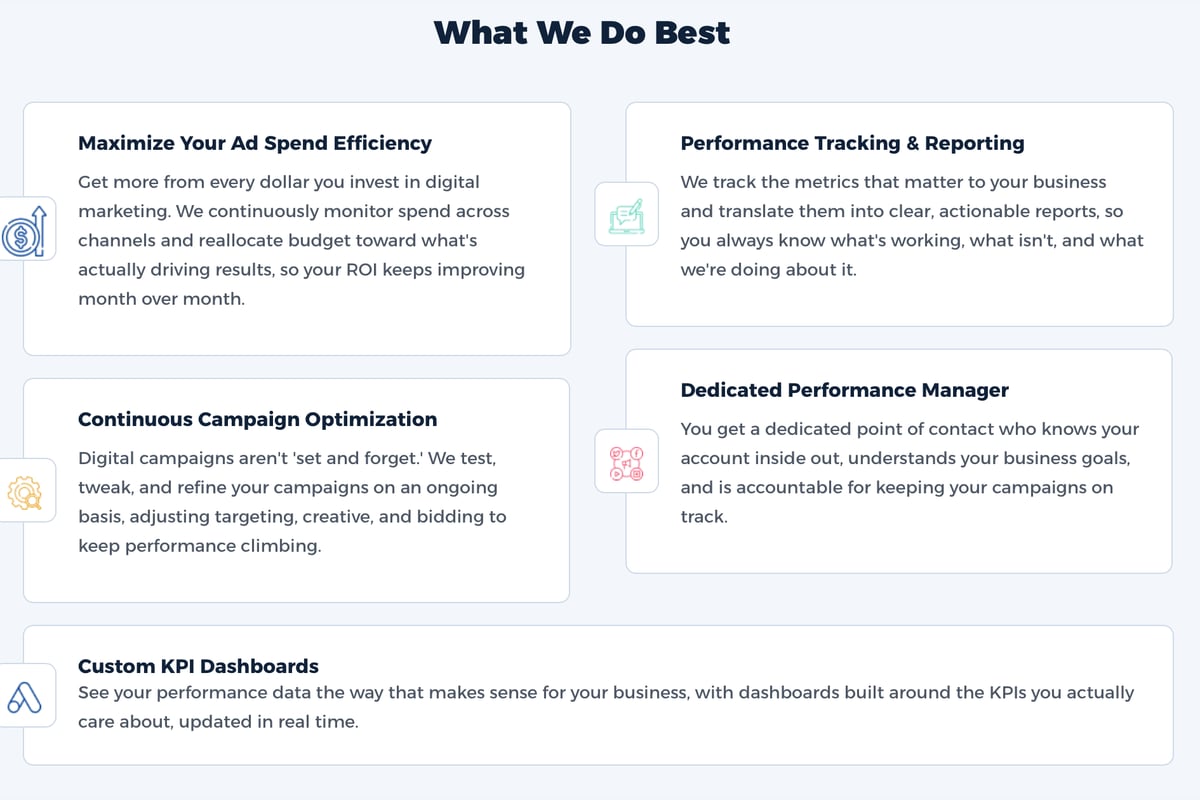
Businesses seeking deeper performance insights often benefit from dedicated performance management that goes beyond platform reporting to connect paid media investments with actual revenue impact across the customer journey.
Attribution Model Selection
Last-click attribution oversimplifies the customer journey, crediting only the final touchpoint before conversion. Multi-touch models distribute credit across awareness, consideration, and decision interactions.
| Attribution Model | Best For | Limitation |
|---|---|---|
| Last Click | Direct response, short sales cycles | Ignores upper-funnel contribution |
| First Click | Brand awareness measurement | Ignores conversion drivers |
| Linear | Equal touchpoint value | Oversimplifies impact variation |
| Time Decay | Longer consideration periods | May undervalue awareness |
| Data-Driven | Sufficient conversion volume | Requires minimum data threshold |
Platform-specific attribution windows also impact reporting. Facebook's default 7-day click, 1-day view window differs from Google's typical 30-day click attribution, creating apparent discrepancies when comparing cross-platform performance.
Advanced Optimization Techniques
Continuous optimization separates high-performing campaigns from mediocre spend. Systematic testing, data analysis, and strategic adjustments compound into significant performance improvements over time.
A/B Testing Framework
Structured testing prevents random changes that muddy performance data. Test one variable at a time with sufficient sample size to reach statistical significance.
High-impact testing priorities:
- Landing page headlines and CTAs
- Audience segment performance
- Ad creative variations (image, video, copy)
- Bidding strategy comparisons
- Placement and device performance
Document all tests with hypotheses, results, and implementation decisions. This institutional knowledge prevents repeating failed experiments and accelerates learning curves for team members.
Quality Score and Ad Rank Optimization
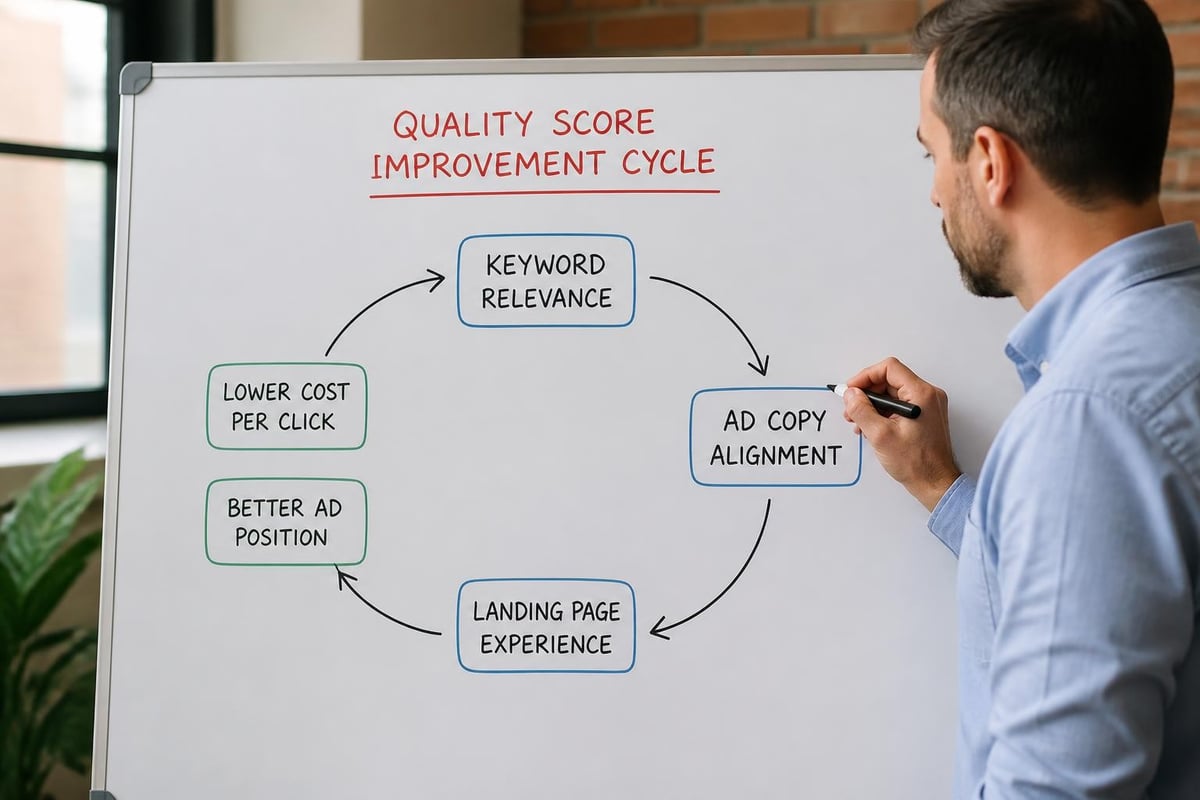
Search platforms use quality metrics to determine ad position and cost. Higher quality scores reduce CPC while improving placement, creating a compounding advantage for well-optimized accounts.
Google's Quality Score combines expected CTR, ad relevance, and landing page experience. Improving these factors often delivers better ROI than simply raising bids.
Emerging Trends Shaping Paid Media Marketing
Platform capabilities, user behaviors, and privacy regulations continuously reshape paid media effectiveness. Staying current with these shifts creates competitive advantages.
Privacy and Tracking Changes
iOS tracking restrictions, cookie deprecation, and privacy regulations fundamentally altered paid media targeting and measurement. First-party data collection through CRM systems, email lists, and website tracking becomes increasingly valuable as third-party targeting options diminish.
Server-side tracking, conversion APIs, and privacy-compliant measurement solutions help maintain campaign effectiveness despite tracking limitations. Platforms investing in privacy-safe targeting through cohort models and on-device processing will likely gain advertiser preference.
AI and Automation Integration
Machine learning powers increasingly sophisticated campaign optimization. Smart bidding algorithms process millions of signals to predict conversion likelihood and adjust bids in real-time. Dynamic creative optimization automatically assembles ad variations from component assets.
The role of paid media marketers shifts from manual optimization to strategic direction, creative development, and AI supervision. Understanding what automation handles well versus where human judgment adds value becomes critical for efficiency.
Video and Connected TV Growth
Video consumption continues migrating from traditional TV to streaming services and digital platforms. Connected TV advertising combines television's immersive format with digital targeting and measurement precision. Platforms like YouTube, Hulu, and streaming services offer various ad formats reaching cord-cutters and younger demographics.
Short-form video on TikTok, Instagram Reels, and YouTube Shorts demands different creative approaches than traditional video ads. The first three seconds determine whether users scroll past or engage, requiring immediate hooks and value delivery.
Building In-House Capabilities vs. Agency Partnerships
Organizations face ongoing decisions about paid media marketing execution models. In-house teams offer control and institutional knowledge. Agencies bring specialized expertise and cross-client learning.
In-house advantages:
- Deep product and customer understanding
- Direct alignment with business priorities
- Faster decision-making processes
- Lower long-term cost structures
- Proprietary data and strategy retention
Agency and consultancy benefits:
- Specialized platform expertise
- Cross-industry best practices
- Established vendor relationships
- Scalable resource allocation
- Objective performance perspective
Many successful organizations adopt hybrid models, maintaining strategic oversight and creative direction in-house while leveraging external specialists for technical execution, platform expertise, or capacity expansion.
Organizations exploring how to build internal capabilities often start with comprehensive training programs that equip teams with platform proficiency, strategic frameworks, and optimization methodologies before transitioning from agency dependence to in-house management.
Platform-Specific Best Practices
Each advertising platform has unique characteristics, audience behaviors, and optimization levers that require tailored approaches.
Meta Advertising Strategy
Facebook and Instagram campaigns benefit from visual storytelling, social proof, and emotional connection. The platform's algorithm rewards engagement, making creative quality paramount.
Campaign objectives align algorithm optimization toward specific actions: awareness, traffic, engagement, leads, or conversions. Choosing the right objective tells Meta what you value, directly impacting who sees your ads and how you're charged.
Meta campaign optimization checklist:
- Install and verify Meta Pixel for conversion tracking
- Build custom audiences from website visitors and customer lists
- Create lookalike audiences from high-value customers
- Test multiple creative variations per ad set
- Use campaign budget optimization for efficient allocation
- Implement broad targeting with creative and offer specificity
- Monitor frequency to prevent ad fatigue
Google Ads Optimization
Google's ecosystem spans search, display, shopping, video (YouTube), and discovery campaigns. Each format serves different user intents and purchase stages.
Shopping campaigns dominate e-commerce advertising, displaying product images, prices, and merchant information directly in search results. Product feed optimization determines visibility and performance.
Responsive search ads automatically test headline and description combinations, learning which variations perform best for specific queries. Providing diverse asset options improves this machine learning effectiveness.
LinkedIn B2B Targeting
LinkedIn commands premium pricing but offers unmatched B2B targeting through job titles, company size, industries, and professional interests. Decision-maker access justifies higher cost-per-click for businesses with appropriate customer lifetime values.
Lead generation forms native to LinkedIn reduce friction by pre-populating user profile data, improving conversion rates compared to external landing pages. This convenience comes with lead quality considerations, as low-friction submissions sometimes generate less qualified prospects.
Common Paid Media Marketing Mistakes
Understanding frequent pitfalls helps organizations avoid expensive learning experiences.
Critical mistakes to avoid:
- Neglecting landing page optimization: Driving traffic to poorly converting pages wastes ad spend regardless of targeting quality
- Insufficient conversion tracking: Optimizing toward clicks rather than business outcomes misallocates budget
- Ignoring mobile experience: Most paid media traffic comes from mobile devices; desktop-only optimization leaves money on the table
- Premature optimization: Making decisions before reaching statistical significance creates false conclusions
- Single-channel dependence: Platform algorithm changes or policy shifts can devastate businesses relying on one channel
- Creative stagnation: Running identical ads indefinitely causes performance degradation as audiences experience fatigue
- Overlooking negative keywords: Allowing irrelevant search queries wastes search budgets and dilutes performance data
Organizations new to paid media marketing often benefit from expert guidance to avoid these common pitfalls while building internal capabilities and establishing performance baselines before scaling investment.
Competitive Intelligence and Market Positioning
Understanding competitor paid media strategies informs positioning decisions and identifies opportunity gaps. Tools like SEMrush, SpyFu, and native platform insights reveal competitor keyword targeting, ad copy approaches, and estimated spend levels.
The goal isn't copying competitor tactics but identifying market positioning opportunities. If competitors emphasize price, quality differentiation might resonate. If everyone targets the same broad keywords, specific long-tail opportunities may offer better efficiency.
Attention measurement frameworks from CIMM help advertisers move beyond basic viewability metrics toward understanding actual ad engagement and effectiveness across placements and formats.
Scaling Profitable Campaigns
Once campaigns demonstrate positive ROI at modest spend levels, systematic scaling captures market opportunity without destroying unit economics.
Scaling methodology:
- Verify conversion tracking accuracy before increasing budgets
- Expand budgets gradually (20-30% weekly increases) to maintain algorithm stability
- Add audience segments with similar characteristics to proven performers
- Test additional geographic markets with demographic fit
- Introduce complementary products to existing customer audiences
- Expand to similar platforms with audience overlap
Rapid budget increases often trigger performance degradation as platforms struggle to maintain conversion rates at higher volume. Patience during scaling preserves profitability while capturing growth.
Seasonal Planning and Budget Flexibility
Paid media marketing budgets should flex with business seasonality, competitive dynamics, and platform opportunities. Retail businesses concentrate spend during Q4 holiday shopping. B2B services often see September budget availability as companies enter fiscal year-end.
Maintaining year-round presence, even at reduced levels during slow periods, preserves account history and quality scores while gathering data. Complete pauses force rebuilding momentum from zero when reactivating.
Platform-specific events like Prime Day, Black Friday, or back-to-school periods create both opportunity and competition. Early planning and creative preparation enable capturing these high-volume windows without last-minute scrambling.
Integration with Broader Marketing Strategy
Paid media marketing performs best as part of cohesive customer acquisition and retention systems rather than as an isolated tactic. Content marketing builds organic authority that improves paid conversion rates. Email nurturing extends value from paid traffic acquisitions. SEO and paid search together dominate visibility for strategic keywords.
Audience insights from paid campaigns inform product development, messaging refinement, and market expansion decisions. The data assets generated through paid media testing create value far beyond direct conversion contribution.
Organizations taking comprehensive digital marketing approaches see multiplier effects as channels reinforce rather than compete with each other, creating sustainable competitive advantages that pure paid media spending cannot replicate.
Paid media marketing delivers immediate visibility and measurable results when built on strategic foundations, continuous optimization, and integration with broader business objectives. The platforms, tactics, and best practices will continue evolving, but the core principles of relevance, value delivery, and performance measurement remain constant. Whether you're building internal capabilities, scaling existing campaigns, or exploring new channels, Intoact offers specialized training, hands-on consultancy, and performance management services designed to maximize your paid media ROI and build sustainable customer acquisition systems.


