


Paid social marketing has become the dominant force in digital advertising, surpassing even paid search to claim the largest share of global ad spend in 2026. Businesses now allocate significant budgets to platforms like Meta, TikTok, and LinkedIn because these channels offer unparalleled targeting capabilities, diverse creative formats, and measurable returns. Understanding how to plan, execute, and optimize campaigns across social platforms is no longer optional for marketing professionals who want to drive real business results.
Understanding the Paid Social Marketing Landscape
The shift toward paid social marketing reflects fundamental changes in how people consume content and make purchasing decisions. According to Pew Research Center’s latest data on social media use, platform adoption continues to evolve across demographics, with younger audiences favoring visual and video-first platforms while professionals remain active on LinkedIn. This diversity means marketers must match their campaign strategies to platform-specific behaviors and audience expectations.
Social advertising now commands more budget than traditional search advertising because it intercepts users during discovery and consideration phases. Rather than waiting for people to express intent through search queries, paid social marketing allows brands to reach potential customers based on interests, behaviors, and connections.
Platform Selection and Audience Alignment
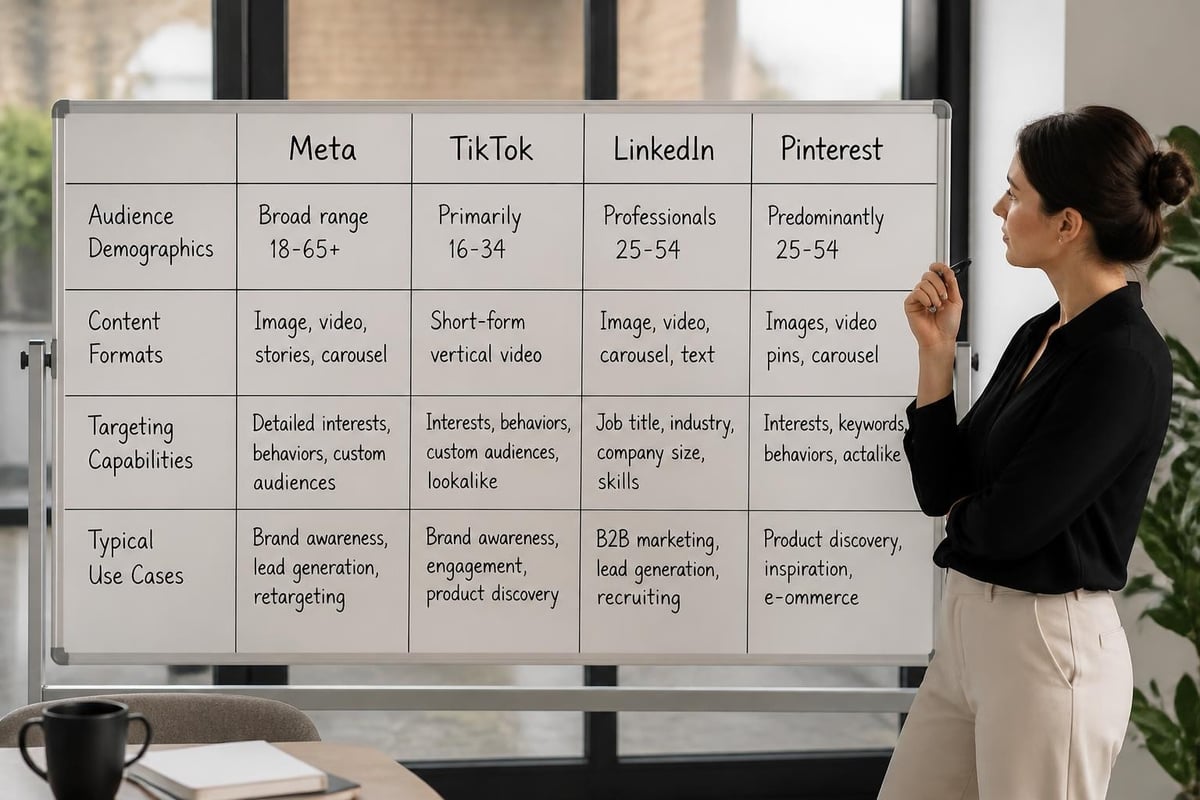
Choosing the right platform determines campaign success before you write a single ad. Each social network serves distinct audiences with different content consumption patterns:
- Meta platforms (Facebook and Instagram) offer the broadest reach and most sophisticated targeting options
- TikTok dominates short-form video engagement and reaches younger demographics with high intent
- LinkedIn provides exclusive access to professional audiences and B2B decision-makers
- Pinterest captures users in active planning and shopping modes
- X (formerly Twitter) serves real-time conversation and news-oriented audiences
The demographics and usage patterns documented by Pew Research show that multi-platform strategies typically outperform single-channel approaches. However, budget concentration on the platforms where your specific audience is most active and engaged delivers better returns than spreading resources too thin.
Campaign Structure and Strategic Planning
Effective paid social marketing begins with clear campaign architecture. The typical hierarchy organizes campaigns by objective, ad sets by audience or placement, and individual ads by creative variation. This structure enables granular performance analysis and budget optimization.
Defining Campaign Objectives
Modern social platforms offer objective-based buying that aligns ad delivery with specific business goals:
| Objective Type | Best For | Key Metrics |
|---|---|---|
| Awareness | Brand visibility, reach | Impressions, reach, CPM |
| Consideration | Traffic, engagement, video views | CTR, cost per click, view rate |
| Conversion | Sales, leads, app installs | ROAS, CPA, conversion rate |
At Intoact, we emphasize performance management that ties every campaign directly to measurable business outcomes. Vanity metrics like likes and shares matter less than conversion actions that generate revenue or qualified leads.
Your objective selection determines how platform algorithms optimize delivery. Awareness campaigns prioritize impressions to unique users, while conversion campaigns focus on showing ads to people most likely to complete your desired action. Misaligning your selected objective with your true business goal wastes budget on irrelevant optimization.
Audience Targeting Strategies
Paid social marketing excels through layered targeting that combines multiple data signals. The most effective campaigns use:
- Core demographics (age, location, language, gender)
- Detailed targeting (interests, behaviors, job titles, life events)
- Custom audiences (website visitors, customer lists, app users)
- Lookalike audiences (people similar to your best customers)
Testing multiple audience segments in parallel reveals which combinations produce the lowest acquisition costs. Start with broader targeting to gather performance data, then refine based on actual conversion patterns rather than assumptions.
Privacy changes have limited third-party data availability, making first-party data increasingly valuable. Pixel implementation, API conversions, and CRM integration now determine targeting precision. Companies that invest in proper tracking infrastructure gain significant competitive advantages in paid social marketing effectiveness.
Creative Development and Ad Formats
Creative quality impacts campaign performance more than any other single factor. Platform algorithms reward ads that generate engagement and positive user experiences with lower costs and better placement. Generic stock photos and direct product pitches typically underperform compared to native-feeling content.
Platform-Specific Creative Best Practices
Each platform favors distinct creative approaches. Meta’s guidance for Reels ads emphasizes vertical video, quick hooks, and mobile-first design. TikTok’s creative best practices stress authentic, trend-aligned content that feels organic rather than promotional.
Key creative principles across platforms include:
- Mobile-first design with text and key elements in the safe zones
- Sound-on optimization for video content with captions as backup
- Fast pacing that captures attention within the first three seconds
- Clear value propositions that answer "what's in it for me?"
- Strong calls-to-action that guide the next step
Testing multiple creative variations simultaneously identifies which messages, visuals, and formats resonate with your target audience. The IAB’s Creator Ad Spend report shows that brands increasingly amplify creator-generated content through paid promotion because it outperforms traditional brand content.
Video Versus Static Content
Short-form video dominates paid social marketing in 2026, but static images and carousels still deliver strong results for certain objectives and audiences. Video works exceptionally well for:
- Product demonstrations and tutorials
- Brand storytelling and emotional connection
- Entertaining content that stops the scroll
- Complex concepts requiring explanation
Static formats excel for:
- Direct response offers with clear pricing
- Multiple product showcases in carousel format
- Text-heavy educational content
- Retargeting audiences already familiar with your brand
Budget allocation between formats should reflect your specific conversion data rather than industry trends. Some businesses discover that simple static ads with compelling copy outperform expensive video production.

Campaign Management and Optimization
Launching campaigns represents just the beginning of paid social marketing success. Continuous monitoring and optimization separate profitable campaigns from budget-wasting efforts.
Performance Monitoring and Key Metrics
Different campaign objectives require different metric priorities. Awareness campaigns track reach, frequency, and cost per thousand impressions (CPM). Consideration campaigns focus on click-through rates, cost per click, and engagement rates. Conversion campaigns prioritize return on ad spend (ROAS), cost per acquisition (CPA), and conversion rate.
| Metric Category | Primary KPIs | Secondary Indicators |
|---|---|---|
| Efficiency | ROAS, CPA, CPM | CTR, CVR, frequency |
| Volume | Conversions, revenue, leads | Impressions, clicks, reach |
| Quality | Customer lifetime value | Time on site, pages per session |
Daily monitoring during the first week identifies serious issues, while weekly reviews suffice for mature campaigns. Algorithm learning periods typically last 3-7 days after major changes, during which performance may fluctuate before stabilizing.
At Intoact, our digital marketing consultancy helps businesses establish proper performance frameworks that connect paid social marketing spend directly to revenue attribution. Many companies track clicks and conversions but fail to calculate true profitability after considering product margins and customer lifetime value.
Optimization Tactics and Testing
Systematic testing reveals optimization opportunities that intuition alone would miss. Effective testing approaches include:
- A/B testing creative elements (headlines, images, videos, CTAs)
- Audience refinement (layering interests, excluding converters, adjusting demographics)
- Placement optimization (feed, stories, reels, in-stream video)
- Bid strategy experimentation (cost cap, bid cap, target ROAS)
- Schedule adjustments (dayparting based on conversion patterns)
Change one variable at a time to isolate what drives performance improvements. Running multiple simultaneous tests on small budgets creates noise that obscures actual performance signals.
Budget reallocation should follow a "double down on winners" approach. Gradually shift spend from underperforming ad sets to top performers, but maintain some budget diversity to avoid over-concentration. Algorithms require ongoing data flow to maintain optimization effectiveness.
Advanced Strategies for Maximum ROI
Sophisticated paid social marketing extends beyond basic campaign setup into strategic initiatives that compound results over time.
Retargeting and Customer Journey Mapping
Website visitors who don't convert on first exposure represent your highest-probability prospects. Retargeting campaigns systematically re-engage these warm audiences with tailored messages based on their specific behaviors.
Effective retargeting sequences might include:
- Dynamic product ads showing items people viewed
- Testimonial and social proof content for consideration-stage prospects
- Limited-time offers for cart abandoners
- Educational content for early-stage researchers
Journey-based messaging acknowledges that different people require different information at different stages. Someone who spent ten minutes reading detailed product information needs a different message than someone who bounced after five seconds.
Frequency caps prevent ad fatigue while ensuring adequate exposure. Most platforms recommend 2-3 impressions per person per week for retargeting, though optimal frequency varies by industry and purchase cycle length.
Integration with Other Marketing Channels
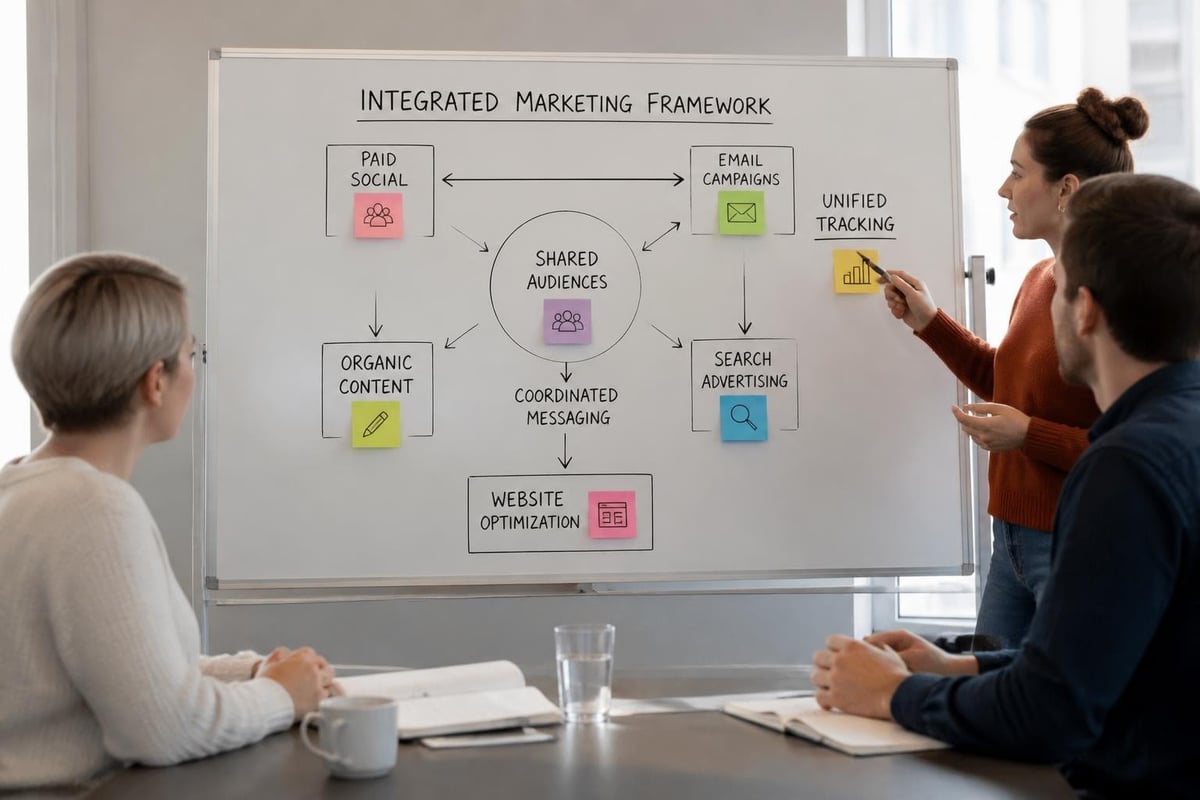
Paid social marketing delivers maximum value when integrated with organic social, content marketing, email, and search campaigns. Coordinated strategies include:
- Amplifying high-performing organic content through paid promotion
- Retargeting email subscribers who don't open messages
- Supporting SEO content with paid social traffic to new pages
- Coordinating message timing across channels for launch campaigns
The IAB’s guidance on modern marketing mix modeling emphasizes that attribution models should account for channel interaction effects. Paid social marketing often assists conversions credited to other channels in last-click models, making its true value higher than basic attribution suggests.
Professionals looking to master these integration strategies often benefit from comprehensive training. The Meta & TikTok Ads Course at Intoact teaches practical campaign management alongside broader digital marketing integration, ensuring students understand how paid social fits within complete marketing systems.

B2B Paid Social Marketing Considerations
Business-to-business marketing requires different paid social approaches compared to direct-to-consumer campaigns. LinkedIn’s marketing resources outline platform-specific strategies for reaching professional audiences with relevant messaging.
LinkedIn Campaign Strategies
LinkedIn's targeting capabilities include job titles, company size, industry, seniority, skills, and even specific companies. This precision enables narrow audience definition that would be impossible on consumer-focused platforms.
Successful B2B campaigns on LinkedIn typically feature:
- Thought leadership content that demonstrates expertise
- Case studies and testimonials providing social proof
- Gated content offers capturing lead information
- Event promotion for webinars and industry conferences
- Account-based marketing targeting specific high-value companies
Cost per click on LinkedIn typically exceeds Meta and TikTok rates significantly, but conversion quality often justifies the premium. Decision-makers reached on LinkedIn frequently hold budget authority and genuine purchase intent.
Content Marketing Amplification
B2B paid social marketing works particularly well for content distribution. Promoting whitepapers, research reports, and educational resources builds authority while capturing contact information from qualified prospects. Multi-step nurture sequences then convert these leads over weeks or months.
The longer B2B sales cycles require patience and sophisticated attribution. A LinkedIn campaign might generate initial awareness that contributes to a sale six months later through multiple touchpoints. Multi-touch attribution models and CRM integration help demonstrate paid social marketing's role in these extended journeys.
Budget Allocation and Scaling Strategies
Determining appropriate paid social marketing budgets requires balancing platform minimums, testing needs, and revenue targets. Each platform requires minimum daily budgets for effective algorithm optimization, typically $20-50 per ad set.
Testing Budget and Ramp-Up Phases
New campaigns benefit from a structured testing phase before scaling. A practical approach allocates 20-30% of total budget to testing multiple audiences, creatives, and placements. Once winning combinations emerge, shift remaining budget to top performers.
Scaling successful campaigns requires gradual budget increases. Doubling budgets overnight often destabilizes algorithm performance, requiring new learning periods. Increase budgets by 20-30% every few days while maintaining acceptable efficiency metrics.
Seasonal businesses should maintain year-round presence at reduced levels rather than going dark between peak periods. Continuous campaigns preserve algorithm learning and audience warmth, making seasonal ramp-ups more efficient.
Measurement, Attribution, and Reporting
Accurate measurement determines whether paid social marketing delivers acceptable returns. Platform-reported metrics provide directional guidance, but third-party analytics often reveal different conversion values.
Tracking Implementation
Proper tracking requires pixel installation, conversion API setup, and event configuration. Common tracking mistakes include:
- Missing pixels on confirmation pages
- Improperly configured custom conversions
- Lack of offline conversion uploads for phone or in-store sales
- Failure to exclude internal traffic
- Neglecting to update tracking after website changes
Privacy regulations and browser restrictions increasingly limit cookie-based tracking. Server-side tracking through Conversion APIs provides more reliable data collection while respecting user privacy preferences.
ROI Calculation and Business Impact
True ROI calculation extends beyond platform-reported ROAS to include full business costs. Comprehensive formulas account for:
- Direct ad spend (platform costs)
- Creative production (design, video, copywriting)
- Management time (internal staff or agency fees)
- Product costs (for e-commerce)
- Customer lifetime value (repeat purchase projections)
A campaign showing 3x ROAS might be unprofitable after considering a 40% product cost and $2,000 monthly management fee. Conversely, a 1.5x initial ROAS campaign could be highly profitable if customers return for five repeat purchases.
Businesses struggling with performance measurement benefit from expert guidance. Intoact's performance management services help companies establish proper tracking, interpret data accurately, and make optimization decisions that improve actual profitability rather than vanity metrics.
Platform Updates and Future Trends
Paid social marketing evolves rapidly as platforms introduce new formats, targeting options, and algorithm changes. Staying current requires ongoing education and experimentation.
Emerging Formats and Features
Recent platform innovations include AI-powered creative optimization, expanded placement options across partner networks, and enhanced attribution modeling. Advantage+ campaigns on Meta and similar automated features reduce manual optimization requirements while maintaining or improving performance.
Short-form video continues expanding across all platforms, with vertical video becoming the default format even on traditionally horizontal-video platforms. Interactive formats like polls, quizzes, and AR filters generate higher engagement but require specialized creative resources.
Privacy and Targeting Evolution
Privacy regulations continue restricting data collection and usage. Successful paid social marketing in 2026 and beyond relies more heavily on first-party data, contextual targeting, and broader audience definitions. Campaigns that previously targeted narrow interest combinations now achieve better results with simplified targeting that allows algorithms more optimization flexibility.
Preparing for these changes requires building owned audiences through email lists, customer data platforms, and community development. Companies with rich first-party data maintain competitive advantages as third-party targeting options diminish.
Paid social marketing success requires strategic planning, continuous optimization, and proper measurement that connects advertising spend to real business results. The platforms, formats, and tactics continue evolving, but the fundamental principles of audience understanding, compelling creative, and performance-based decision making remain constant. Whether you're managing campaigns internally or seeking expert support, Intoact provides the training, consulting, and performance management services needed to maximize your paid social marketing ROI and build sustainable competitive advantages in digital advertising.


