


Performance marketing companies have fundamentally changed how businesses approach digital advertising by shifting focus from impressions and reach to measurable outcomes and return on investment. Unlike traditional marketing agencies that bill for time or creative deliverables, these specialized firms tie their success directly to the results they generate, whether that's leads, sales, app installs, or other defined conversion actions. This accountability-driven model has made performance marketing the preferred approach for businesses seeking predictable growth and transparent campaign management.
What Defines Performance Marketing Companies
Performance marketing companies operate on a results-based compensation model where payment correlates directly with specific actions or outcomes. This fundamental difference separates them from traditional advertising agencies that charge retainers or project fees regardless of campaign performance.
The business model centers on risk sharing between the company and client. When campaigns underperform, the agency earns less. When campaigns exceed targets, both parties benefit proportionally. This alignment creates powerful incentives for continuous optimization and strategic innovation.
Core characteristics that define performance marketing companies include:
- Payment structures tied to conversions, sales, or qualified leads
- Advanced tracking infrastructure across all marketing touchpoints
- Real-time campaign monitoring and adjustment capabilities
- Data-driven decision making backed by analytics platforms
- Transparent reporting on every dollar spent and result generated
Specialization Areas Within Performance Marketing
Most performance marketing companies develop expertise in specific channels or industries. Some focus exclusively on paid search and shopping campaigns, while others specialize in social media advertising across platforms like Meta and TikTok. Industry specialization allows agencies to build deep knowledge of customer acquisition costs, conversion benchmarks, and creative approaches that work within specific sectors.
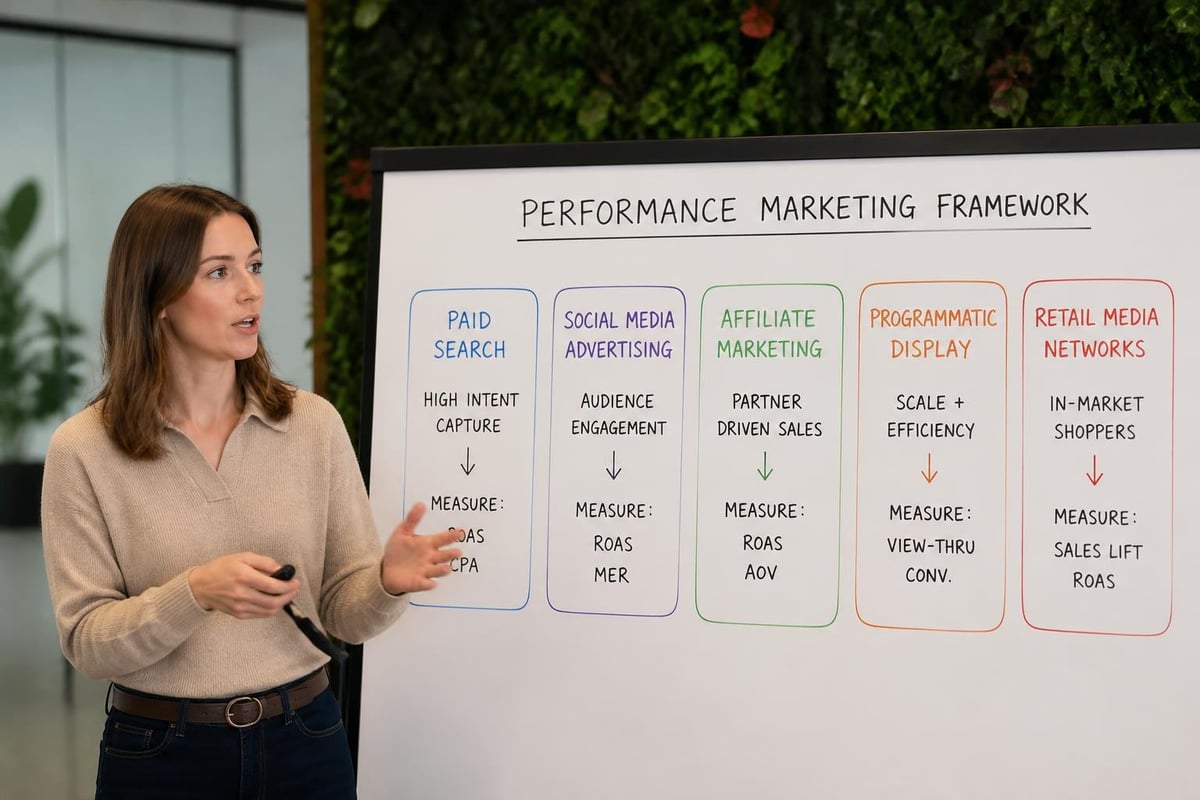
The most effective performance marketing companies master attribution modeling to understand how different channels contribute to conversions. They implement multi-touch attribution that reveals the customer journey across awareness, consideration, and decision stages, rather than crediting only the last click before purchase.
How Performance Marketing Companies Measure Success
Measurement separates professional performance marketing companies from those simply running ads. The industry has moved beyond basic metrics like click-through rates to sophisticated frameworks that isolate true incremental impact.
Modern measurement approaches combine multiple methodologies to create a complete picture of marketing effectiveness. Media mix modeling analyzes historical data to understand how different channels drive results over time. Incrementality testing uses control groups to measure the lift generated by specific campaigns or tactics.
| Measurement Method | Primary Use Case | Time Frame | Best For |
|---|---|---|---|
| Last-click attribution | Direct response campaigns | Real-time | Bottom-funnel optimization |
| Multi-touch attribution | Cross-channel journeys | Days to weeks | Understanding customer paths |
| Media mix modeling | Budget allocation | Quarterly/annual | Strategic planning |
| Incrementality testing | True lift measurement | Campaign duration | Validating effectiveness |
Key Performance Indicators Beyond Conversions
While conversions remain central, performance marketing companies track numerous indicators that signal campaign health and optimization opportunities. Customer acquisition cost (CAC) reveals the efficiency of different channels and campaigns. Lifetime value (LTV) projections help determine acceptable acquisition costs and inform bidding strategies.
Return on ad spend (ROAS) provides immediate feedback on campaign profitability, but sophisticated agencies look deeper. They calculate contribution margin ROAS that factors in product costs and fulfillment expenses, not just gross revenue. This approach prevents the common mistake of scaling unprofitable campaigns that generate revenue but destroy value.
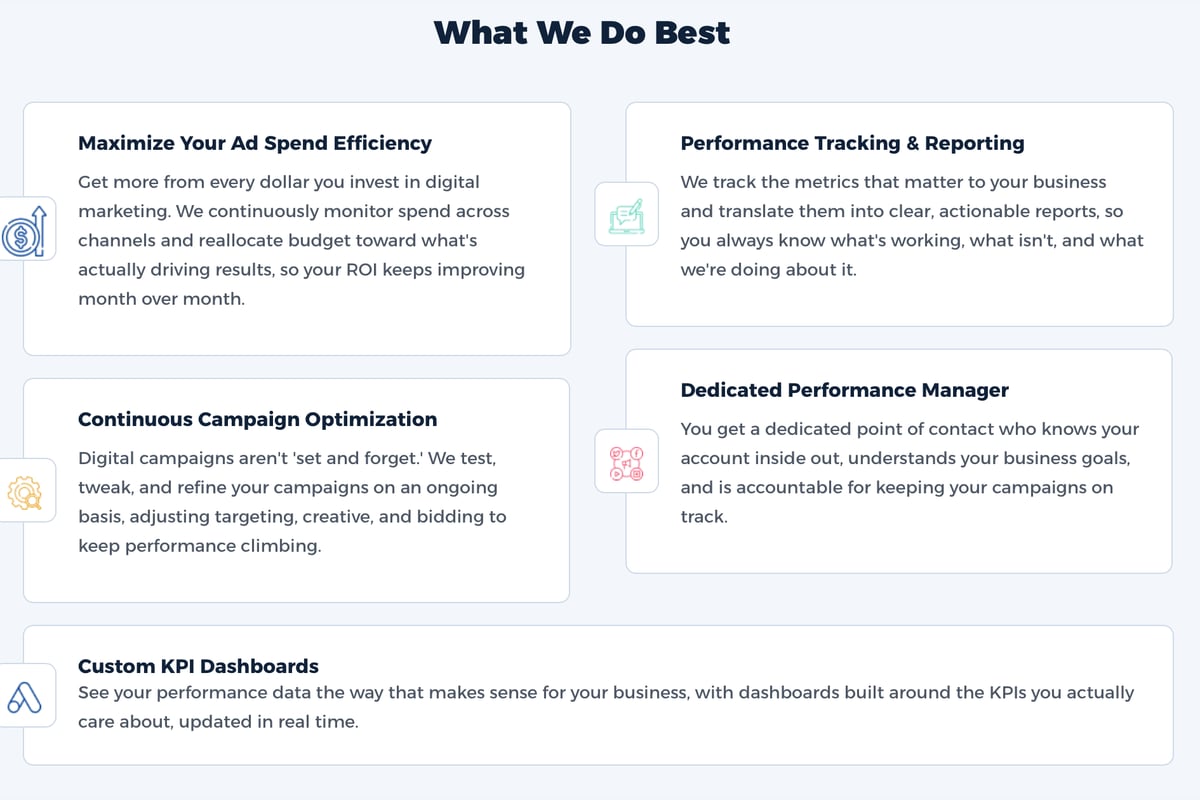
Businesses investing in Digital Marketing Performance Management gain access to these advanced measurement frameworks without building internal capabilities from scratch. The service continuously monitors campaign performance across channels, identifies optimization opportunities, and implements adjustments that compound returns over time.
Channel Strategies Employed by Top Performance Marketing Companies
Channel selection and allocation represent critical strategic decisions for performance marketing companies. The best agencies maintain expertise across multiple channels while recognizing that channel effectiveness varies dramatically by business model, product category, and customer segment.
Paid Search and Shopping Campaigns
Search advertising remains foundational for most performance marketing companies because of its high intent and direct attribution. Users actively searching for solutions or products demonstrate purchase readiness that makes conversion tracking straightforward.
Advanced paid search strategies include:
- Audience layering that combines search intent with demographic and behavioral signals
- Dynamic search ads that automatically match queries to landing pages
- Shopping feed optimization for e-commerce products
- Bid strategy automation using first-party conversion data
- Negative keyword refinement based on search query reports
Performance marketing companies constantly refine keyword targeting and bidding to balance volume and efficiency. They identify high-value queries that competitors overlook and eliminate wasteful spending on terms that generate clicks but rarely convert.
Social Media Performance Advertising
Platforms like Meta and TikTok offer sophisticated targeting and creative testing capabilities that performance marketing companies leverage systematically. Unlike search advertising where users express intent, social platforms require compelling creative that interrupts consumption and generates interest.
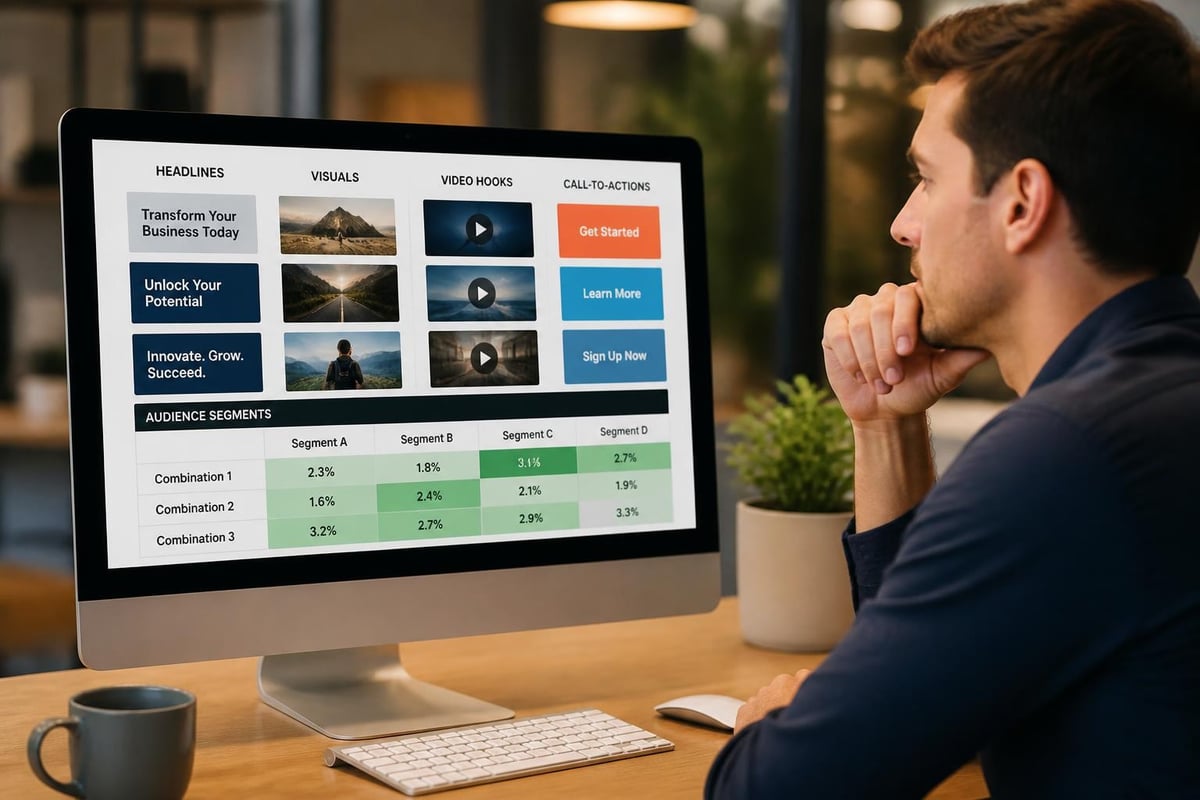
The testing methodology separates effective performance marketing companies from mediocre ones. Top agencies run structured creative experiments that isolate specific variables like headlines, images, video hooks, or offer positioning. They analyze performance by audience segment to understand which messages resonate with different customer groups.
Tools and frameworks covered in Meta and TikTok advertising training help marketers understand platform-specific best practices, from Meta's Advantage+ campaign types to TikTok's emphasis on native, entertaining content formats.
Technology Stack and Data Infrastructure
Performance marketing companies invest heavily in technology that enables real-time decision making and accurate attribution. The martech stack typically includes analytics platforms, attribution tools, conversion tracking systems, creative management software, and reporting dashboards that consolidate data from multiple sources.
Tag management systems ensure accurate tracking across websites and apps without requiring constant developer involvement. Conversion APIs supplement pixel-based tracking to improve data accuracy as browser restrictions and privacy regulations limit traditional tracking methods.
Privacy-Compliant Measurement Approaches
Privacy regulations and platform changes have forced performance marketing companies to adapt measurement methodologies. Privacy-enhancing technologies like differential privacy allow for aggregate insights while protecting individual user data.
First-party data collection has become essential as third-party cookies disappear. Performance marketing companies help clients implement customer data platforms that unify information from websites, apps, email systems, and CRM platforms. This consolidated data powers better targeting and more accurate measurement.
The shift toward privacy-safe advertising practices requires technical adaptation but also creates competitive advantages for companies that implement compliant solutions early. Businesses that build robust first-party data strategies reduce dependence on platform-provided audiences and gain proprietary insights competitors cannot replicate.
Balancing Performance and Brand-Building
A common misconception positions performance marketing and brand building as opposing strategies. Forward-thinking performance marketing companies recognize these approaches as complementary rather than contradictory.
Research demonstrates that brand strength directly impacts performance marketing efficiency. Strong brands command higher prices, generate more direct traffic, and convert at higher rates from paid channels. This reduces customer acquisition costs and improves return on ad spend across all performance channels.
Integration strategies include:
- Using performance channels to test brand messages before broader campaigns
- Incorporating brand metrics like aided awareness into performance dashboards
- Allocating budget to upper-funnel campaigns that reduce mid-funnel acquisition costs
- Testing creative that balances immediate response triggers with brand building elements
- Measuring long-term effects of performance campaigns on brand perception
Performance marketing companies that ignore brand building often achieve initial success but hit efficiency ceilings as they exhaust high-intent audiences. Those that invest strategically in awareness and consideration create expanding pools of prospects who respond better to conversion-focused messages.
Optimization Methodologies and Testing Frameworks
Continuous improvement distinguishes exceptional performance marketing companies from those that simply manage campaigns. Optimization happens at multiple levels, from account structure and bidding strategies to landing page experiences and creative messaging.
The testing cadence matters as much as the testing methodology. Top performance marketing companies maintain structured experiment calendars that ensure consistent learning without overwhelming systems with too many simultaneous changes. They understand statistical significance requirements and avoid making decisions based on insufficient data.
Landing Page and Conversion Optimization
Traffic quality matters little if landing experiences fail to convert visitors. Performance marketing companies extend optimization beyond ad platforms to the entire conversion funnel, analyzing user behavior data to identify friction points and testing variations that improve outcomes.
Common landing page optimization areas:
- Above-fold clarity and value proposition communication
- Form field reduction and progressive disclosure
- Trust signals including testimonials and security badges
- Mobile experience optimization for touch interactions
- Page speed improvements that reduce abandonment
- Clear call-to-action prominence and testing
Tools like session recording and heat mapping reveal how users actually interact with pages rather than how marketers assume they behave. These insights drive hypothesis formation for structured A/B tests that incrementally improve conversion rates.
Retail Media and Emerging Performance Channels
Retail media networks have emerged as powerful performance channels, particularly for consumer product companies. Platforms operated by Amazon, Walmart, Target, and other retailers offer advertising placements with unique advantages including point-of-purchase positioning and closed-loop attribution.
Performance marketing companies specializing in retail media understand platform-specific dynamics like the importance of product detail page optimization, sponsored product versus sponsored brand campaign strategies, and the interplay between organic ranking and paid visibility.
The measurement capabilities within retail media platforms often surpass those available in other channels because retailers control both the advertising exposure and the transaction. This enables precise incrementality measurement and profit optimization rather than just revenue maximization.
Connected TV and Audio Performance Advertising
Streaming platforms have introduced performance marketing capabilities to traditionally brand-focused television and audio channels. Connected TV advertising now supports clickable calls-to-action, QR code integration, and deterministic attribution through device matching.
Performance marketing companies experiment with these emerging channels, testing whether their efficiency justifies inclusion in client media mixes. Early adopters often find competitive advantages as auction dynamics favor advertisers before channels become saturated.
Agency Selection Criteria for Performance Marketing Companies
Choosing the right performance marketing company requires evaluating capabilities beyond promises and case studies. The selection process should assess technical competencies, strategic thinking, communication practices, and cultural alignment.
Critical evaluation criteria include:
- Platform certifications and partnership status
- Proprietary technology or unique data advantages
- Vertical expertise relevant to your business
- Transparent reporting and data access policies
- Team composition and account management structure
- Contract terms and performance guarantees
Reference conversations with current and former clients reveal operational realities that sales presentations obscure. Ask specifically about communication frequency, strategic contribution beyond execution, and how the agency handles underperforming campaigns.
In-House Versus Agency Performance Marketing
Some businesses develop internal performance marketing capabilities rather than outsourcing to specialized companies. This approach offers certain advantages including direct control, proprietary knowledge accumulation, and elimination of agency fees.
The decision depends on scale, complexity, and strategic importance. Businesses spending less than $50,000 monthly on performance channels often lack the budget to hire specialized talent across all platforms. Companies in this range typically benefit more from agency partnerships or consultancy support.
Organizations investing significantly in performance marketing might combine approaches, maintaining internal leadership while leveraging agency expertise for specialized channels or testing. Resources like digital marketing consultancy services help businesses assess optimal organizational structures based on their specific situations.
Future Trends Reshaping Performance Marketing Companies
Industry experts identify several developments that will reshape how performance marketing companies operate over the next several years. Artificial intelligence continues expanding from basic bid automation to creative generation, audience discovery, and strategic planning.
AI-powered tools now generate ad copy variations, produce image and video creative, and predict which combinations will perform best for specific audiences. Performance marketing companies incorporate these capabilities while maintaining human oversight for brand alignment and strategic direction. Meta’s new AI tools for advertisers demonstrate how platforms are democratizing capabilities that previously required significant expertise or resources.
Measurement Evolution and Industry Standards
The measurement landscape continues evolving as the industry develops solutions for privacy-compliant attribution and incrementality testing. Cross-platform measurement remains challenging, but emerging standards aim to create consistent methodologies that enable meaningful comparison.
Performance marketing companies must stay current with privacy compliance requirements across jurisdictions. State-level privacy laws in the United States create complexity that requires technical and legal expertise to navigate properly.
The shift toward server-side tracking, consent management platforms, and privacy-preserving technologies represents significant infrastructure investments. Performance marketing companies that lead in these areas will help clients maintain measurement accuracy while meeting evolving regulatory requirements.
Building Performance Marketing Capabilities Internally
Organizations seeking to develop internal performance marketing expertise face the build-versus-buy decision. Training existing team members offers advantages including cultural fit and institutional knowledge retention, but requires time and structured learning approaches.
Comprehensive digital marketing training programs cover platform-specific tactics alongside strategic frameworks for channel selection, budget allocation, and performance measurement. These programs help marketing teams understand how performance marketing companies approach optimization and what results realistic campaigns should achieve.
Corporate training tailored to specific organizational needs accelerates capability development compared to generic courses. Customized programs address actual business challenges, use real campaign data for analysis exercises, and align learning objectives with strategic priorities.
Performance marketing companies deliver measurable business outcomes by combining technical platform expertise, sophisticated measurement frameworks, and continuous optimization methodologies that traditional agencies cannot match. Success requires selecting partners with proven capabilities in your specific channels and industries, supported by transparent reporting and strategic thinking that extends beyond tactical execution. Whether you choose to work with specialized agencies, build internal capabilities, or combine both approaches, Intoact offers the training, consultancy, and performance management services needed to maximize return on investment across all your digital marketing initiatives.


