


Performance marketing has fundamentally changed how businesses approach digital advertising. Unlike traditional marketing models where you pay for exposure and hope for results, performance marketing services operate on a different principle: you pay based on specific, measurable actions. This shift toward accountability has made performance marketing one of the fastest-growing segments in digital advertising, with businesses increasingly demanding transparent ROI from every dollar spent.
What Performance Marketing Services Actually Include
Performance marketing services encompass a comprehensive approach to digital advertising where payment is tied directly to measurable results. These results can include clicks, leads, conversions, sales, or other predetermined actions that align with business objectives.
The foundation of these services rests on three core pillars: data-driven strategy, continuous optimization, and transparent reporting. Unlike traditional agency relationships, performance marketing partnerships typically involve shared risk and reward, with agencies often tying their compensation to campaign outcomes.
Key Service Components
Most comprehensive performance marketing services include:
- Campaign strategy and planning based on business goals and target audience analysis
- Multi-channel media buying across search, social, display, and emerging platforms
- Creative development and testing optimized for conversion rather than brand awareness
- Advanced tracking implementation including pixel setup, conversion tracking, and attribution modeling
- Real-time optimization adjusting bids, budgets, and targeting based on performance data
- Detailed performance reporting with clear ROI metrics and actionable insights

The distinction between performance marketing and traditional digital marketing lies in the measurement framework. While brand campaigns might measure impressions and reach, performance campaigns focus exclusively on actions that directly impact revenue. According to recent industry research on performance marketing tactics, this outcomes-focused approach has driven significant shifts in how marketing budgets are allocated across channels.
Channel Strategy in Performance Marketing
Performance marketing services leverage multiple digital channels, each offering unique advantages for different business objectives. The key is selecting channels based on where your target audience spends time and which platforms offer the best cost-per-acquisition for your specific goals.
Primary Performance Channels
| Channel | Best For | Typical Cost Model | Key Advantage |
|---|---|---|---|
| Paid Search | High-intent customers | CPC, CPA | Captures existing demand |
| Social Media Ads | Audience building, remarketing | CPM, CPC, CPA | Sophisticated targeting options |
| Display Advertising | Awareness, remarketing | CPM, CPC | Broad reach, visual impact |
| Affiliate Marketing | E-commerce, lead generation | CPA, Revenue share | Pay only for results |
| Native Advertising | Content discovery | CPC, CPM | Higher engagement rates |
Paid search through platforms like Google Ads remains the cornerstone of most performance marketing strategies. The intent-driven nature of search advertising means you're reaching people actively looking for solutions, making conversion rates typically higher than other channels.
Social media platforms, particularly Meta and TikTok, have evolved their advertising capabilities significantly. These platforms now offer conversion-optimized campaigns that use machine learning to find and convert your ideal customers. The detailed guidance on creative performance from Google highlights how creative quality directly impacts campaign performance across these channels.
Emerging Channel Opportunities
The performance marketing landscape continues to evolve with new opportunities emerging regularly:
- Retail media networks like Amazon Ads offering purchase-ready audiences
- Connected TV advertising bringing performance metrics to television
- Influencer partnerships with performance-based compensation models
- Podcast advertising with attribution tracking capabilities
Digital marketing planning resources can help structure a comprehensive channel strategy that balances immediate performance with long-term growth.
Attribution and Measurement Frameworks
Understanding which marketing touchpoints drive conversions is central to performance marketing services. Attribution modeling has become increasingly complex as customer journeys span multiple devices, channels, and interactions before conversion.
Modern attribution approaches include:
Last-click attribution credits the final touchpoint before conversion. While simple to implement, it ignores the contribution of earlier interactions that may have been equally important.
First-click attribution gives all credit to the initial touchpoint. This model helps identify which channels are best at creating awareness but undervalues nurturing efforts.
Linear attribution distributes credit equally across all touchpoints. This approach recognizes the entire journey but doesn't account for the varying importance of different interactions.
Time-decay attribution gives more credit to touchpoints closer to conversion. This model assumes recent interactions matter more, which works well for shorter sales cycles.
Data-driven attribution uses machine learning to assign credit based on actual conversion patterns. This approach requires substantial data volume but provides the most accurate picture of channel contribution.

The shift toward privacy-focused browsing and the deprecation of third-party cookies has complicated attribution significantly. Marketing Dive’s coverage of evolving measurement approaches shows how marketers are adapting with marketing mix modeling and incrementality testing to maintain measurement accuracy.
For businesses investing in performance marketing services, understanding these measurement frameworks is essential. Digital Marketing Performance Management combines advanced tracking with strategic analysis to ensure accurate attribution across all touchpoints, helping businesses make informed decisions about channel investment and optimization priorities.
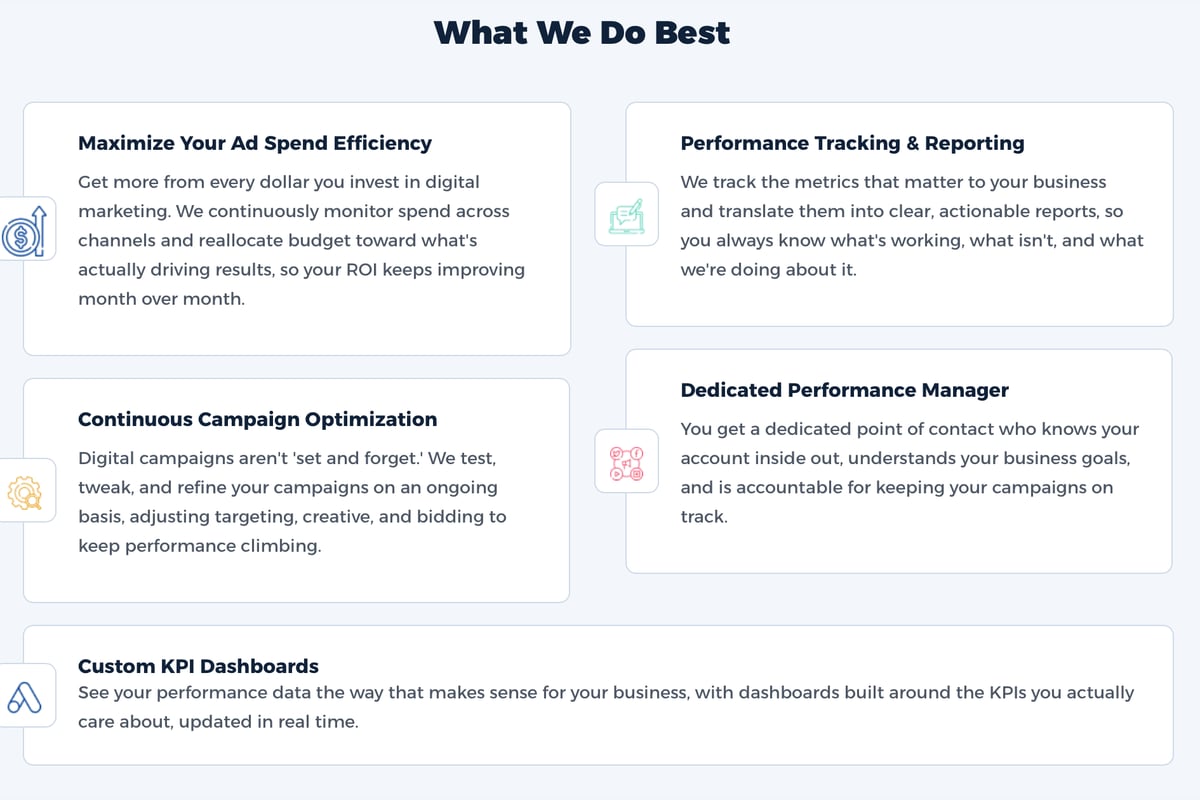
The ROI-Focused Optimization Process
Continuous optimization separates exceptional performance marketing services from basic campaign management. This iterative process involves constant testing, analysis, and refinement to improve results over time.
Optimization Cycle Components
The optimization process typically follows this structure:
- Baseline performance establishment through initial campaign setup and data collection
- Hypothesis development based on performance data and industry best practices
- Controlled testing of new approaches using A/B or multivariate methods
- Statistical analysis to determine winning variations and insights
- Implementation and scaling of successful approaches across campaigns
- Documentation and knowledge building to inform future optimization efforts
Testing variables include audience segments, ad creative, messaging, landing pages, bidding strategies, and campaign structures. The key is isolating individual variables to understand their specific impact on performance.
Budget Allocation and Bid Management
Effective performance marketing services dynamically allocate budgets based on real-time performance. High-performing campaigns receive increased investment while underperforming initiatives are paused or restructured.
Modern bid management goes beyond simple manual adjustments. Platform algorithms now handle much of the tactical bidding work, using machine learning to predict conversion likelihood and adjust bids accordingly. However, strategic oversight remains essential to ensure algorithms optimize toward the right objectives.
| Bidding Strategy | When to Use | Management Level |
|---|---|---|
| Manual CPC | Testing phase, small budgets | High |
| Enhanced CPC | Moderate data volume | Medium |
| Target CPA | Clear cost-per-acquisition goals | Low to Medium |
| Target ROAS | E-commerce, known value per conversion | Low to Medium |
| Maximize Conversions | Growing conversion volume | Low |
According to Forbes expert insights on 2026 performance marketing trends, automation and AI-driven optimization will continue to handle more tactical decisions, freeing marketers to focus on strategy, creative direction, and cross-channel orchestration.
Creative Strategy for Performance Campaigns
Creative assets directly impact performance marketing outcomes, yet many businesses underinvest in creative development relative to media spend. Research consistently shows creative quality accounts for a larger portion of campaign performance variance than targeting or placement.
Performance-focused creative differs fundamentally from brand-building creative. The goal is immediate action rather than long-term perception. This means:
- Clear value propositions stated within the first three seconds
- Strong calls-to-action that specify the desired next step
- Mobile-optimized formats that work across device types
- Rapid iteration based on performance data rather than subjective preferences
- Platform-native formats that blend with organic content
Testing Creative Variables
Systematic creative testing identifies which elements drive the strongest response:
- Headlines and opening hooks that capture attention
- Visual elements including images, video, and graphics
- Offer positioning and value statement clarity
- Call-to-action language and button placement
- Social proof elements such as testimonials and ratings
- Length and format across platforms
Kantar’s research on marketing effectiveness demonstrates the measurable impact of creative quality on campaign ROI, particularly when creative strategy aligns with performance objectives from the outset.

For businesses developing performance campaigns, content creation resources provide frameworks for crafting messages that capture attention and drive action across digital channels.
Platform-Specific Approaches
Each advertising platform has unique characteristics that influence how performance marketing services should be structured and optimized.
Google Ads Performance Marketing
Google's ecosystem offers unparalleled reach across search, display, video, and shopping channels. Performance marketing on Google focuses on capturing high-intent users actively searching for solutions.
Key considerations include:
- Keyword strategy balancing broad reach with conversion efficiency
- Quality Score optimization to reduce costs and improve ad position
- Shopping feed management for e-commerce businesses
- Remarketing audiences to re-engage previous visitors
- Search query analysis to identify negative keywords and new opportunities
Meta Platform Strategies
Facebook and Instagram advertising excels at audience discovery and remarketing. The platform's detailed targeting capabilities and visual formats make it effective for building awareness and nurturing consideration.
Effective Meta performance marketing requires:
- Custom audience development using website visitors, customer lists, and lookalikes
- Campaign budget optimization letting algorithms distribute spend across ad sets
- Video-first creative optimized for mobile viewing
- Conversion tracking through the Meta Pixel and Conversions API
- Advantage+ campaigns leveraging machine learning for audience expansion
TikTok Advertising Considerations
TikTok has rapidly emerged as a performance marketing channel, particularly for younger demographics and certain product categories. The platform's algorithm-driven content discovery creates opportunities for viral reach at relatively low costs.
TikTok performance marketing benefits from:
- Native, entertainment-focused creative that doesn't feel like advertising
- Spark Ads that leverage organic content performance
- Rapid testing cycles due to lower production requirements
- Interest-based targeting rather than detailed demographic filters
- Integration with TikTok Shop for direct commerce
Mastering these platforms requires ongoing education and hands-on experience. Practical training resources help marketers stay current with platform changes and emerging best practices across paid social channels.
Data Privacy and Compliance Considerations
Performance marketing services must navigate an increasingly complex privacy landscape. Regulatory frameworks like GDPR, CCPA, and emerging legislation worldwide impose strict requirements on data collection, storage, and usage.
Privacy-First Performance Marketing
Adapting to privacy restrictions requires several strategic adjustments:
First-party data collection has become essential as third-party tracking becomes less reliable. Building direct relationships with customers through email lists, account creation, and loyalty programs creates sustainable data assets.
Consent management must be implemented properly to ensure compliance while maintaining measurement capabilities. Cookie consent impacts both remarketing audiences and attribution accuracy.
Server-side tracking using tools like Google Tag Manager Server-Side and platform Conversions APIs helps maintain measurement accuracy despite browser-level tracking restrictions.
Privacy-preserving measurement techniques including aggregated reporting and conversion modeling help fill gaps created by signal loss.
According to IAB measurement guidance, the industry is moving toward privacy-centric measurement frameworks that balance user protection with advertiser needs for performance visibility.
Selecting and Working With Performance Marketing Partners
Choosing the right performance marketing services provider significantly impacts campaign outcomes. The partnership model differs from traditional agency relationships, with greater emphasis on shared objectives and transparent communication.
Evaluation Criteria
When assessing potential partners, consider:
| Factor | What to Evaluate |
|---|---|
| Track Record | Case studies in your industry, verifiable results |
| Technical Capabilities | Platform certifications, tool stack, tracking expertise |
| Reporting Transparency | Dashboard access, reporting frequency, metric clarity |
| Communication Model | Response time, strategic input, proactive optimization |
| Compensation Structure | Performance incentives, alignment with your goals |
| Team Experience | Specialist expertise, account continuity, escalation paths |
The best partnerships involve collaborative goal-setting with clear success metrics defined upfront. Rather than vanity metrics like impressions or clicks, focus on outcomes that directly impact business results: cost per acquisition, return on ad spend, customer lifetime value, and overall revenue contribution.
Internal Capabilities vs. Outsourced Services
Many businesses face the build-versus-buy decision for performance marketing capabilities. Building internal expertise offers greater control and institutional knowledge but requires significant investment in hiring, training, and tools.
Outsourcing to specialized performance marketing services provides immediate access to expertise and established processes but may reduce direct control over day-to-day decisions. For businesses exploring digital marketing capabilities, consulting services offer strategic guidance on building the right mix of internal and external resources based on business objectives and growth stage.
Integration With Broader Marketing Strategy
While performance marketing services focus on measurable short-term results, they shouldn't exist in isolation from broader marketing efforts. The most effective approaches balance immediate conversion goals with long-term brand building.
Balancing Performance and Brand
Research consistently shows that brand strength influences performance marketing efficiency. Strong brands typically achieve lower acquisition costs and higher conversion rates because awareness and trust already exist before the first click.
The optimal allocation between brand-building and performance marketing depends on:
- Business maturity with newer companies needing more awareness investment
- Purchase cycle length affecting how quickly brand efforts translate to conversions
- Competitive intensity in your category and position relative to competitors
- Customer lifetime value justifying longer payback periods for acquisition
- Available budget with smaller budgets often forced toward immediate performance
Cross-Channel Orchestration
Modern customer journeys rarely follow linear paths. Someone might discover your brand through organic social media, research on Google, compare options through review sites, and finally convert through a remarketing ad.
Effective performance marketing services recognize these interconnections and coordinate across channels rather than optimizing each in isolation. This requires:
- Unified measurement frameworks that track the full customer journey
- Consistent messaging adapted to each platform's context and format
- Sequential targeting strategies that adjust messaging based on previous interactions
- Budget flexibility to shift investment toward high-performing channel combinations
SEO and content marketing efforts complement performance marketing by building organic visibility that reduces overall acquisition costs and creates touchpoints throughout the consideration process.
Future Directions in Performance Marketing
The performance marketing landscape continues to evolve rapidly, driven by technological advancement, privacy regulation, and changing consumer behavior. Several trends are shaping the future of performance marketing services.
Artificial intelligence and automation are handling increasingly sophisticated optimization tasks. Beyond basic bid management, AI now assists with creative production, audience discovery, budget allocation, and predictive analytics. This shift allows human marketers to focus on strategic direction rather than tactical execution.
Retail media networks from Amazon, Walmart, Target, and other retailers are creating new performance channels with unique advantages. These platforms offer access to high-intent shoppers with built-in attribution to actual purchases.
Privacy-first measurement will continue evolving as browsers and platforms restrict tracking. Marketing mix modeling, incrementality testing, and first-party data strategies will become standard rather than advanced tactics.
Creative automation using AI tools enables rapid production of platform-specific variants, allowing more extensive testing without proportional cost increases. However, strategic creative direction remains essential to guide these tools effectively.
Video and interactive formats are becoming table stakes across platforms. Static image ads still have a role, but video content increasingly drives better performance, particularly on social platforms.
Understanding and adapting to these shifts requires continuous learning. For marketing professionals looking to stay current, comprehensive training programs covering both foundational principles and emerging techniques provide the knowledge needed to navigate this evolving landscape.
Performance marketing services have transformed digital advertising by creating accountability and transparency around marketing investment. By focusing on measurable outcomes, continuous optimization, and data-driven decision making, businesses can achieve sustainable growth with clear visibility into ROI. Whether you're looking to build internal capabilities, optimize existing campaigns, or explore new performance channels, Intoact offers specialized training, consulting, and performance management services designed to help businesses and professionals master results-driven marketing strategies that deliver measurable business impact.


