


Searching for a "ppc agency near me" reflects a critical decision point for businesses ready to invest in paid advertising. The proximity advantage offers face-to-face strategy sessions, deeper collaboration, and familiarity with regional market dynamics. Yet geography alone never guarantees competence, transparency, or ROI-focused execution.
Why Geographic Proximity Still Matters for PPC Partnerships
Local PPC agencies understand regional search behavior patterns, seasonal demand fluctuations, and competitive landscapes specific to your market. When your agency is physically near you, quarterly business reviews become collaborative working sessions rather than hurried video calls. You can walk through campaign dashboards together, align on strategic pivots immediately, and build accountability through regular in-person check-ins.
Regional expertise extends beyond understanding local culture. Agencies operating in your area often manage campaigns for complementary businesses, giving them insights into auction dynamics, audience overlap, and vertical-specific performance benchmarks. A PPC partner near your headquarters can attend product launches, observe operations firsthand, and translate business realities into campaign strategies faster than remote teams relying solely on briefing documents.
The Coordination Advantage
Physical proximity accelerates problem-solving when campaigns underperform or market conditions shift rapidly. When your PPC agency is local, you can schedule same-day strategy adjustments, review creative assets in person, and bring technical teams together for landing page optimization sprints. This coordination speed becomes especially valuable during product launches, seasonal peaks, or crisis management situations requiring immediate media spend adjustments.

Evaluation Criteria Beyond Location
Finding a "ppc agency near me" requires assessment frameworks that go far deeper than geographic convenience. The best local agencies demonstrate measurable expertise through transparent performance histories, structured audit processes, and clear communication protocols.
Performance Transparency Standards
Request case studies with verifiable results from industries similar to yours. Look for agencies that share granular metrics: cost per acquisition trends over time, conversion rate improvements across campaign iterations, and return on ad spend benchmarks segmented by channel and audience. Generic "we increased conversions by 200%" claims without context, timeline, or starting baseline indicate superficial reporting capabilities.
The 5-Pillar Audit framework provides a structured approach to diagnosing both strategic and tactical performance issues. When vetting agencies, ask how they conduct account audits across tracking accuracy, campaign structure, keyword relevance, creative performance, and bid optimization. Agencies with mature diagnostic processes articulate specific methodologies rather than vague promises to "review everything."
| Audit Component | What to Ask | Red Flag Response |
|---|---|---|
| Tracking Setup | "How do you verify conversion tracking accuracy?" | "We'll set up Google Analytics" |
| Campaign Structure | "What's your approach to campaign segmentation?" | "We group everything by product category" |
| Keyword Strategy | "How do you balance broad and exact match?" | "We use mostly broad match modified" |
| Creative Testing | "What's your ad testing cadence?" | "We update ads when they stop working" |
| Bid Management | "Manual or automated bidding, and why?" | "Always automated, it's best practice" |
Technical Competency Signals
Strong PPC agencies maintain current platform certifications, but certifications alone don't guarantee strategic thinking. During initial consultations, present a specific campaign challenge from your business and evaluate their diagnostic approach. Do they ask clarifying questions about attribution windows, lifetime value calculations, and competitive positioning? Or do they immediately prescribe tactics without understanding business context?
Request a preliminary account audit as part of the proposal process. Reputable agencies invest time diagnosing existing campaign structures, identifying wasted spend, and quantifying opportunity gaps before quoting services. Agencies that provide generic proposals without examining your current performance lack the analytical rigor required for sophisticated account management.
Cost Structures and Benchmark Expectations
Understanding regional PPC cost benchmarks helps calibrate expectations when discussing budgets with prospective agencies. Cost per click varies dramatically by industry, competitive intensity, and geographic targeting parameters. Healthcare, legal services, and financial products typically command premium CPCs, while e-commerce and local services often see more affordable auction dynamics.
Management Fee Models
Local PPC agencies typically structure fees through percentage-of-spend models, fixed monthly retainers, or performance-based arrangements. Each model creates different incentive alignments:
- Percentage-of-spend (typically 10-20% of media budget): Scales naturally as campaigns grow but may incentivize spend increases over efficiency improvements
- Fixed retainer (common range $2,000-$15,000 monthly): Provides budget predictability and aligns agency focus on performance rather than spend volume
- Performance-based (baseline fee plus conversion bonuses): Aligns incentives closely but requires sophisticated attribution infrastructure and clear conversion value definitions
Request detailed breakdowns showing exactly what activities each fee covers. Comprehensive management should include campaign strategy, keyword research, ad copywriting, landing page recommendations, bid optimization, monthly reporting, and quarterly strategic reviews. Agencies charging premium rates while outsourcing creative work or providing only basic performance dashboards offer questionable value propositions.
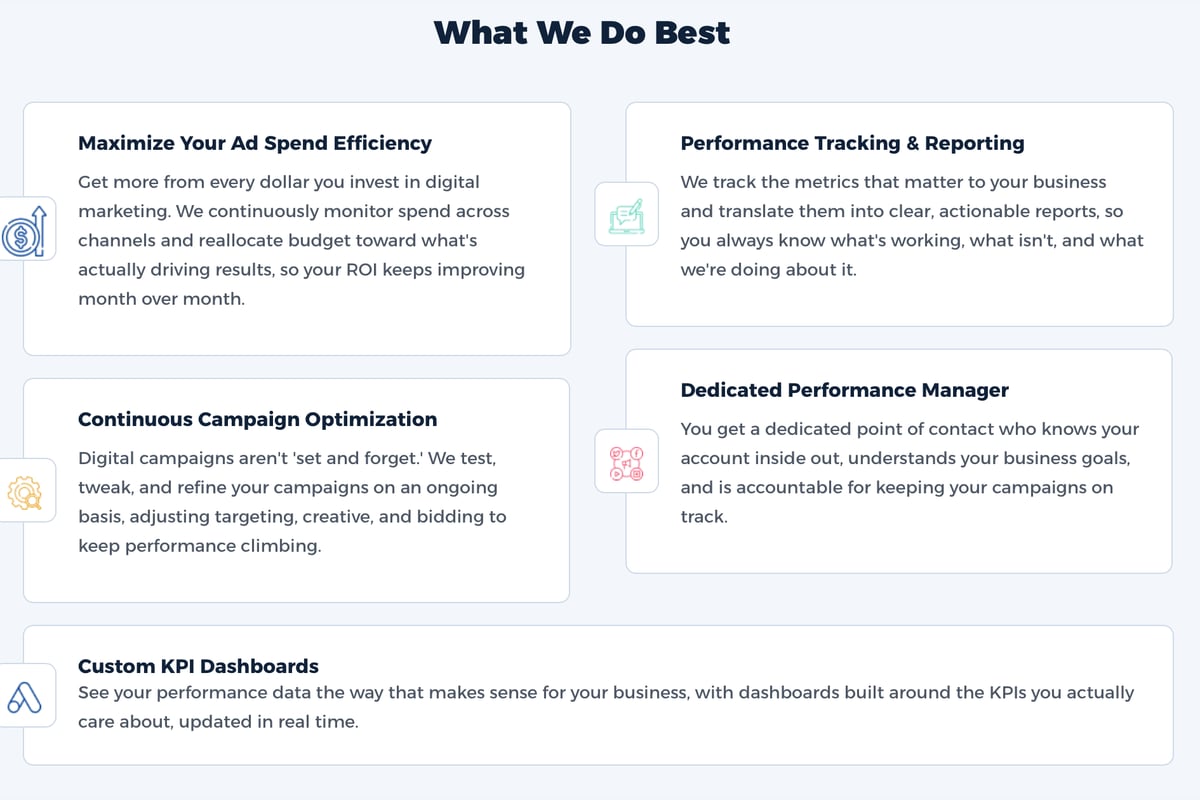
For businesses seeking expert campaign management with clear ROI accountability, Digital Marketing Performance Management services focus specifically on continuous optimization, conversion analysis, and measurable performance improvements across paid channels.
Asking the Right Discovery Questions
Initial consultations reveal agency sophistication through the questions they ask and the frameworks they reference. Strong PPC partners probe business economics, competitive positioning, and customer behavior patterns before discussing tactics.
Strategic Assessment Questions
Conversion Value Understanding: "How does the agency plan to align campaign optimization with your actual profit margins rather than just lead volume?" Agencies optimizing purely for conversion volume without understanding customer lifetime value, average order value variation by product category, or seasonal profitability differences will drive inefficient results.
Attribution Philosophy: "What attribution model does the agency recommend for your specific customer journey, and why?" Cookie-cutter recommendations for last-click attribution in industries with lengthy consideration cycles indicate limited strategic thinking. Sophisticated agencies discuss data-driven attribution, position-based models, and cross-channel measurement challenges upfront.
Competitive Intelligence: "How will the agency monitor competitive auction behavior and adjust bidding strategies accordingly?" Strong answers reference auction insights analysis, competitive share-of-voice tracking, and systematic competitive creative monitoring rather than vague promises to "keep an eye on competitors."
Tactical Execution Standards
Beyond strategic frameworks, evaluate execution capabilities through specific tactical questions:
- Testing Methodology: What's their approach to ad creative testing cadence, statistical significance thresholds, and creative refresh cycles?
- Audience Segmentation: How do they build and refine audience segments using first-party data, customer match lists, and behavioral signals?
- Landing Page Strategy: Do they take ownership of landing page recommendations, coordinate with development teams, and conduct conversion rate optimization testing?
- Platform Diversification: What's their perspective on expanding beyond Google Ads into Microsoft Advertising, Amazon Ads, or social platforms based on your audience behavior?

Compliance and Reporting Standards
Professional PPC management requires adherence to advertising standards, privacy regulations, and transparent reporting practices. The Interactive Advertising Bureau guidelines establish measurement standards and reporting best practices that credible agencies follow consistently.
Regulatory Awareness
Agencies managing campaigns in regulated industries must demonstrate familiarity with FTC advertising guidance, particularly around endorsements, disclosure requirements, and substantiation standards. For healthcare, financial services, or legal industries, ask specifically how the agency ensures ad copy complies with industry-specific regulations beyond platform policies.
Privacy compliance extends beyond legal minimums to consumer expectations. Strong agencies implement consent management properly, respect opt-out preferences systematically, and build targeting strategies that maintain effectiveness even as third-party cookie availability declines. Ask about their preparation for continued privacy regulation expansion and cookieless targeting methodologies.
Reporting Depth and Frequency
Monthly reporting should extend far beyond vanity metrics like impressions and clicks. Comprehensive reports include:
- Conversion funnel analysis showing drop-off points from ad click through purchase completion
- Audience performance breakdowns revealing which segments drive profitable conversions
- Search term reports identifying new keyword opportunities and negative keyword additions
- Quality score trends indicating ad relevance and landing page experience improvements
- Competitive benchmarks comparing your performance against industry averages
- Forecasting models projecting performance trajectories based on current optimization trends
Request sample reports during vetting. Generic templated dashboards with minimal interpretation indicate limited analytical investment. Agencies that provide customized insights, proactive recommendations, and clear next-step priorities demonstrate genuine partnership commitment.
Vetting Process Framework
Selecting the right "ppc agency near me" requires systematic evaluation across multiple dimensions. Approaching agency selection as you would a significant hire, complete with reference checks, trial projects, and cultural fit assessment, prevents costly misalignments.
Reference Check Structure
When agencies provide client references, prepare specific questions that reveal both strengths and limitations:
| Reference Question | What It Reveals |
|---|---|
| "How quickly does the agency respond to urgent campaign issues?" | Responsiveness and account prioritization |
| "Can you describe a time the agency made a costly mistake? How did they handle it?" | Error recovery, accountability, and communication under pressure |
| "What's one thing you wish the agency did differently?" | Honest assessment of weaknesses |
| "How has the agency relationship evolved over time?" | Capacity for strategic growth versus tactical execution only |
| "Would you recommend them for campaigns outside their current scope for you?" | Breadth of genuine expertise versus narrow specialization |
Beyond formal references, research the agency's public thought leadership. Do they publish case studies, contribute to industry publications, or speak at marketing conferences? Active participation in professional communities indicates commitment to staying current with platform updates, algorithm changes, and emerging best practices.
Trial Project Considerations
Many businesses benefit from starting with limited-scope trial engagements before committing to comprehensive retainers. A focused 60-90 day trial managing a single campaign or product category reveals execution quality, communication patterns, and optimization capabilities with contained risk.
Structure trial agreements with clear success metrics, defined scope boundaries, and predetermined evaluation criteria. Avoid agencies that resist trial periods or demand long-term contracts without demonstrated results. The best partnerships emerge from proven performance rather than contractual lock-in.
Red Flags and Warning Signs
Certain patterns during agency vetting processes reliably predict problematic partnerships. Recognizing these warning signs early prevents wasted investment and campaign disruption.
Guarantee Promises
Agencies guaranteeing specific performance outcomes (particularly for new accounts without historical data) either lack understanding of auction dynamics or intentionally misrepresent realistic expectations. PPC performance depends on product-market fit, competitive intensity, landing page effectiveness, and dozens of variables beyond media buying alone. Ethical agencies discuss performance ranges based on comparable client benchmarks while acknowledging uncertainty inherent in competitive auctions.
Opacity Around Tactics
Agencies refusing to explain their optimization approaches in detail, claiming "proprietary methods" that can't be disclosed, often employ basic tactics while obscuring simplicity behind mysterious language. Legitimate strategic advantages come from execution discipline, creative testing rigor, and analytical sophistication, not secret techniques. When evaluating agencies using vendor-neutral selection criteria, prioritize transparency over mystique.
Communication Inconsistency
Agencies that respond quickly during sales processes but become difficult to reach after contract signing reveal their true client service priorities. During vetting, notice response times, communication completeness, and proactive follow-up. Patterns established during courtship typically continue throughout the relationship.
Building Effective Agency Relationships
Successful PPC partnerships require active participation from both sides. While agencies bring platform expertise and optimization capabilities, clients provide business context, market insights, and strategic direction that inform campaign decisions.
Information Sharing Protocols
Establish regular information exchange cadences covering:
- Product roadmaps enabling campaign preparation for launches
- Inventory levels allowing bid adjustments during stock constraints
- Promotional calendars ensuring ad creative aligns with site-wide offers
- Competitive intelligence from sales conversations informing messaging strategy
- Customer feedback patterns revealing conversion barriers addressable through campaign optimization
The most productive client-agency relationships treat PPC campaigns as collaborative projects rather than outsourced tasks. Regular strategic sessions examining business objectives, market shifts, and growth opportunities keep campaigns aligned with evolving priorities.
Performance Review Cadences
Beyond monthly reporting, quarterly business reviews provide opportunities for deeper strategic assessment. Effective QBRs examine performance trends across multiple months, evaluate campaign structure against business evolution, and align upcoming quarter priorities with broader marketing goals.
Structure these reviews around forward-looking strategy rather than backward-looking reporting. Monthly reports handle historical analysis; quarterly sessions should focus on opportunity identification, competitive positioning evolution, and strategic campaign expansion possibilities.

Platform Expertise Depth
While Google Ads dominates search advertising, comprehensive PPC strategies often span multiple platforms. When searching for a "ppc agency near me," evaluate cross-platform capabilities based on where your audiences actively research and make purchase decisions.
Multi-Platform Considerations
- Microsoft Advertising: Often overlooked despite lower CPCs and valuable audience segments, particularly in B2B and professional services
- Amazon Ads: Essential for e-commerce businesses selling through Amazon or competing with Amazon-listed products
- YouTube Advertising: Powerful for visual product demonstrations, brand building, and retargeting engaged audiences
- LinkedIn Ads: Precise B2B targeting capabilities justify premium CPCs for complex professional services
- Meta Platforms: Facebook and Instagram offer sophisticated interest and behavior targeting complementing search intent campaigns
Strong agencies recommend platform mixes based on customer journey analysis rather than defaulting to Google-only strategies. They articulate specific rationales for each platform's role in your conversion funnel and demonstrate measurement capabilities across channels.
For businesses looking to develop internal platform expertise alongside agency partnerships, Intoact’s courses provide practical training across major paid advertising platforms, enabling more informed collaboration with external partners.
Industry Specialization Versus Generalist Approaches
PPC agencies often position themselves along the specialization spectrum from vertical-focused experts to full-service generalists. Neither approach inherently outperforms the other; alignment with your specific needs determines optimal fit.
Vertical Specialists
Agencies focused exclusively on healthcare, legal services, e-commerce, or other specific industries develop deep expertise in industry-specific regulations, competitive dynamics, and performance benchmarks. They understand seasonal patterns, recognize optimal audience segments immediately, and bring relevant creative insights from comparable clients.
However, vertical specialization sometimes constrains innovation. Agencies working exclusively in single industries may miss cross-pollination opportunities, applying tactics that work in adjacent verticals but haven't penetrated your industry yet.
Strategic Generalists
Full-service agencies managing diverse client portfolios bring fresh perspectives and cross-industry innovation. Tactics successful in retail might translate powerfully to professional services. Measurement approaches from SaaS businesses could improve attribution for local services.
The trade-off comes in onboarding time and initial learning curves. Generalist agencies require more client education about industry nuances, regulatory constraints, and competitive positioning before developing fully informed strategies.
Technology Stack and Integration Capabilities
Modern PPC management relies heavily on technology infrastructure extending far beyond platform interfaces. When evaluating agencies, assess their martech capabilities, integration expertise, and data infrastructure sophistication.
Essential Technology Components
| Technology Category | Why It Matters | Questions to Ask |
|---|---|---|
| Attribution platforms | Accurate cross-channel conversion credit | "What attribution tools do you use and how do they integrate with our CRM?" |
| Bid management software | Algorithmic optimization at scale | "Manual bidding, platform automation, or third-party bid tools?" |
| Creative management | Dynamic ad customization and testing | "How do you manage ad variations and creative testing systematically?" |
| Call tracking | Offline conversion measurement | "How do you attribute phone conversions to specific campaigns and keywords?" |
| Analytics infrastructure | Custom reporting and data visualization | "What analytics platforms connect to campaign data, and who maintains integrations?" |
Sophisticated agencies build data pipelines connecting campaign platforms to your CRM, analytics infrastructure, and business intelligence systems. This integration enables optimization based on downstream business metrics like customer lifetime value, repeat purchase behavior, and profit margin rather than just front-end conversions.
Timeline Expectations and Ramp-Up Periods
Unlike organic channels requiring months to show results, PPC campaigns generate immediate traffic and data. However, optimization cycles still require time to reach peak performance. Understanding realistic ramp-up timelines prevents premature judgments about agency effectiveness.
Performance Evolution Stages
Month 1: Infrastructure and Learning
Initial 30 days focus on account setup, conversion tracking verification, baseline campaign launches, and data collection. Performance typically underperforms optimal levels as algorithms learn audience signals and agencies gather performance insights.
Months 2-3: Iteration and Optimization
With performance data accumulating, agencies refine targeting parameters, test ad variations, adjust bid strategies, and expand promising audience segments while pausing underperformers. Expect meaningful improvements from baseline but not peak performance yet.
Months 4-6: Refinement and Scaling
Agencies identify winning formulas, scale proven campaigns, and expand into new keywords, audiences, or platforms. Performance stabilizes around sustainable efficiency levels as account structure matures.
Months 6+: Continuous Improvement
Ongoing optimization focuses on incremental gains, creative refresh cycles, seasonal adjustments, and strategic expansion opportunities. Performance improvements become more gradual as major efficiency opportunities get captured.
Agencies promising immediate peak performance either manage unrealistic expectations or have access to your historical account data enabling faster optimization. New accounts require patience through learning phases before reaching full potential.
Making the Final Selection Decision
After thorough vetting, final agency selection often comes down to intangible factors beyond checklists and scorecards. Trust your assessment of communication chemistry, strategic alignment, and genuine partnership potential.
Decision Framework
Weight evaluation criteria based on your specific priorities:
- Performance-focused businesses: Prioritize transparent reporting, sophisticated attribution capabilities, and proven ROI improvements in comparable industries
- Growth-stage companies: Value strategic thinking, platform diversification expertise, and scalability to support rapid expansion
- Compliance-sensitive industries: Emphasize regulatory knowledge, risk management protocols, and documented quality assurance processes
- Resource-constrained teams: Seek comprehensive service including creative development, landing page recommendations, and strategic guidance beyond media buying
Schedule final conversations with your top two or three candidates focusing on partnership dynamics rather than technical capabilities. Discuss how they handle disagreements, manage changing priorities, and adapt strategies when initial approaches underperform.
The right "ppc agency near me" feels like an extension of your internal team: collaborative, accountable, and genuinely invested in your business success beyond billable hours.
Finding the right PPC partner requires systematic evaluation across technical capabilities, strategic sophistication, and collaborative compatibility. Whether you choose a local agency or supplement with internal expertise development, success depends on clear expectations, transparent communication, and continuous optimization discipline. Intoact helps businesses build both agency collaboration skills and internal PPC capabilities through practical courses, consultancy services, and performance management focused on measurable ROI improvements.


