


Return on investment remains the single most important metric for marketing leaders and business owners in 2026. While impressions, engagement rates, and follower counts provide useful context, roi in digital marketing ultimately determines which campaigns receive budget allocation and which get cut. Understanding how to measure, track, and optimize your marketing ROI separates profitable growth strategies from expensive guessing games.
Understanding Digital Marketing ROI Beyond Basic Formulas
The fundamental ROI calculation (revenue minus cost, divided by cost) sounds straightforward on paper. In practice, measuring roi in digital marketing involves attribution challenges, multi-touch customer journeys, and time lags between initial exposure and final conversion.
A customer might see your Meta ad on Monday, click a Google search result on Wednesday, receive an email on Friday, and purchase on Saturday after a direct website visit. Which channel deserves credit? The answer shapes your entire marketing strategy and budget allocation.
Modern ROI measurement requires:
- First-party data collection and management
- Attribution modeling across touchpoints
- Customer lifetime value calculations
- Incremental lift measurement
- Marketing mix modeling for channel contribution
Traditional last-click attribution assigns 100% of credit to the final touchpoint before conversion. This approach systematically undervalues awareness and consideration channels while overvaluing bottom-funnel tactics. Your Meta campaigns building brand awareness receive no credit, while generic branded search ads claim full ROI attribution despite capturing demand that already existed.
Moving Beyond Last-Click Attribution
Multi-touch attribution models distribute credit across the customer journey. Linear attribution splits credit equally, time-decay models weight recent interactions more heavily, and position-based attribution emphasizes first and last touches.
Data-driven attribution uses machine learning to analyze actual conversion patterns across your customer base. Google's algorithm examines thousands of conversion paths to determine each touchpoint's statistical contribution. This approach requires sufficient conversion volume but provides more accurate ROI measurement than rule-based models.

Marketing Mix Modeling for Channel-Level ROI
Marketing mix modeling (MMM) analyzes historical performance data to quantify each channel's contribution to sales outcomes. Unlike digital attribution that tracks individual user journeys, MMM uses regression analysis to isolate marketing variables from external factors like seasonality, competitive activity, and economic conditions.
MMM answers strategic questions about overall channel effectiveness. If you increase Meta ad spend by 20%, what sales lift should you expect? How do offline channels like radio or direct mail contribute to digital conversions? What's the optimal budget split across paid search, social media, content marketing, and email?
| MMM Strengths | MMM Limitations |
|---|---|
| Measures all channels including offline | Requires 2-3 years of historical data |
| Accounts for external market factors | Aggregate level, not user-specific |
| Provides budget optimization scenarios | Cannot measure rapid tactical changes |
| Privacy-compliant, no tracking required | Expensive specialized expertise needed |
The technical limitations of MMM include multicollinearity between marketing variables, identification challenges when variables move together, and sensitivity to model specification choices. Results vary significantly based on data transformations, lag structures, and control variables included.
Open-source MMM tools like Meta’s Robyn platform have democratized access to marketing mix modeling. Organizations no longer need six-figure consulting engagements to build basic MMM capabilities. However, interpreting results and making sound business decisions still requires statistical expertise and marketing domain knowledge.
Combining Attribution and MMM for Complete ROI Visibility
Leading organizations use attribution for tactical optimization and MMM for strategic planning. Attribution data guides daily campaign adjustments, creative testing, and audience refinement. MMM informs quarterly budget allocation, channel expansion decisions, and investment cases for new marketing programs.
This dual-measurement framework addresses the measurement priorities outlined by IAB research, balancing granular optimization with holistic effectiveness measurement. Your paid social team uses attribution data to shift budgets between Meta and TikTok campaigns hourly, while leadership uses MMM insights to set overall social media investment levels quarterly.
Incrementality Testing for True ROI Measurement
Correlation doesn't equal causation. Customers who see your ads might have purchased anyway without exposure. Incrementality testing measures the causal lift your marketing generates beyond baseline sales that would occur organically.
Common incrementality test designs:
- Geo-based holdout tests split similar geographic markets into test and control groups, running campaigns only in test markets
- User-level randomized experiments randomly assign users to exposed and control groups, measuring conversion rate differences
- Ghost ads submit bids but don't serve impressions to control users, isolating ad exposure effects
- PSA (public service announcement) experiments show control users PSA content instead of marketing messages
A Meta ad campaign showing 5x ROI based on attribution might deliver only 2x incremental ROI after accounting for users who would have converted without ad exposure. This 60% difference between attributed and incremental performance fundamentally changes budget allocation decisions.
Running incrementality tests quarterly across major channels provides ground truth for calibrating attribution models. If attribution suggests 4x ROI but incrementality testing measures 2.5x, you can adjust attribution weights accordingly for more accurate ongoing measurement.
Tracking Customer Lifetime Value Instead of First Purchase
First-purchase ROI misses the complete picture for subscription businesses, repeat purchase categories, and products with upsell opportunities. A campaign acquiring customers at 0.8x first-purchase ROI might deliver 3.5x ROI over 24 months when accounting for repeat purchases, subscription renewals, and referrals.
Customer lifetime value (CLV) calculations project total profit contribution across the customer relationship. Tracking customer surplus value provides additional perspective on the total value customers receive beyond what they pay, which correlates with retention and referral behavior.
Building CLV-Based ROI Dashboards
Connect customer acquisition cost (CAC) from each marketing channel to actual customer behavior cohorts. Track cohorts acquired in January 2026 from paid search separately from social media cohorts, measuring repeat purchase rates, average order values, and retention curves over time.
Key CLV metrics for roi in digital marketing:
- CAC payback period: months until cumulative gross profit exceeds acquisition cost
- CAC ratio: CLV divided by CAC (healthy SaaS businesses target 3:1 or higher)
- Cohort retention curves: percentage of customers still active at 3, 6, 12, 24 months
- Revenue retention: dollars retained from cohorts over time (can exceed 100% with expansion)
Businesses building comprehensive digital marketing training programs need measurement systems that connect marketing investments to student enrollment, course completion, certification achievement, and career outcomes. Short-term enrollment ROI matters, but lifetime student value including additional courses, referrals, and testimonials provides the complete picture.
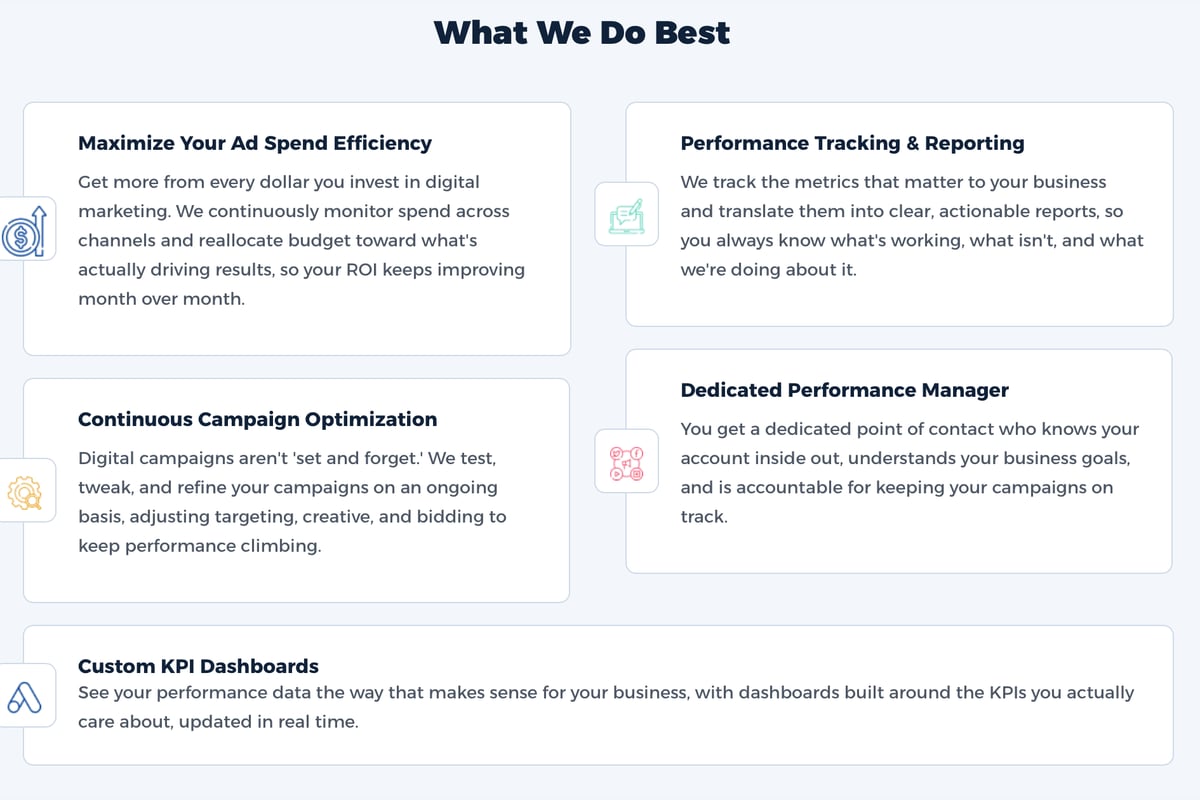
Many organizations struggle to connect marketing platforms, CRM systems, and financial data to calculate accurate channel-level CLV. Digital Marketing Performance Management services address this challenge by building integrated measurement systems that track customer cohorts from initial acquisition through long-term value realization, providing clear ROI visibility across all marketing investments.
Platform-Specific ROI Measurement Strategies
Each marketing channel presents unique measurement considerations. Paid search conversion tracking is relatively straightforward with direct response clicks and conversions. Social media measurement requires balancing direct response metrics with brand awareness impact that drives future organic searches and direct traffic.
Meta and TikTok Campaign ROI
Meta's Conversion API combined with pixel tracking provides robust conversion measurement despite iOS privacy restrictions. Server-side event sharing recovers conversion visibility lost to ATT (App Tracking Transparency) limitations affecting pixel-only implementations.
TikTok campaigns often show lower direct attribution ROI than Meta or Google because younger audiences research on TikTok but purchase on other devices or platforms later. Multi-touch attribution and brand lift studies capture TikTok's full contribution more accurately than last-click measurement.
Platform measurement best practices:
- Implement Conversion API for Meta and TikTok alongside pixels
- Use UTM parameters consistently across all paid social campaigns
- Track engagement metrics (video views, comments, shares) as leading indicators
- Run brand lift studies quarterly to measure awareness and consideration impact
- Analyze organic search volume trends for branded terms after social campaigns

SEO and Content Marketing ROI
Organic search ROI requires different timeframes and metrics than paid advertising. SEO investments in technical optimization, content creation, and link building typically require 3-6 months to show measurable traffic increases and 6-12 months to demonstrate revenue impact.
Content marketing ROI extends beyond direct conversions to include lead nurturing, customer education, and sales enablement value. A comprehensive guide that doesn't directly generate conversions but shortens sales cycles by answering customer questions provides real business value not captured in simple conversion tracking.
Track SEO ROI through:
- Organic traffic value: sessions multiplied by average conversion value by channel
- Ranking improvements: keyword position changes for target commercial terms
- Featured snippet captures: percentage of target keywords triggering featured snippets
- Assisted conversions: organic content touches in multi-channel conversion paths
- Sales cycle impact: days from first touch to close for organic-sourced opportunities
Organizations investing in advanced SEO, GEO and AEO services need measurement frameworks that account for traditional search visibility, AI-powered search features like Google SGE, and optimization for answer engines beyond Google.
Building ROI Dashboards That Drive Decisions
Measurement systems fail when they produce reports nobody uses. Effective ROI dashboards answer specific business questions, update at appropriate frequencies, and present information at the right level of detail for each stakeholder.
Executive dashboards show overall marketing ROI, budget allocation by channel, and trends over time. Marketing managers need campaign-level performance, audience segment breakdowns, and week-over-week changes. Campaign specialists require daily performance by ad set, keyword, or creative variant.
Dashboard Design Principles
Start with business questions, not available metrics. What decisions will this dashboard inform? Budget reallocation, campaign pausing, audience expansion, creative refresh, channel testing?
Essential dashboard components:
- Clear ROI or ROAS (return on ad spend) by channel and campaign
- Trend lines showing performance trajectory, not just current snapshots
- Benchmark comparisons to goals, historical periods, or industry standards
- Statistical significance indicators for A/B test results
- Actionable alerts for significant performance changes requiring attention
Avoid vanity metrics that don't connect to business outcomes. Impressions, reach, and engagement rate provide context but shouldn't dominate dashboard real estate unless they directly predict conversions and revenue in your business model.
Attribution Window Optimization
The time between ad exposure and conversion varies dramatically across industries, products, and customer segments. B2B software sales might involve 6-month evaluation cycles. E-commerce impulse purchases convert within hours. Subscription trials convert during free trial periods.
Attribution windows determine which conversions get credited to marketing campaigns. Overly short windows miss delayed conversions, underestimating true ROI. Excessively long windows credit campaigns for conversions that would have happened anyway, inflating apparent ROI.
| Window Length | Best For | Risk |
|---|---|---|
| 1-day click | Impulse purchases, retargeting | Misses consideration time |
| 7-day click | Standard e-commerce | Balanced approach |
| 28-day click | Considered purchases | Overattribution risk |
| 1-day view | Awareness impact | Very conservative |
| 7-day view | Brand campaigns | Balanced view-through credit |
Analyze conversion distribution by time lag in your analytics platform. If 80% of conversions happen within 7 days but 15% occur between 8-14 days, a 7-day window systematically undervalues your campaigns by missing that additional 15%.
Platform defaults don't optimize for your business. Meta's default 7-day click, 1-day view window might be perfect for fast-fashion retailers but completely wrong for furniture stores where customers research for weeks before purchasing.
Audience Segmentation for ROI Analysis
Aggregate ROI metrics hide critical performance differences across customer segments. New customer acquisition ROI differs from remarketing ROI. Geographic markets perform differently. Age demographics respond to different creative approaches and show different conversion values.
Break down roi in digital marketing by:
- New vs. returning visitors: measure both acquisition and retention effectiveness
- Geographic regions: identify high-performing markets for expansion
- Device types: optimize mobile vs. desktop experiences and bidding
- Customer demographics: age, gender, income where available and appropriate
- Product categories: understand which offerings drive the best marketing ROI
- Seasonal cohorts: account for promotional periods vs. baseline performance
A campaign showing 3x overall ROI might deliver 5x ROI for customers aged 35-50 but only 1.5x for under-25 audiences. This insight suggests budget reallocation toward higher-performing segments or creative adjustments to improve younger audience performance.
Nielsen’s research demonstrates how combining multiple measurement methods (digital attribution, MMM, brand lift) across audience segments provides more complete ROI visibility than any single approach.

Privacy, Consent, and Future-Proof ROI Measurement
Cookie deprecation, privacy regulations (GDPR, CCPA), and platform restrictions (iOS ATT) continue reshaping digital marketing measurement. Organizations over-reliant on third-party cookies and pixel tracking face growing measurement gaps.
Future-proof ROI measurement prioritizes first-party data collection through owned channels. Email addresses, phone numbers, and account IDs enable deterministic tracking across devices and sessions that probabilistic cookie matching can't match.
Privacy-compliant measurement strategies:
- Server-side tracking implementation (Conversion APIs)
- First-party data collection and customer data platforms
- Consent-based tracking with clear value exchange
- Privacy-safe cohort analysis and aggregated reporting
- Marketing mix modeling as privacy-independent measurement layer
- Incrementality testing using platform-native tools
Google's Privacy Sandbox and other emerging standards attempt to balance advertiser measurement needs with user privacy. However, reduced signal quality compared to cookie-based tracking is inevitable. Organizations need measurement systems robust enough to drive decisions with less granular data.
Practical ROI Improvement Frameworks
Understanding measurement theory matters less than improving actual results. Systematic testing, optimization, and budget reallocation based on ROI data drives performance improvement.
The Test-Learn-Scale Optimization Cycle
Week 1-2: Establish baseline performance and identify optimization hypotheses based on ROI data analysis.
Week 3-4: Launch controlled experiments testing one variable at a time (audience, creative, placement, bidding strategy).
Week 5-6: Analyze test results with statistical significance testing, calculate incremental ROI improvement.
Week 7-8: Scale winning variations while launching next round of tests on different variables.
This continuous optimization approach compounds improvements over time. A 5% ROI increase monthly seems modest but delivers 80% annual improvement through compounding effects.
Budget Reallocation Based on Marginal ROI
Optimal budget allocation equalizes marginal ROI across channels. If paid search delivers 4x ROI at current spend while Meta delivers 2.5x, shifting budget from Meta to search increases overall returns.
However, marginal ROI curves aren't flat. The first $1,000 in monthly paid search spend might deliver 6x ROI, the next $5,000 delivers 4x, and incremental dollars beyond $10,000 drop to 2x as you exhaust high-intent audiences.
Sophisticated budget optimization requires understanding these diminishing return curves for each channel, then allocating budgets where marginal returns equalize across all investments. Businesses leveraging strategic digital marketing consulting can build optimization models that account for channel saturation effects and competitive dynamics.
Training Teams to Think in ROI Terms
Marketing teams optimizing for impressions, clicks, or engagement rates make systematically different decisions than teams optimizing for revenue and profit contribution. Cultural change toward ROI-focused decision-making requires training, tools, and incentive alignment.
Building ROI-focused marketing teams:
- Train all marketing staff on basic financial metrics (CAC, CLV, ROI, ROAS)
- Provide dashboard access showing how tactical changes impact revenue outcomes
- Include ROI metrics in performance reviews and compensation structures
- Celebrate wins in terms of revenue impact, not vanity metrics
- Require ROI projections for all new campaign proposals and channel tests
Junior marketers focused on engagement rates need to understand how engagement correlates (or doesn't) with conversions and revenue. If Instagram Story views don't predict purchases in your business model, optimizing for Story reach wastes resources despite impressive-looking metrics.
Organizations offering comprehensive digital marketing certification programs emphasize practical ROI measurement and optimization throughout curriculum design, ensuring graduates think in business outcome terms rather than tactical metrics alone.
Common ROI Measurement Mistakes to Avoid
Even sophisticated marketing organizations make systematic measurement errors that distort ROI calculations and lead to poor budget allocation decisions.
Mistake 1: Ignoring Brand Building Impact
Direct response campaigns optimized for immediate conversions show clear ROI attribution. Brand awareness campaigns that don't generate clicks or immediate conversions appear to deliver zero ROI in last-click attribution systems.
This measurement bias systematically underinvests in upper-funnel brand building that drives future organic search volume, direct traffic, and conversion rate improvements across all channels. Balance short-term performance marketing with longer-term brand investments measured through brand lift studies and organic search trends.
Mistake 2: Not Accounting for Costs Comprehensively
Media spend is obvious, but comprehensive ROI calculations include creative production, agency fees, platform subscriptions, team salaries, and allocated overhead. A campaign showing 5x ROI on media spend alone might drop to 3x after full cost allocation.
Mistake 3: Comparing ROI Across Incompatible Timeframes
Paid search ROI measured over 7 days isn't comparable to SEO ROI measured over 12 months or brand campaign ROI measured over 6 months. Standardize measurement windows or clearly communicate timeframe differences when presenting performance comparisons.
Mistake 4: Optimizing for Early Signals That Don't Predict Final Outcomes
Optimizing campaigns for email signups makes sense only if email subscribers convert to customers at profitable rates. If signup conversion rates are low and email ROI is negative, optimizing for more signups accelerates losses rather than building profitable growth.
Validate that optimization metrics genuinely predict revenue outcomes in your specific business before building entire strategies around them.
Measuring roi in digital marketing accurately requires moving beyond simple formulas to embrace attribution modeling, incrementality testing, customer lifetime value tracking, and continuous optimization frameworks. The organizations winning in 2026 combine multiple measurement methods, invest in first-party data infrastructure, and build teams that think in business outcome terms rather than vanity metrics. Intoact helps businesses and marketing professionals master these advanced measurement approaches through specialized training programs, performance management services, and strategic consulting that transforms marketing from a cost center into a measurable growth engine with clear ROI accountability.


