


Finding the right agency partner can transform your business trajectory. The landscape of digital marketing has evolved dramatically, with AI integration, performance-based models, and omnichannel strategies becoming standard expectations rather than optional add-ons. When you search for a top digital marketing agency, you're not just looking for creative talent or technical expertise, you're seeking a partner who understands your business goals and can deliver measurable returns on your investment.
What Defines a Top Digital Marketing Agency in 2026
A top digital marketing agency combines strategic thinking with execution excellence across multiple channels. The best agencies demonstrate clear expertise in their specialized areas while maintaining flexibility to adapt to your unique business needs.
Core Service Capabilities
Modern agencies must offer integrated services that work together cohesively. Here's what separates exceptional agencies from average providers:
- Performance-focused campaign management with transparent ROI tracking
- Advanced analytics and measurement using modern attribution models
- AI-powered optimization for content, targeting, and bidding
- Multi-channel expertise across paid media, organic search, and social platforms
- Strategic consulting that connects tactics to business outcomes
The distinction between a competent agency and a top digital marketing agency lies in their approach to performance management. Leading agencies prioritize measurable business outcomes over vanity metrics, implementing rigorous tracking systems that connect marketing activities directly to revenue generation.

According to Forrester’s research on digital business strategy services, organizations that partner with agencies demonstrating strong strategic planning capabilities achieve 34% better campaign performance than those working with execution-only providers.
Specialization Versus Full-Service Models
The choice between specialized and full-service agencies depends on your specific needs. Specialized agencies excel in particular channels like paid social advertising or search engine optimization, offering deep expertise and often more competitive pricing in their niche.
Full-service agencies provide convenience and integrated strategies across channels. However, their breadth sometimes comes at the expense of depth in specific areas.
| Agency Type | Best For | Typical Strengths | Potential Limitations |
|---|---|---|---|
| Specialized (Paid Media) | Companies with clear channel priorities | Deep platform expertise, advanced testing | Limited cross-channel integration |
| Specialized (SEO/Content) | Long-term organic growth focus | Technical depth, content strategy | Slower results, requires patience |
| Full-Service | Brands needing integrated campaigns | Channel coordination, unified reporting | Higher costs, variable expertise depth |
| Performance Marketing | ROI-driven businesses | Conversion optimization, attribution | Less focus on brand building |
At Intoact, we recognize that businesses often need flexible support rather than rigid agency models. Our digital marketing consultancy adapts to specific client requirements, whether that means ongoing performance management or targeted assistance in particular channels.
Essential Evaluation Criteria for Agency Selection
Choosing the right agency requires systematic evaluation across multiple dimensions. Skip this due diligence, and you risk wasting budget on partnerships that don't deliver.
Track Record and Proven Results
Request case studies with specific, verifiable metrics. A top digital marketing agency shares concrete examples showing:
- Starting baseline metrics and business context
- Specific strategies and tactics implemented
- Timeline of improvements with data points
- Final results tied to business outcomes
- Client testimonials that validate claims
Be skeptical of agencies that only show percentage improvements without absolute numbers. A 300% increase sounds impressive until you learn it meant going from 10 to 30 conversions monthly on a $50,000 budget.
Industry-Specific Experience
While fundamental marketing principles apply across sectors, industry knowledge accelerates results. Agencies familiar with your market understand customer behavior patterns, competitive dynamics, regulatory constraints, and seasonal trends without requiring extensive onboarding.
Questions to ask about industry experience:
- What similar companies have you worked with?
- How do compliance requirements in our industry affect campaign strategy?
- What conversion rates are typical for our sector?
- Which acquisition channels perform best for businesses like ours?
Team Structure and Access
Understanding who actually manages your account matters significantly. Many agencies use senior strategists for sales presentations but assign junior team members to daily execution.
Clarify the team structure upfront. Ask about the experience level of people who will handle your campaigns, response times for questions, and escalation processes for urgent issues.

Technology Stack and AI Integration
The tools an agency uses directly impact their efficiency and your results. Think with Google’s analysis of AI adoption in advertising reveals that agencies leveraging AI-powered optimization achieve 28% better cost per acquisition compared to those using manual-only approaches.
Platform Expertise
A top digital marketing agency demonstrates certified expertise across relevant platforms. Look for:
- Google Ads certifications for paid search campaigns
- Meta Blueprint certifications for Facebook and Instagram advertising
- LinkedIn Marketing Labs credentials for B2B campaigns
- TikTok for Business certification for emerging platform expertise
- Google Analytics 4 proficiency for measurement
Beyond certifications, evaluate their practical application. Request examples of advanced campaign structures, custom tracking implementations, or innovative testing methodologies they've deployed.
For businesses looking to build internal capabilities alongside agency support, programs like the Certified Digital Marketing & AI Course provide comprehensive training that helps teams better collaborate with agencies and evaluate their recommendations.
AI-Powered Optimization Capabilities
Modern agencies integrate artificial intelligence throughout their workflows. This includes AI-assisted creative development, predictive bid optimization, automated audience segmentation, and performance forecasting.
Ask specific questions about their AI implementation:
- Which AI tools do you use for campaign optimization?
- How do you train AI models on our specific business data?
- What safeguards prevent AI from making costly mistakes?
- Can you demonstrate efficiency gains from AI integration?
Pricing Models and Budget Transparency
Understanding agency pricing structures prevents surprises and ensures alignment between their incentives and your goals. Different models suit different business situations.
Common Agency Pricing Structures
| Pricing Model | How It Works | Advantages | Disadvantages |
|---|---|---|---|
| Monthly Retainer | Fixed monthly fee for agreed services | Predictable budgeting, ongoing support | May not align with performance |
| Percentage of Spend | Fee equals percentage of ad budget | Scales with investment | Can incentivize higher spend |
| Performance-Based | Compensation tied to results (CPA, ROAS) | Strong alignment with outcomes | Requires clear tracking, higher risk for agency |
| Project-Based | One-time fee for specific deliverables | Clear scope and timeline | Limited ongoing optimization |
| Hybrid Models | Combination of retainer plus performance bonuses | Balances stability and incentives | More complex to structure |
Performance-based pricing aligns agency incentives with your business results but requires sophisticated tracking infrastructure. According to HubSpot’s guidance on working with paid media agencies, businesses should ensure their analytics foundation can accurately attribute conversions before implementing performance pricing.
Budget Allocation Transparency
Understand exactly how your budget divides between media spend and agency fees. Some agencies mark up media costs or receive platform rebates they don't disclose.
Key transparency questions:
- What percentage of my budget goes to actual media versus agency fees?
- Do you receive any platform rebates or incentives?
- How do you handle media buying, direct or through intermediaries?
- What reporting will I receive on spend allocation?
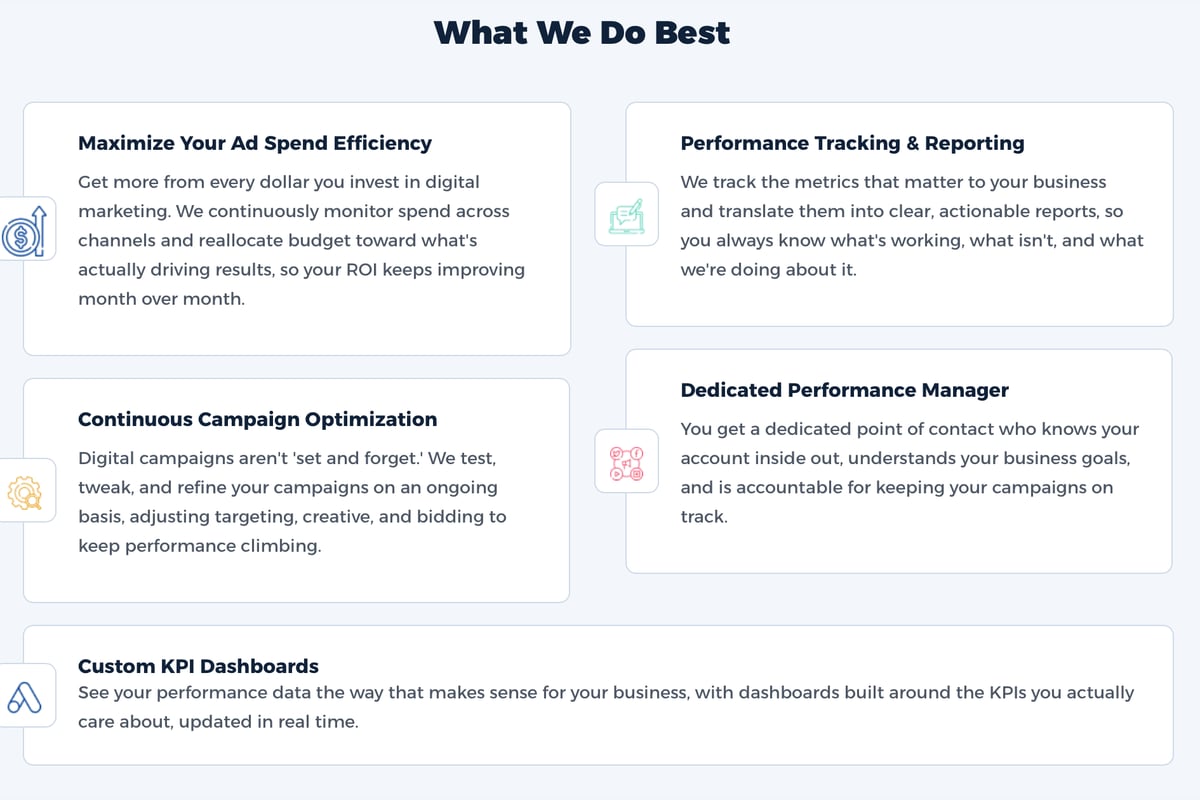
When working with Intoact’s performance management services, clients receive complete transparency on budget allocation with detailed reporting that separates media investment from management fees, ensuring every dollar's destination is clear.
Measurement Framework and Reporting Standards
A top digital marketing agency implements rigorous measurement that goes beyond surface-level metrics. The IAB’s best practices for marketing mix modeling emphasizes the importance of multi-touch attribution and incrementality testing for accurate ROI assessment.
Beyond Vanity Metrics
Quality agencies focus on metrics that connect to business outcomes:
- Customer Acquisition Cost (CAC) across channels
- Customer Lifetime Value (CLV) projections
- Return on Ad Spend (ROAS) and blended ROI
- Conversion rates at each funnel stage
- Attribution modeling showing channel contribution
Avoid agencies that primarily report on impressions, reach, or engagement without connecting these metrics to conversions and revenue. These awareness metrics have value but shouldn't dominate performance discussions.
Reporting Frequency and Detail
Establish reporting expectations during contract negotiations. Monthly reports should include:
- Executive summary with key wins and challenges
- Performance against goals with trend analysis
- Channel-specific metrics with optimization actions taken
- Budget pacing and allocation adjustments
- Strategic recommendations for the next period
- Competitive insights where relevant
Real-time dashboard access between formal reports helps you monitor campaign health and spot issues quickly.
Red Flags That Indicate Agency Problems
Certain warning signs during the evaluation process signal potential partnership issues. Recognizing these early saves time and resources.
Overpromising and Guarantees
Be cautious of agencies guaranteeing specific rankings or results. Digital marketing involves variables beyond any agency's complete control, including algorithm changes, competitive actions, and market conditions.
Specific promises that should raise concerns:
- "We guarantee first-page Google rankings within 30 days"
- "We'll triple your traffic in the first month"
- "Our proprietary system ensures 500% ROI"
- "We have special relationships with platforms that give us advantages"
Ethical agencies discuss realistic expectations based on your market, budget, and competition. They share probability ranges rather than absolute guarantees.
Lack of Strategic Questioning
If an agency doesn't ask detailed questions about your business, customers, competition, and goals during initial conversations, they're likely applying cookie-cutter solutions rather than custom strategies.
A top digital marketing agency invests time understanding your business model, unit economics, customer journey, competitive positioning, and growth objectives before proposing solutions.
Proprietary Platforms and Data Hostage
Some agencies build campaigns on proprietary platforms that make it difficult to take your data and assets if you switch providers. This creates unhealthy dependency and complicates transitions.
Ensure you maintain ownership of:
- Campaign data and performance history
- Creative assets developed during the partnership
- Customer lists and audience segments
- Website content and technical implementations
- Analytics accounts and tracking configurations
Inconsistent Communication
Pay attention to responsiveness during the sales process. If an agency is slow to respond, vague in answers, or assigns different people to each conversation without context transfer, expect similar communication challenges during the partnership.
Compliance and Ethical Standards
Marketing regulations have expanded significantly, with agencies bearing responsibility for compliant campaign execution. The FTC’s guidance on endorsements, influencers, and reviews outlines legal requirements for transparent advertising.
Privacy and Data Protection
Agencies handling customer data must demonstrate GDPR compliance, CCPA adherence, and proper data security measures. Ask about:
- Data storage and encryption practices
- Third-party data sharing policies
- Consent management implementation
- Data retention and deletion procedures
- Incident response protocols
Platform Policy Adherence
A top digital marketing agency stays current with evolving platform policies across Google, Meta, LinkedIn, TikTok, and other advertising channels. Policy violations can result in account suspensions that disrupt campaigns and damage your brand reputation.

Verify that agencies follow IAB standards and guidelines for digital advertising practices, ensuring your campaigns meet industry benchmarks for quality and compliance.
The Onboarding Process and Partnership Success
The first 90 days of an agency partnership establish the foundation for long-term success. Structured onboarding ensures both parties align on goals, processes, and expectations.
Initial Discovery and Goal Setting
Comprehensive discovery sessions should cover:
- Business objectives with specific, measurable targets
- Target audience profiles including demographics, behaviors, and pain points
- Competitive landscape analysis and differentiation strategy
- Historical marketing performance to establish benchmarks
- Budget parameters and resource constraints
- Timeline expectations and milestone definition
Successful agencies document this information and reference it throughout the partnership to ensure strategic alignment.
Access and Integration Setup
Technical setup includes granting platform access, implementing tracking, and integrating tools. Quality agencies provide detailed checklists and timelines for this process.
Common integration requirements:
- Advertising platform admin access (Google Ads, Meta Business Manager)
- Analytics platform access (Google Analytics 4, attribution tools)
- Website tag implementation or tag manager access
- CRM integration for conversion tracking
- Communication channels and project management tools
Performance Benchmarking
Before launching optimization efforts, establish clear baseline metrics. Document current performance across all relevant channels so improvements can be accurately measured.
Understanding audience behavior also informs strategy development. Pew Research’s analysis of social media use in 2025 provides valuable context for channel selection and audience targeting decisions.
Building Internal Marketing Capabilities
While agencies provide valuable expertise, building internal marketing knowledge strengthens your ability to evaluate agency performance and make strategic decisions. Organizations that combine agency partnerships with internal skill development achieve better long-term results.
Investing in team training through programs focused on digital marketing fundamentals helps your staff ask better questions, interpret agency reports more critically, and contribute to strategic discussions. Resources available through Intoact’s course offerings enable businesses to develop this internal capability alongside external agency support.
Collaborative Partnership Models
The most successful agency relationships function as true partnerships rather than vendor relationships. This requires:
- Regular strategic reviews beyond tactical performance updates
- Shared access to insights and competitive intelligence
- Collaborative planning for campaigns and initiatives
- Transparent feedback in both directions
- Flexibility to adjust approaches based on results
Agencies that resist client input or become defensive about performance questions create friction that undermines results. A top digital marketing agency welcomes scrutiny and treats questions as opportunities to demonstrate value.
When to Reevaluate Your Agency Partnership
Even successful partnerships require periodic evaluation to ensure continued alignment with evolving business needs. Consider reassessment when:
- Business priorities shift significantly from the original scope
- Performance plateaus despite optimization efforts
- Communication deteriorates or responsiveness declines
- Market conditions change dramatically
- New capabilities become necessary that the agency cannot provide
- Cost-benefit analysis no longer justifies the investment
Before ending a partnership, clearly communicate concerns and provide opportunity for improvement. Sometimes relationship issues stem from misaligned expectations that can be resolved through honest conversation.
Transition Planning
If you decide to switch agencies, structured transition planning minimizes disruption:
- Document current campaign structures and performance baselines
- Export all accessible data and creative assets
- Map out transition timeline with overlap period if possible
- Communicate with current agency professionally and clearly
- Prepare new agency with comprehensive briefing materials
Organizations looking for flexible support models that adapt to changing needs might consider consultancy-based approaches rather than traditional agency retainers. Digital marketing consulting services provide strategic guidance without long-term commitments, offering an alternative for businesses seeking more control over execution.
Industry-Specific Considerations for Agency Selection
Different industries have unique requirements that influence agency selection. B2B companies need agencies understanding longer sales cycles and account-based marketing. E-commerce businesses prioritize conversion optimization and attribution modeling. Service businesses focus on lead quality over quantity.
Vertical-specific agency requirements:
| Industry | Key Agency Capabilities | Critical Success Metrics |
|---|---|---|
| B2B Technology | Account-based marketing, LinkedIn expertise, long-cycle attribution | Pipeline contribution, influenced revenue, account engagement |
| E-commerce | Product feed optimization, dynamic retargeting, conversion rate optimization | ROAS, customer acquisition cost, repeat purchase rate |
| Healthcare | HIPAA compliance, local SEO, reputation management | Cost per patient acquisition, appointment bookings, patient lifetime value |
| Financial Services | Regulatory compliance, trust-building content, security emphasis | Application completion rate, approval rate, account value |
| Professional Services | Thought leadership, referral integration, local visibility | Qualified lead cost, consultation booking rate, client lifetime value |
Understanding these nuances helps you evaluate whether an agency's experience truly aligns with your business requirements.
Making Your Final Decision
After evaluating multiple agencies against these criteria, synthesize your findings to make an informed decision. Create a scoring matrix weighting factors by importance to your specific situation.
Sample evaluation framework:
- Strategic approach and understanding of your business (25%)
- Demonstrated expertise and case study relevance (20%)
- Team structure and access to senior talent (15%)
- Technology capabilities and AI integration (15%)
- Measurement framework and reporting (10%)
- Pricing transparency and value proposition (10%)
- Cultural fit and communication style (5%)
The lowest price rarely indicates the best value. Focus on expected return on investment rather than minimizing cost. An agency charging 20% more but delivering 40% better results provides superior value.
Request pilot projects or trial periods when possible. A 90-day engagement with clear performance targets provides real-world evidence of the agency's capabilities before committing to longer contracts.
Selecting a top digital marketing agency requires careful evaluation of expertise, alignment with your business goals, and capability to deliver measurable results. The right partner combines strategic thinking with execution excellence, providing transparency throughout the relationship and adapting to your evolving needs. Whether you need comprehensive campaign management, specialized channel expertise, or strategic guidance to build internal capabilities, Intoact offers flexible solutions from performance management and advanced SEO services to digital marketing training that empowers your team with practical, results-focused skills.


