Online retail competition has intensified dramatically in 2026, forcing store owners to rethink how they attract customers. Ecommerce SEO agencies now specialize in a landscape where traditional search engines compete with AI-powered answer engines, where product discovery happens across multiple touchpoints, and where technical excellence determines whether your catalog even gets indexed properly. The right agency partner transforms your product pages from invisible listings into revenue-generating assets.
What Ecommerce SEO Agencies Actually Do
Ecommerce SEO agencies focus on improving search visibility for online stores through specialized tactics that differ significantly from standard SEO work. Unlike content-focused sites, ecommerce platforms face unique challenges: thousands of product pages, complex site architectures, duplicate content issues, and the constant tension between user experience and search engine requirements.
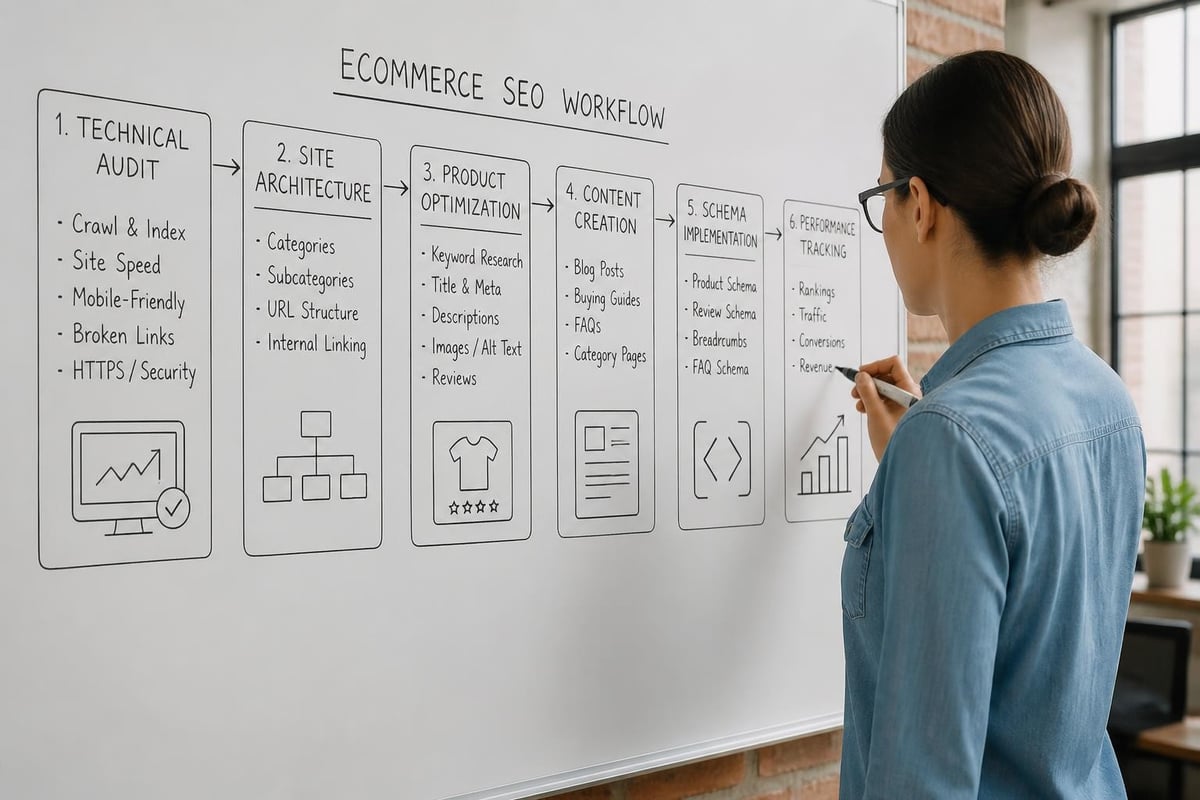
These agencies typically start with comprehensive technical audits that identify crawl issues, indexation problems, and structural weaknesses. They examine your site architecture to ensure Google can efficiently crawl your entire product catalog without wasting crawl budget on duplicate or low-value pages.
Core Services That Drive Results
Most ecommerce SEO agencies deliver a consistent set of services, though execution quality varies widely:
- Technical SEO audits covering crawlability, site speed, mobile optimization, and JavaScript rendering
- Product page optimization including title tags, meta descriptions, schema markup, and content structure
- Category page strategy balancing SEO requirements with user navigation needs
- Internal linking architecture that distributes authority and guides both users and crawlers
- Structured data implementation following Google’s ecommerce structured data guidelines
- Content strategy for blog posts, buying guides, and category descriptions
- Link building focused on product reviews, industry publications, and relevant partnerships
The best agencies integrate these services into a cohesive strategy rather than treating them as isolated tasks. They understand that fixing technical issues means nothing if your product pages lack compelling content, and brilliant content won't rank if Google can't crawl your site properly.
Technical Expertise That Separates Good from Great
Technical proficiency separates competent ecommerce SEO agencies from exceptional ones. The technical complexity of modern ecommerce platforms requires deep expertise across multiple domains.
Site architecture decisions made early determine how well your store scales. Agencies must design URL structures that accommodate category hierarchies, filter parameters, and product variants without creating duplicate content nightmares. They implement canonical tags correctly, manage faceted navigation parameters, and ensure variant pages (color, size) don't cannibalize each other in search results.
Performance and Crawl Budget Management
Page speed directly impacts both rankings and conversion rates. Agencies optimize Core Web Vitals by addressing image compression, lazy loading, server response times, and resource prioritization. For large catalogs, crawl budget management becomes critical.
Advanced agencies use tools like Screaming Frog for comprehensive ecommerce auditing to identify technical issues at scale. They configure proper pagination, implement rel="next" and rel="prev" tags where appropriate, and use robots.txt strategically to prevent crawlers from wasting resources on low-value pages.
| Technical Challenge | Agency Solution | Impact on Rankings |
|---|---|---|
| Duplicate product content | Canonical tags, parameter handling, content differentiation | Prevents keyword cannibalization |
| Slow page load times | Image optimization, CDN, lazy loading, code minification | Improves Core Web Vitals scores |
| Poor mobile experience | Responsive design, touch optimization, mobile-first indexing | Increases mobile visibility |
| JavaScript rendering issues | Server-side rendering, dynamic rendering, prerendering | Ensures proper indexation |
Structured data implementation requires precision. Agencies must implement Product schema correctly across thousands of pages, including price, availability, reviews, and aggregate ratings. They validate markup to ensure rich result eligibility and monitor for errors that could suppress rich snippets.
Content Strategy Beyond Product Descriptions
Product descriptions alone rarely differentiate ecommerce stores in search results. Ecommerce SEO agencies develop comprehensive content strategies that address different stages of the customer journey.
They create category pages that serve dual purposes: helping users navigate while targeting competitive commercial keywords. These pages balance user experience requirements (clear product grids, effective filtering) with SEO needs (unique content, keyword targeting, internal linking).
Building Information Architecture
Smart agencies develop content hubs around product categories, creating buying guides, comparison pages, and educational content that attracts top-of-funnel traffic. This approach follows proven ecommerce SEO strategies that build topical authority and capture searches before users know which specific product they want.
Blog content supports product pages indirectly by targeting informational queries that eventually convert. A well-executed content strategy might include:
- How-to guides that naturally link to relevant products
- Comparison articles featuring your products alongside competitors
- Problem-solution content that positions specific products as answers
- Seasonal buying guides timed to search volume patterns
- Technical specifications and compatibility information
The content must align with actual search behavior. Agencies analyze ecommerce search patterns and user behavior to understand how customers actually search for products, then create content that matches those patterns.
Keyword Research for Product-Led Businesses
Keyword research for ecommerce differs fundamentally from other SEO work. Ecommerce SEO agencies must identify purchase-intent keywords while avoiding the trap of targeting keywords that attract browsers instead of buyers.
They segment keywords by intent: navigational (brand searches), informational (research phase), and transactional (ready to purchase). Product pages target transactional keywords, while blog content captures informational searches earlier in the journey.
Commercial Intent Analysis
The best agencies look beyond search volume to examine commercial intent signals. They analyze metrics like cost-per-click in paid search, conversion rates for similar keywords, and SERP features that indicate shopping intent.
They also identify long-tail variations that reflect specific product attributes: colors, sizes, technical specifications, compatibility requirements. These longer queries often convert better despite lower search volumes because they indicate more specific purchase intent.

Link Building That Actually Works for Stores
Link building for ecommerce sites presents unique challenges. Ecommerce SEO agencies must build links to both product pages and supporting content without resorting to manipulative tactics.
Product review sites, industry publications, and manufacturer relationships provide natural link opportunities. Agencies facilitate product sampling programs, leverage unique data or research, and create linkable assets like industry reports or tools.
They also recognize that most high-quality links will point to informational content rather than product pages. The strategy involves building authority through content, then using strong internal linking to pass that authority to commercial pages.
Relationship-Based Outreach
Successful ecommerce link building relies on relationships more than templates. Agencies cultivate connections with journalists, bloggers, and industry influencers who naturally mention products in their coverage.
They identify unlinked brand mentions and convert them to actual links. They find competitor backlinks and develop strategies to earn similar placements. They leverage supplier and manufacturer relationships for authoritative links from established industry sites.
Measuring What Matters in Ecommerce SEO
Ecommerce SEO agencies must tie their work directly to revenue outcomes. Vanity metrics like keyword rankings matter less than metrics that connect to business results.
They track organic traffic to product and category pages separately from informational content. They measure assisted conversions that show how organic search contributes to multi-touch customer journeys. They calculate revenue per organic session and monitor how SEO traffic converts compared to other channels.
Attribution and Performance Tracking
Advanced agencies implement proper attribution modeling that accounts for the role organic search plays across the customer journey. They set up enhanced ecommerce tracking in analytics platforms to monitor product performance, category performance, and conversion funnels.
They segment performance by device type, recognizing that mobile and desktop users often behave differently. They track metrics like:
- Organic revenue and conversion rate by landing page type
- Average order value from organic traffic versus other channels
- Bounce rate and engagement metrics for product pages
- Internal search behavior indicating navigation or content gaps
- Product page performance across different categories and price points
This data drives continuous optimization. Agencies use performance insights to refine content strategy, identify technical issues affecting specific product categories, and allocate resources to highest-impact opportunities.
Choosing an Agency That Understands Your Platform
Platform expertise matters significantly for ecommerce SEO agencies. The technical approach for Shopify differs from WooCommerce, Magento, or custom platforms. Agencies should demonstrate specific experience with your platform's limitations and opportunities.
Shopify’s ecommerce SEO considerations differ from self-hosted platforms in meaningful ways: URL structure constraints, theme limitations, app dependencies, and checkout flow restrictions. An agency working with Shopify must understand these constraints and work within them effectively.
They should provide specific examples of results achieved on your platform. Ask about their approach to common platform-specific challenges: handling product variants, managing collections, optimizing theme performance, and integrating necessary apps without degrading site speed.
Questions That Reveal Real Expertise
When evaluating ecommerce SEO agencies, specific questions reveal their depth of knowledge:
- How do you handle faceted navigation and filter parameters on category pages?
- What's your approach to product page optimization when you have thousands of similar products?
- How do you manage crawl budget for sites with large product catalogs?
- What schema markup do you implement, and how do you validate it at scale?
- How do you balance user experience requirements with SEO best practices on category pages?
- What metrics do you use to measure success, and how do you attribute revenue to SEO efforts?
Their answers should reference specific tactics, tools, and real examples rather than generic best practices. They should acknowledge platform constraints and explain workarounds they've successfully implemented.
The ROI Equation for Agency Services
Ecommerce SEO agencies typically charge between $3,000 and $15,000 monthly depending on store size, competition level, and service scope. The investment makes sense when organic search can realistically become a significant revenue channel.
Calculate potential ROI by examining your current organic traffic, average order value, and typical conversion rates. If you're getting 1,000 organic sessions monthly with a 2% conversion rate and $100 average order value, that's $2,000 monthly organic revenue. Doubling organic traffic would generate an additional $2,000 monthly, justifying a $5,000 agency investment if maintained over time.
When Agency Partnership Makes Sense
Agency engagement makes most sense when:
- Your catalog exceeds 100-200 products (complexity justifies specialized expertise)
- You lack in-house SEO resources with ecommerce-specific experience
- Technical issues require platform expertise you don't possess internally
- You're entering competitive markets where ranking requires sophisticated strategies
- Organic search currently represents less than 20% of total traffic (opportunity exists)
Companies with strong internal teams often engage specialized agencies for specific needs: technical audits, content strategy, or link building while handling other aspects internally. This hybrid approach can deliver better results than fully outsourcing or trying to build complete expertise in-house.
For businesses that want to build internal capabilities while getting expert guidance, comprehensive digital marketing training provides teams with the skills to execute effectively alongside agency support or independently.

Integration with Broader Marketing Strategy
The most effective ecommerce SEO agencies don't operate in isolation. They coordinate with your paid search, social media, email marketing, and conversion optimization efforts to create cohesive customer experiences.
They align keyword targeting with paid search campaigns to avoid internal competition. They coordinate content calendars with social media and email to amplify content distribution. They share insights from organic search data to inform paid media targeting and creative strategy.
For companies working across multiple marketing channels, specialized SEO, AEO, and GEO services integrate search optimization with broader digital strategies. This integrated approach ensures consistent messaging and maximizes the value of each marketing investment.
Cross-Channel Optimization
Smart agencies use organic search data to improve other channels. Search query data reveals customer language, questions, and concerns that inform ad copy, email content, and product descriptions. Conversion data from organic traffic helps identify high-performing products worth promoting through paid channels.
They also recognize that customers rarely convert on first visit. They design strategies that account for multi-touch attribution, understanding that organic search often serves an assist role in customer journeys that begin with social media or end with direct traffic.
Emerging Trends Reshaping Ecommerce SEO
The ecommerce SEO landscape continues evolving rapidly in 2026. AI-powered search experiences, visual search capabilities, and voice shopping are changing how customers discover products.
Answer Engine Optimization (AEO) and Generative Engine Optimization (GEO) now complement traditional SEO. Forward-thinking agencies optimize for AI-generated answers in ChatGPT, Google's AI Overviews, and other AI search tools that increasingly mediate product discovery.
Visual search optimization requires different approaches: high-quality product images, accurate image alt text, proper schema markup including image properties, and consideration of how products appear in visual search results.
Voice and Conversational Search
Voice shopping through smart speakers and voice assistants demands content that answers natural language questions. Agencies optimize for longer, conversational queries that reflect how people actually speak rather than type.
They create FAQ content, conversational product descriptions, and structured data that helps AI understand product features, compatibility, and use cases. They monitor performance across different search interfaces to understand how products appear in various contexts.
| Emerging Trend | Agency Response | Implementation Priority |
|---|---|---|
| AI search visibility | AEO and GEO optimization, structured content | High (2026) |
| Visual search | Image optimization, visual schema, alt text | Medium-High |
| Voice shopping | Natural language content, FAQ schema | Medium |
| Personalized search | User intent optimization, product recommendations | Medium-Low |
Common Pitfalls in Agency Relationships
Many ecommerce businesses struggle with agency partnerships due to misaligned expectations or poor communication. The most common problems include unclear success metrics, insufficient access to data and platforms, unrealistic timeline expectations, and failure to integrate agency work with internal initiatives.
Successful partnerships require clear goal definition upfront. Agree on specific KPIs tied to revenue outcomes, not just rankings or traffic. Establish realistic timelines understanding that meaningful SEO results typically require 4-6 months for established sites and 6-12 months for newer ones.
Setting Proper Expectations
Agencies should provide transparent reporting that connects their activities to business outcomes. Monthly reports should include:
- Organic traffic trends segmented by page type and product category
- Ranking movements for priority keywords with commercial value
- Technical issues identified and resolved with impact assessment
- Content created and its performance metrics
- Links acquired with quality assessment and placement details
- Revenue and conversion metrics attributed to organic search
They should also communicate challenges honestly. If technical limitations prevent ideal implementations, they should explain workarounds and trade-offs rather than promising impossible results.
Platform Migration and Replatforming Support
Ecommerce platform migrations present enormous SEO risks. Poor migration execution can destroy years of organic search equity overnight. Experienced ecommerce SEO agencies provide critical guidance during replatforming projects.
They conduct pre-migration audits documenting current performance, top-performing pages, and existing technical issues. They develop comprehensive redirect mapping ensuring all valuable URLs properly redirect to new equivalents. They configure new platforms with proper technical foundations before launch.
Post-migration monitoring catches issues quickly before they compound. Agencies watch for broken redirects, indexation problems, duplicate content issues, and performance degradation that commonly occur during platform transitions.
Migration Planning and Execution
A proper migration plan includes:
- Complete URL mapping with redirect rules tested pre-launch
- Schema markup migration ensuring structured data remains intact
- Content preservation for all high-performing pages
- Technical configuration matching or exceeding previous platform capabilities
- Monitoring protocols for immediate post-launch issue detection
The agency should also coordinate with developers, project managers, and other stakeholders to ensure SEO considerations influence platform selection, theme development, and feature implementation.
International Ecommerce SEO Considerations
For stores selling across multiple countries or languages, ecommerce SEO agencies must handle additional complexity. International SEO requires proper hreflang implementation, country-specific keyword research, cultural adaptation of content, and understanding of local search engine preferences.
They structure international sites correctly: subdirectories versus subdomains versus country-code domains, each with specific implications for SEO. They ensure hreflang tags correctly signal language and regional variations to search engines.
Content localization goes beyond translation. Agencies must adapt product descriptions, navigation terminology, and marketing content to local language preferences and cultural norms while maintaining brand consistency.
Multi-Market Optimization Strategies
Different markets require different strategies based on competition levels, search volume, and local search behavior. Practical product page optimization tactics must adapt to local preferences while maintaining technical consistency across markets.
Agencies coordinate pricing display, currency handling, shipping information, and legal requirements across jurisdictions. They monitor performance by market to identify opportunities and challenges specific to each region.
Building Long-Term Organic Growth
The best ecommerce SEO agencies focus on sustainable, long-term growth rather than quick wins that don't last. They build foundations that continue delivering results even as algorithms evolve and competition intensifies.
This means prioritizing technical excellence that prevents future problems, creating genuinely useful content that attracts natural links, and building brand authority that translates into search preference. Short-term tactics like thin content, manipulative linking, or keyword stuffing might produce temporary ranking improvements but ultimately damage long-term potential.
Agencies committed to sustainable growth invest in educating clients about SEO fundamentals, maintaining transparent communication about tactics and risks, and building internal capabilities that reduce long-term dependence on external support. They view their role as building capacity, not creating dependency.
Ecommerce SEO agencies deliver specialized expertise that most online retailers can't efficiently build in-house, particularly for technical optimization and large-scale content strategy. Success requires choosing partners with platform-specific knowledge, measurable ROI focus, and integration capabilities across your broader marketing efforts. Whether you need comprehensive agency support or want to build internal capabilities through expert training and consulting, Intoact provides the specialized knowledge and practical tools to improve your ecommerce search performance and drive measurable business results.